
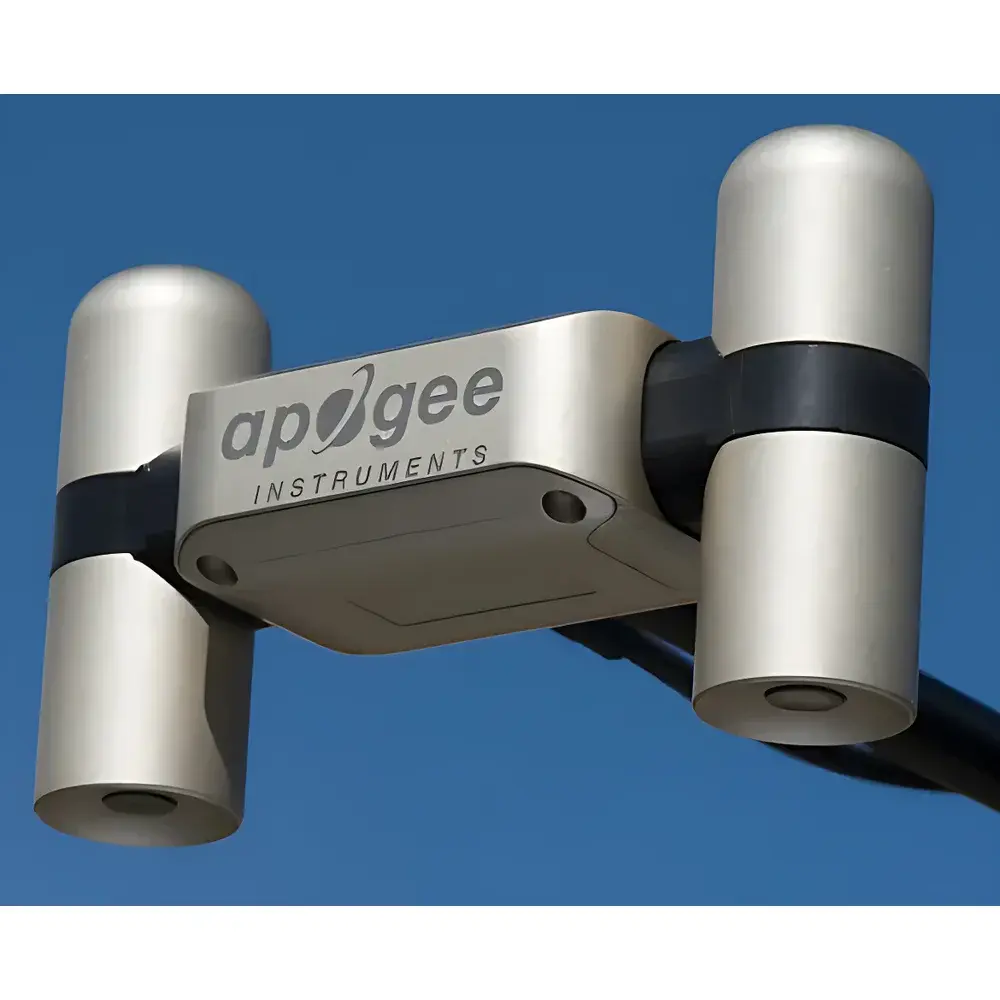
Apogee SN-500 Four-Component Net Radiometer
| Brand | Apogee |
|---|---|
| Origin | USA |
| Model | SN-500 |
| Measurement Range | Shortwave Up: 0–2000 W/m² |
| Shortwave Down | 0–2000 W/m² |
| Longwave Up | –200 to +200 W/m² |
| Longwave Down | –200 to +200 W/m² |
| Spectral Range | Shortwave Up: 385–2105 nm |
| Shortwave Down | 295–2685 nm |
| Longwave Up/Down | 5000–30,000 nm |
| Sensitivity | 55 µV/W/m² (SW Up) |
| Response Time | <1 s (to 95%) |
| Zero Offset (5 K/h) | 18.2 W/m² (SW Up) |
| Field of View | SW Up: 180° |
| SW Down | 150° |
| LW Up/Down | 180° |
| Built-in Temperature Sensor | PT-100 Platinum RTD |
| Heater | 12 V DC |
| Cable Length | 5 m |
| Ingress Protection | IP67 |
| Output Interface | SDI-12 (4 independent channels) |
| Operating Environment | –50 °C to +80 °C, 0–100 % RH |
Overview
The Apogee SN-500 Four-Component Net Radiometer is a precision-engineered instrument designed for continuous, high-fidelity measurement of the four fundamental components of surface radiation balance: upward shortwave (solar), downward shortwave (solar), upward longwave (terrestrial infrared), and downward longwave (atmospheric infrared) irradiance. Based on thermopile detection principles with spectrally selective filters and temperature-stabilized sensing elements, the SN-500 enables direct quantification of net radiation (Rn = SW↓ − SW↑ + LW↓ − LW↑), a critical variable in energy budget modeling, evapotranspiration estimation, and biophysical process studies. Its compact, modular architecture integrates all four sensors into a single mounting platform, minimizing spatial separation error and ensuring synchronous sampling—essential for applications requiring high temporal coherence across spectral bands.
Key Features
- Four independently calibrated thermopile detectors housed in a single weatherproof enclosure, each optimized for its designated spectral band and directional response
- SDI-12 digital output protocol enabling seamless integration with widely deployed environmental data loggers (e.g., Campbell Scientific CR series, Onset HOBO, Decagon EM50) without external signal conditioning
- Integrated PT-100 platinum resistance thermometer for real-time sensor body temperature monitoring—critical for post-acquisition thermal offset correction per ISO 9060:2018 Class C requirements
- 12 V DC resistive heater assembly to suppress dew, frost, and snow accumulation on dome surfaces, maintaining optical clarity under high-humidity or sub-zero conditions
- IP67-rated housing with marine-grade stainless steel and UV-stabilized polymer components, validated for continuous outdoor deployment across arctic tundra, desert, and tropical agroecosystems
- Factory-calibrated traceability to NIST-traceable reference standards; calibration certificates include spectral responsivity curves and temperature-dependent zero-offset characterization
Sample Compatibility & Compliance
The SN-500 is engineered for unattended, long-term operation in open-field agricultural research, eddy covariance flux towers, soil-plant-atmosphere continuum (SPAC) monitoring networks, and USDA ARS watershed observatories. It complies with the physical measurement definitions outlined in ASTM E892 (Standard Test Method for Spectral Match of Solar Simulators) for shortwave bands and ISO 18434-1 (Condition monitoring and diagnostics of machines — Thermography — Part 1: General procedures) for longwave thermal emission contexts. While not certified to IEC 61724-1 (Photovoltaic system performance monitoring), its spectral response aligns closely with the CIE daylight illuminant D65 and blackbody emission profiles used in FAO-56 Penman-Monteith reference evapotranspiration modeling. Data generated by the SN-500 supports GLP-compliant field trials when paired with audit-trail-capable data loggers meeting FDA 21 CFR Part 11 electronic record requirements.
Software & Data Management
Raw SDI-12 outputs are compatible with Apogee’s free AC-100 Configuration Utility and third-party platforms including LoggerNet (Campbell Scientific), HOBOware Pro (Onset), and R-based microclimate analysis workflows (e.g., microclima, eddyproc). Each channel delivers calibrated irradiance values in W/m² as floating-point ASCII strings, eliminating the need for post-processing gain/offset application. The instrument supports configurable measurement intervals (1–3600 s), automatic heater activation thresholds (user-defined relative humidity and temperature setpoints), and diagnostic status flags (e.g., heater-on, sensor-saturated, communication timeout). All metadata—including serial number, calibration date, spectral band assignment, and factory sensitivity coefficients—is embedded in the SDI-12 response frame, facilitating automated metadata ingestion into FAIR-aligned environmental data repositories such as EDI Data Portal or USDA National Agricultural Library Ag Data Commons.
Applications
- Quantifying canopy-level radiation partitioning in precision agriculture trials evaluating cultivar-specific light-use efficiency and photoinhibition thresholds
- Supporting dual-source energy balance models (e.g., TSEB, SEBS) for satellite validation and irrigation scheduling in vineyards and orchards
- Measuring diurnal and seasonal net radiation dynamics in soil moisture–energy coupling studies under climate change scenarios
- Providing boundary condition inputs for WRF-ARW and CLM5 land surface model spin-up and parameterization refinement
- Validating radiative transfer simulations in atmospheric science campaigns involving aerosol–cloud–radiation interactions
- Long-term monitoring of albedo and emissivity shifts in post-fire succession, glacier ablation zones, and urban heat island transects
FAQ
Does the SN-500 require external power for the heater during standard operation?
No—the integrated 12 V DC heater draws power only when activated by user-defined environmental triggers (e.g., RH > 90 % and T < 2 °C), minimizing total system energy demand.
Can individual sensor outputs be disabled or re-mapped in SDI-12 command structure?
Yes—via AC-100 utility or direct SDI-12 ‘M’ commands, users may disable unused channels or assign custom measurement IDs to align with site-specific data schema conventions.
Is the SN-500 suitable for underwater or submerged deployments?
No—while IP67 rated for rain, snow, and temporary splashing, it is not pressure-rated for submersion; the thermopile housings are vented to ambient pressure and lack waterproof electrical feedthroughs.
How frequently should field recalibration be performed?
Apogee recommends annual laboratory recalibration against a primary standard at an ISO/IEC 17025-accredited facility; field verification using shaded/unshaded comparisons or pyrheliometer cross-checks is advised every 3–6 months in high-dust or coastal salt environments.
Are spectral responsivity files available for radiative transfer modeling?
Yes—NIST-traceable spectral response curves (350–30,000 nm, 5 nm resolution) and angular response maps are provided in CSV format with each unit’s calibration certificate and accessible via Apogee’s secure customer portal.







