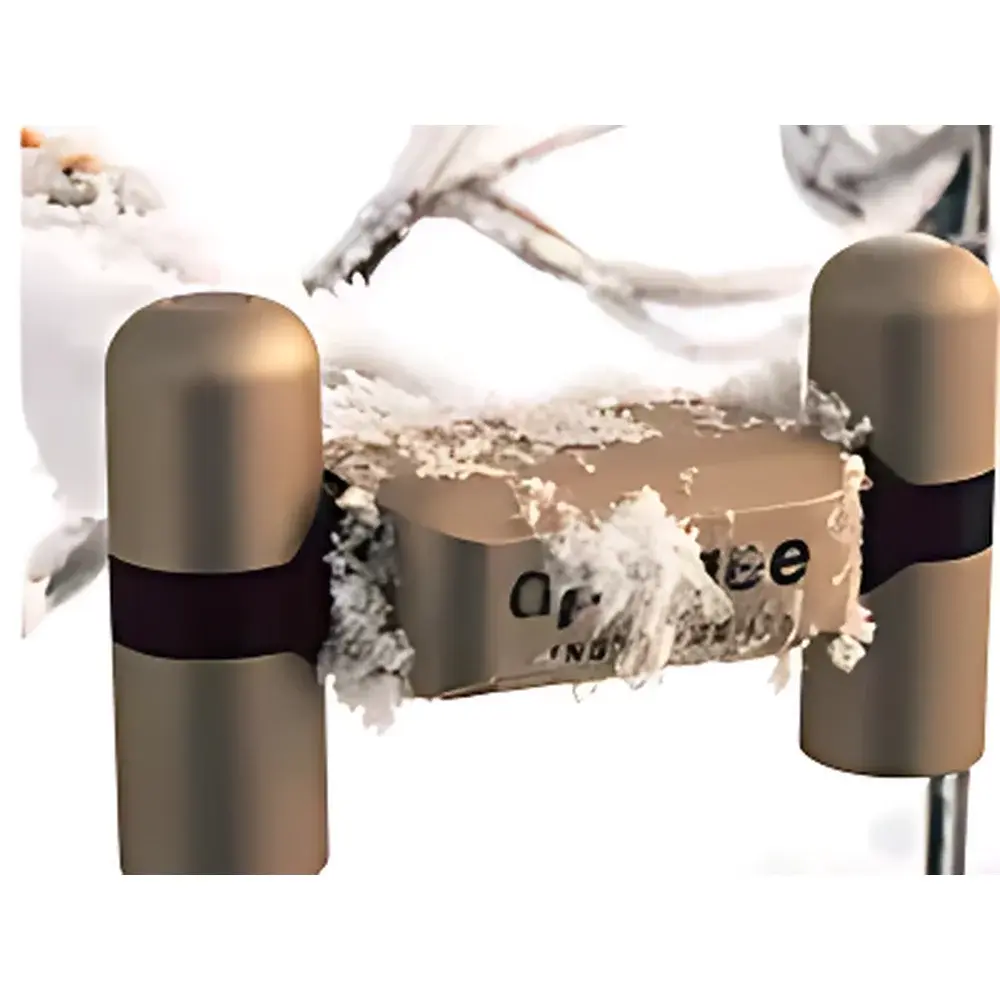
Apogee SN-500 Net Radiometer
| Brand | Apogee |
|---|---|
| Origin | USA |
| Model | SN-500 |
| Measurement Range (Shortwave Up) | 0–2000 W/m² |
| Measurement Range (Shortwave Down) | 0–2000 W/m² |
| Measurement Range (Longwave Up) | −200 to +200 W/m² |
| Measurement Range (Longwave Down) | −200 to +200 W/m² |
| Spectral Range (Shortwave Up) | 385–2105 nm |
| Spectral Range (Shortwave Down) | 295–2685 nm |
| Spectral Range (Longwave) | 5000–30,000 nm |
| Sensitivity | 55 µV/(W/m²) (SW↑), 150 µV/(W/m²) (SW↓), 100 µV/(W/m²) (LW↑/LW↓) |
| Response Time | 1 s (detector) |
| Zero Offset (5 K/h) | 18.2 W/m² (SW↑), 6.67 W/m² (SW↓), 10 W/m² (LW) |
| Field of View | 180° (SW↑), 150° (SW↓), 180° (LW↑/LW↓) |
| Output | Four SDI-12 digital channels (SW↑, SW↓, LW↑, LW↓) |
| Supply Voltage | 5–16 V DC (heater rated at 12 V DC) |
| Power Consumption | 62 mA / 740 mW @ 12 V DC |
| Operating Temperature | −50 °C to +80 °C |
| Relative Humidity | 0–100 % RH |
| Dimensions | 116 mm (L) × 45 mm (W) × 66 mm (H) |
| Weight | 320 g (including mounting rod and 5-m cable) |
| Cable | 5-m, 4-conductor shielded twisted pair with ethylene propylene rubber jacket |
Overview
The Apogee SN-500 Net Radiometer is a precision-calibrated, four-component pyranometer/pyrgeometer system engineered for continuous, high-fidelity measurement of net radiation exchange in terrestrial and aquatic surface energy balance studies. It operates on the principle of thermopile-based detection, where incident shortwave (solar) and longwave (terrestrial infrared) radiation induce temperature differentials across blackened thermopile junctions, generating proportional microvolt-level signals that are digitized onboard via integrated analog-to-digital conversion. Unlike legacy analog-only radiometers requiring external data loggers with multiple analog input channels, the SN-500 implements SDI-12 protocol—enabling all four radiation components (upward shortwave, downward shortwave, upward longwave, downward longwave) to be acquired over a single serial bus, reducing wiring complexity and channel allocation overhead. Its compact, weather-resistant architecture and active thermal management make it suitable for unattended deployment across extreme climatic gradients—from Arctic permafrost monitoring to tropical agroecosystem flux towers.
Key Features
- Integrated SDI-12 Digital Output: Onboard A/D conversion eliminates analog signal degradation and enables direct connection to SDI-12–compatible dataloggers (e.g., Campbell Scientific CR1000X, Onset HOBO RX3000), preserving measurement integrity and simplifying system integration.
- Active Heater Compensation: Each sensor element incorporates a low-power (0.2 W) resistive heater to mitigate dew, frost, rain, and snow accumulation—critical for maintaining optical clarity and minimizing zero-offset drift under high-humidity or subfreezing conditions.
- Thermopile-Based Multi-Spectral Detection: Independent thermopile detectors optimized for distinct spectral bands: quartz-covered for shortwave (385–2105 nm upward; 295–2685 nm downward) and silicon dome-filtered for longwave (5000–30,000 nm), ensuring spectrally appropriate responsivity and minimal cosine error.
- Onboard PT100 Temperature Reference: Embedded platinum resistance thermometer provides real-time sensor body temperature for post-acquisition thermal correction of longwave measurements per ISO 9060:2018 Class C requirements.
- Ruggedized Environmental Design: IP67-rated M8 connector, ethylene propylene rubber-jacketed 5-m shielded twisted-pair cable, and −50 °C to +80 °C operational envelope support long-term field deployment without enclosure dependency.
Sample Compatibility & Compliance
The SN-500 is designed for open-field, canopy-level, and aquatic surface installations where bidirectional radiative fluxes govern energy partitioning. Its 180° hemispherical FOV (upward shortwave and longwave) and 150° FOV (downward shortwave) conform to ASTM E892 and ISO 9060:2018 guidelines for broadband solar and infrared radiometry. Calibration traceability follows NIST-traceable procedures, with individual unit certificates provided. The device supports GLP-compliant data acquisition when paired with SDI-12 loggers featuring audit-trail functionality (e.g., timestamped command logs, firmware version reporting). While not intrinsically certified for hazardous locations, its low-voltage operation (5–16 V DC) and absence of moving parts align with IEC 61000-6-2/6-4 immunity and emission standards for environmental monitoring instrumentation.
Software & Data Management
Data retrieval is fully compatible with standard SDI-12 command sets (e.g., “a001!” for measurement initiation, “a001R” for reading values). Raw outputs are scaled using factory-provided sensitivity coefficients (µV per W/m²) and zero-offset corrections. Apogee provides free Excel-based calibration utilities and Python-compatible example scripts for batch processing and unit conversion. When deployed with Campbell Scientific’s LoggerNet or Onset’s HOBOlink platform, the SN-500 integrates seamlessly into automated QA/QC workflows—including spike detection via first-difference thresholds, physical plausibility checks (e.g., LW↓ > 0 W/m² at night), and time-synchronized multi-sensor fusion for Bowen ratio or latent heat flux derivation. All SDI-12 transactions are logged with millisecond timestamps, satisfying minimum metadata requirements for FLUXNET and AmeriFlux submission protocols.
Applications
- Surface energy balance modeling in micrometeorology and land–atmosphere interaction studies
- Evapotranspiration estimation for irrigation scheduling and drought monitoring
- Albedo and emissivity characterization of snowpack, tundra, cropland, and urban surfaces
- Validation of satellite-derived radiation products (e.g., CERES, MODIS) at ground-truth sites
- Long-term climate observatories requiring stable, low-maintenance net radiation measurement
- Permafrost and avalanche forecasting systems (e.g., Alaska Electric Light & Power deployments)
FAQ
What is the recommended mounting orientation for optimal accuracy?
Mount the SN-500 horizontally on a stable, non-reflective platform with unobstructed sky view. Ensure the upward-facing sensors are level within ±0.5°; use Apogee’s optional leveling base (LN-100) for critical applications.
Can the heater be operated continuously?
Yes—the 0.2 W heater may run continuously at 12 V DC without thermal saturation; power draw remains within specification limits even at ambient temperatures below −40 °C.
How is longwave downwelling radiation corrected for sensor temperature?
The onboard PT100 provides real-time thermistor readings; users apply the Stefan–Boltzmann correction term (σ·Tsensor4) during post-processing using Apogee’s documented algorithm.
Is recalibration required annually?
Apogee recommends recalibration every two years under typical field conditions; annual verification against a reference radiometer is advised for flux network compliance.
Does the SN-500 meet ISO 9060:2018 classification requirements?
It meets Class C specifications for spectral selectivity and directional response—intended for research-grade applications where absolute uncertainty < ±5% is acceptable.