
Apogee SN-522-SS / SN-522 Four-Component Net Radiometer with Modbus Output
| Brand | Apogee |
|---|---|
| Origin | USA |
| Model | SN-522-SS / SN-522 |
| Spectral Range (Shortwave, Upward) | 385–2105 nm |
| Spectral Range (Shortwave, Downward) | 295–2685 nm |
| Spectral Range (Longwave) | 5–30 µm |
| Shortwave Measurement Range | 0–2000 W/m² |
| Longwave Net Measurement Range | −200 to +200 W/m² |
| Sensitivity (Shortwave, Up) | 0.045 mV/(W/m²) |
| Sensitivity (Shortwave, Down) | 0.035 mV/(W/m²) |
| Sensitivity (Longwave) | 0.12 mV/(W/m²) |
| Calibration Uncertainty (Shortwave) | <3% @ 1000 W/m² |
| Calibration Uncertainty (Longwave) | ±5% |
| Output Signal (Shortwave) | 0–90 mV (up), 0–70 mV (down) |
| Output Signal (Longwave) | −24 to +24 mV |
| Response Time | <0.5 s (analog), 750 ms (digital processing) |
| Field of View | 180° (upward shortwave), 150° (downward shortwave & longwave) |
| Cosine Response Error | <30 W/m² at 80° solar zenith (up), <20% from 0–60° (down) |
| Zero Offset A | <5 W/m² (unheated), <10 W/m² (heated) |
| Zero Offset B | <5 W/m² |
| Nonlinearity | <1% |
| Repeatability | <1% |
| Long-Term Drift | <2%/year |
| Temperature Operating Range | −50 to +80 °C |
| Relative Humidity Range | 0–100% RH |
| Power Supply | 5.5–24 V DC |
| Current Draw (Heater On, 12 V DC) | 72 mA |
| Current Draw (Heater Off, 12 V DC) | 13.5 mA |
| Heater Power (per sensor) | 740 mW @ 12 V DC |
| Dimensions | 116 × 45 × 66 mm |
| Weight | 320 g (incl. mounting rod and 5 m cable) |
| Cable | 5 m shielded twisted-pair, Santoprene jacket, M8 IP68 connector |
| Integrated Temperature Sensor | 30 kΩ thermistor, ±1 °C tolerance at 25 °C |
| Thermistor Output | 0–2500 mV (typical), excitation voltage 2500 mV (typical) |
Overview
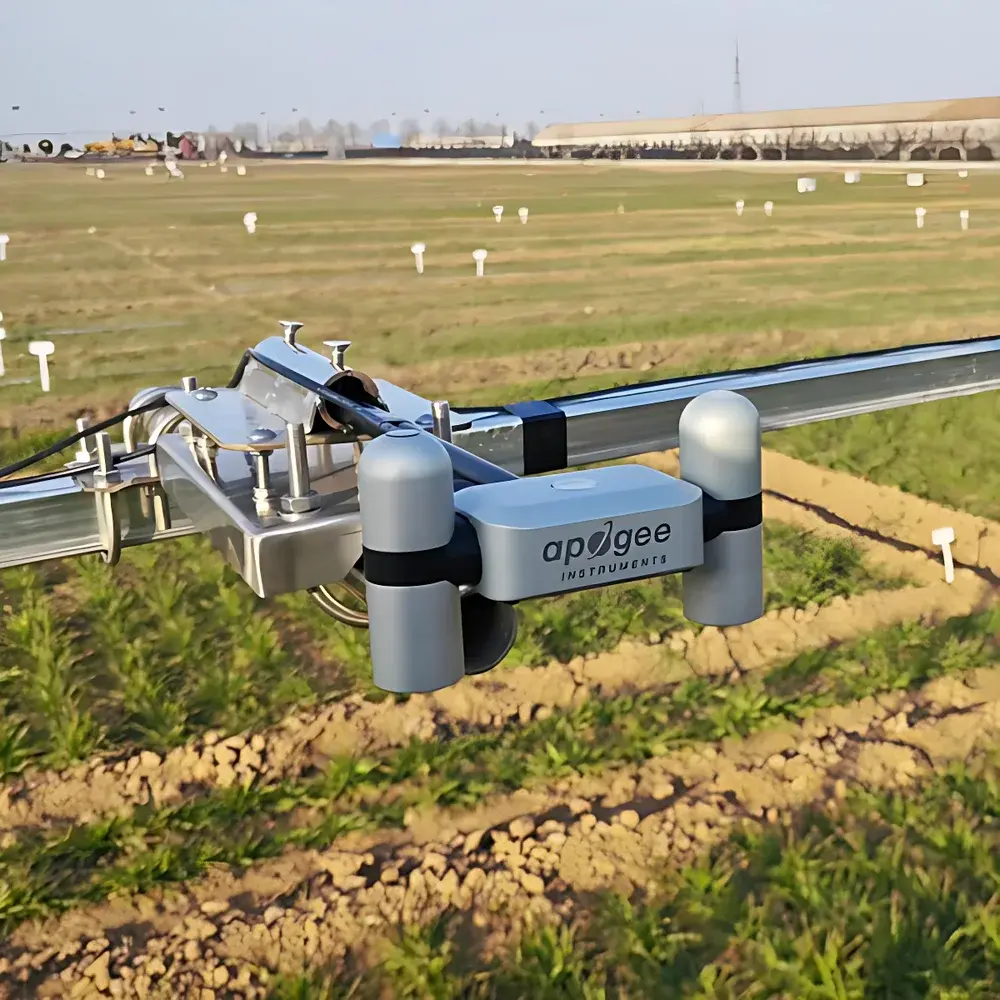
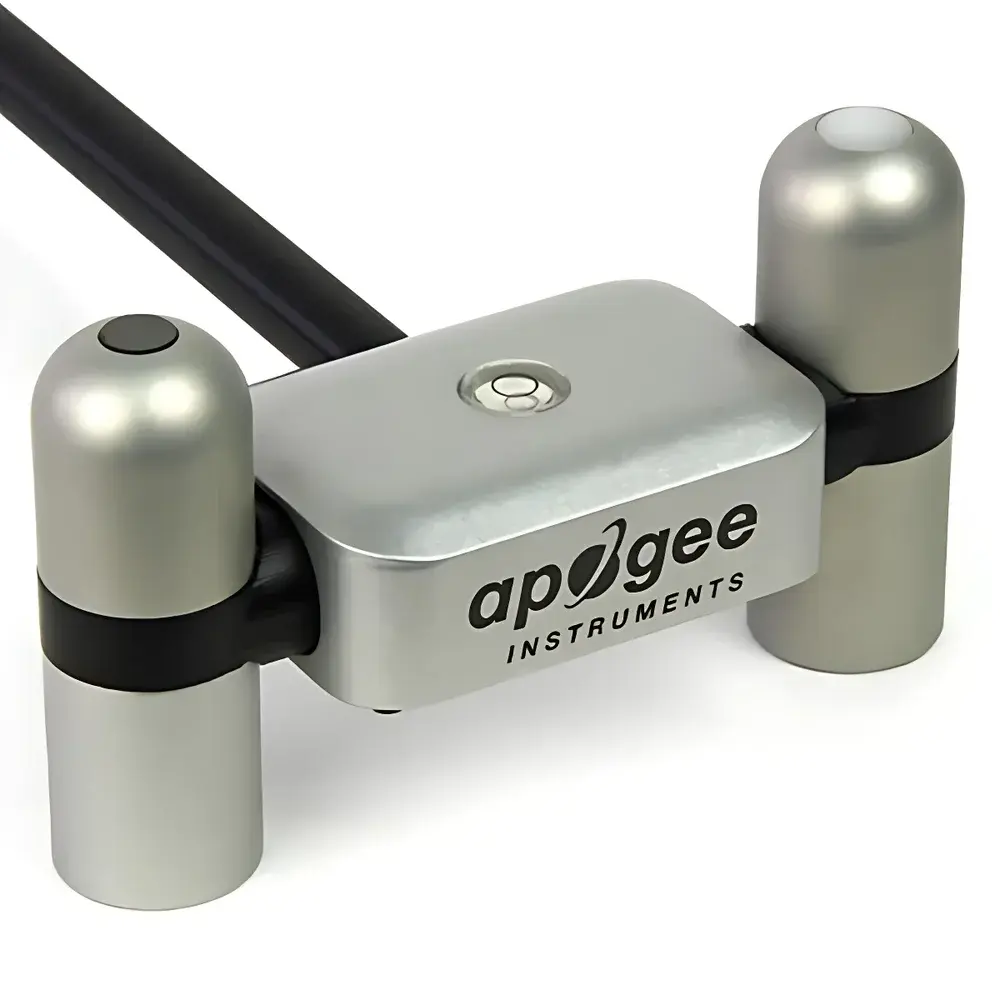
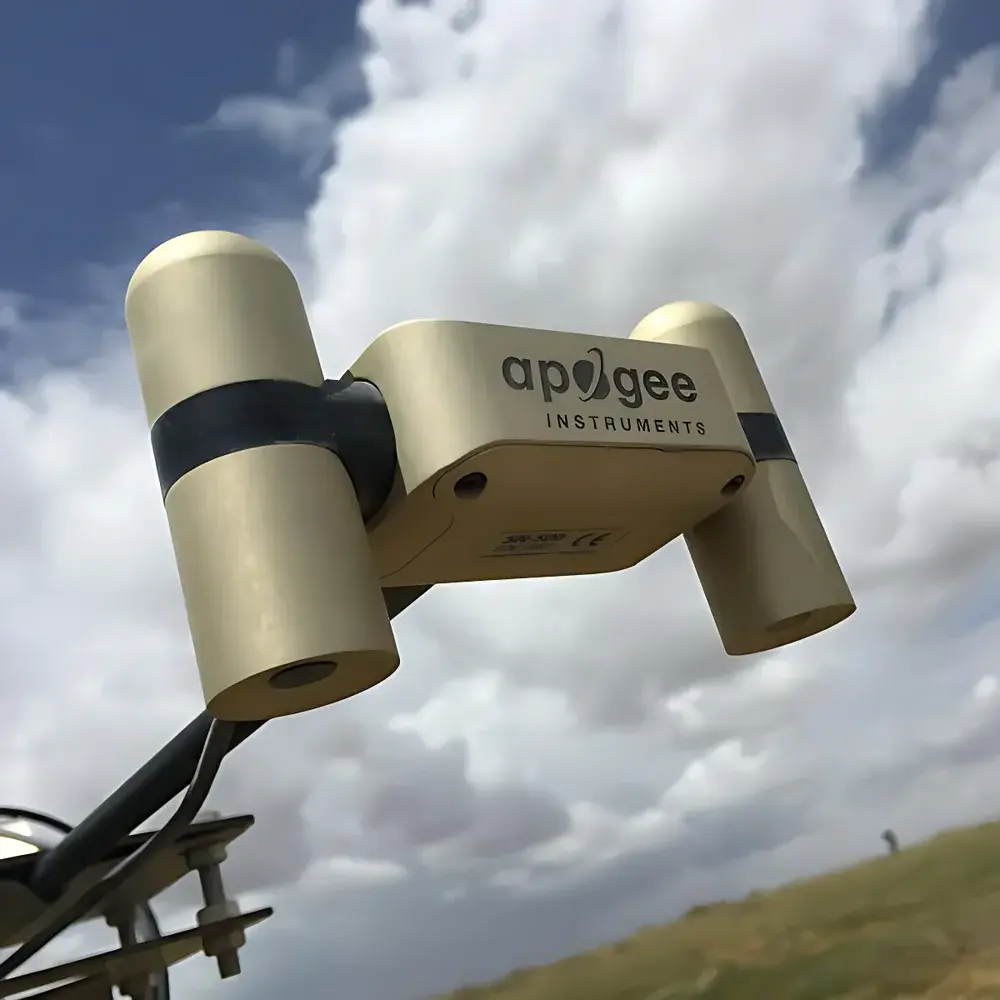
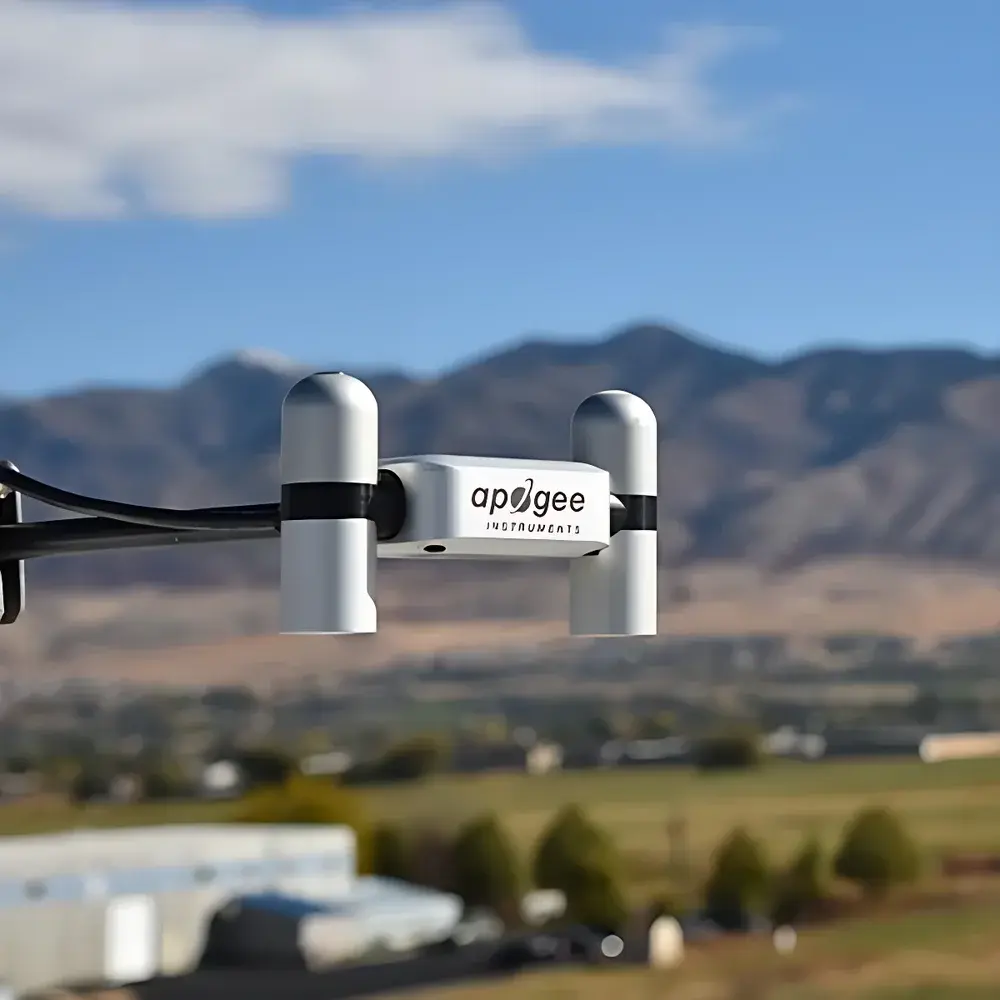
The Apogee SN-522-SS / SN-522 is a precision-engineered, four-component net radiometer designed for continuous, high-fidelity measurement of surface radiation budgets in micrometeorological, eddy covariance, and environmental monitoring applications. It simultaneously quantifies four fundamental radiative fluxes: upward and downward shortwave (solar) irradiance and upward and downward longwave (terrestrial infrared) irradiance. By integrating four independent thermopile detectors—two upward-facing (shortwave and longwave) and two downward-facing (shortwave and longwave)—the instrument enables direct calculation of net shortwave, net longwave, and total net radiation (Rn) with minimal inter-sensor cross-talk or mechanical misalignment error. Its fully sealed, monolithic housing eliminates moving parts, ensuring long-term stability under field conditions. The built-in resistive heating system—individually controlled per detector—mitigates dew, frost, rain, and snow accumulation on sensor windows, preserving optical transmission integrity without compromising thermal equilibrium or introducing significant zero-offset drift.
Key Features
- Modbus RTU communication over RS-485 (standard) or RS-232 (optional), enabling seamless integration into SCADA, PLC, and data logger networks compliant with industrial automation protocols.
- Active window heating (740 mW per detector at 12 V DC) with SDI-12-compatible disable command, allowing dynamic power management in low-energy deployments.
- Thermopile-based detection with no moving optics or spectral filters—ensuring inherent spectral fidelity and immunity to filter degradation.
- Optimized cosine response: upward shortwave maintains <30 W/m² deviation at 80° solar zenith; downward shortwave exhibits <20% error across 0–60° incidence angles—critical for accurate albedo and canopy transmittance derivation.
- Integrated 30 kΩ precision thermistor (±1 °C at 25 °C) for concurrent surface or sensor body temperature monitoring—essential for longwave correction and energy balance closure analysis.
- Robust environmental rating: operational from −50 to +80 °C and 0–100% RH; IP68-rated M8 connector and Santoprene-jacketed cable ensure reliability in harsh outdoor installations.
Sample Compatibility & Compliance
The SN-522-SS is engineered for deployment in unattended, long-term observational networks including AmeriFlux, ICOS, FLUXNET, and national meteorological services. Its measurement methodology aligns with ISO 9060:2018 (spectroradiometers) and ASTM E892 (calibration of pyranometers/pyrgeometers). While not certified for regulatory compliance out-of-the-box, its traceable calibration (NIST-traceable reference standards), documented uncertainty budgets (<3% shortwave, ±5% longwave), and stable long-term drift (<2%/year) support adherence to FAO-56, USGS, and WMO guidelines for surface energy balance modeling. The Modbus interface supports configurable polling intervals and register mapping, facilitating audit-ready data acquisition compatible with GLP-aligned data logging systems requiring timestamped, version-controlled output.
Software & Data Management
Data acquisition is supported via standard Modbus function codes (03h Read Holding Registers, 04h Read Input Registers). Each sensor component (up/down shortwave, up/down longwave, thermistor) occupies dedicated 16-bit registers, with optional scaling factors stored in configuration memory. Apogee provides a publicly available Modbus register map and Python/Node-RED example scripts for rapid integration. When deployed with compliant dataloggers (e.g., Campbell Scientific CR6, Onset HOBO RX3000), the sensor supports automated heater control logic based on humidity or temperature thresholds—enabling adaptive operation without manual intervention. All raw voltage outputs are digitally converted onboard with 16-bit resolution and temperature-compensated linearization, eliminating post-processing corrections required by analog-only instruments.
Applications
- Eddy covariance flux towers: Quantifying Rn as the primary driver of sensible and latent heat flux partitioning.
- Agricultural water use modeling: Supporting FAO-56 Penman-Monteith ETo calculations with site-specific radiation inputs.
- Urban climate studies: Measuring radiation divergence in canyon geometries and evaluating cool roof performance.
- Glaciology and snowpack energy balance: Resolving melt-phase longwave forcing under sub-zero conditions with active heating.
- Renewable energy site assessment: Validating satellite-derived irradiance products and calibrating PV yield models.
- Climate benchmarking networks: Contributing to GCOS Surface Network (GSN) and Baseline Surface Radiation Network (BSRN) tier-2 instrumentation requirements.
FAQ
Does the SN-522-SS require external calibration after installation?
No routine recalibration is required. Apogee provides factory calibration with NIST-traceable uncertainty statements. Users may verify stability annually using a shaded/unshaded comparison test per ISO 9060 procedures.
Can the heater be powered independently of the signal circuitry?
Yes—the heater circuit is electrically isolated and draws power directly from the main supply rail; it operates regardless of Modbus communication status.
What is the impact of heater activation on longwave zero offset?
Heater-induced zero offset is characterized and specified as <10 W/m² (A-type) and <5 W/m² (B-type), both well within the ±5% longwave uncertainty budget.
Is the thermistor output compatible with standard datalogger excitation voltages?
Yes—it is designed for 2500 mV excitation but functions linearly across 2.5–5 V DC, accommodating common datalogger configurations.
How does the SN-522-SS handle partial shading or oblique precipitation events?
The 150° downward FOV and heated windows minimize localized obscuration effects; combined with <1% repeatability and <0.5 s response time, transient errors are confined to sub-second intervals with negligible integration impact.
Related Products







