
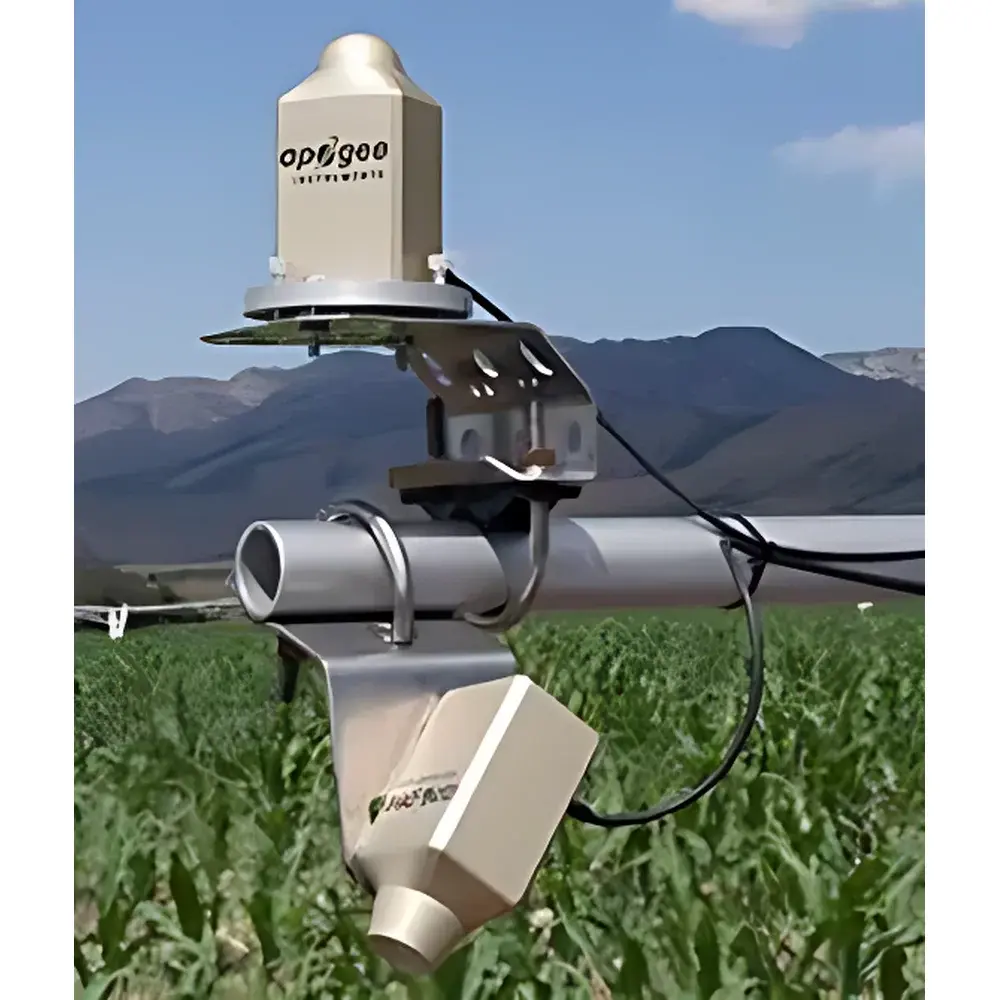
Apogee SS-120 Spectroradiometer
| Brand | Apogee |
|---|---|
| Origin | USA |
| Model | SS-120 |
| Spectral Range | 635–1100 nm |
| Spectral Sampling Interval | 1.0 nm |
| Spectral Resolution | 3.0 nm |
| Spectral Accuracy | ±0.5 nm |
| Spectral Repeatability | ±0.2 nm |
| A/D Conversion | 14-bit |
| Signal-to-Noise Ratio | 1500:1 |
| Stray Light | ≤0.25% at 850 nm |
| Noise Level | ≤3 counts |
| Integration Time | 10 ms – 10 s |
| Linearity | <1% or 0.5% |
| Quantum Efficiency | >10% (λ < 1030 nm) |
| Radiometric Repeatability | <1% (λ < 1020 nm) |
| Cosine Response Error | ±5% at 75° zenith angle |
| Field of View | 25° or 150° (downward-facing configuration) |
| Operating Temperature | −20 to +70 °C |
| Relative Humidity | 0–100% RH |
| Power Consumption | 1 W (USB-powered) |
| Current Draw | 190 mA |
| Weight | 300 g |
| Dimensions | 89.3 × 50.8 × 38.1 mm (H × W × L) |
| Communication Interface | USB |
| Software Compatibility | Windows XP and later |
| Irradiance Calibration Uncertainty | ±5% |
| Temperature Coefficient | −0.1 ± 0.1 %/°C |
Overview
The Apogee SS-120 Spectroradiometer is a compact, high-fidelity field-deployable instrument engineered for precise spectral irradiance and radiance measurements in the near-infrared (NIR) region. Unlike broadband or filtered sensors, the SS-120 employs a fixed-grating optical bench with a thermoelectrically stabilized silicon photodiode array detector, enabling direct, calibrated spectral sampling at 1.0 nm intervals across its 635–1100 nm range. Its design adheres to the physical principles of dispersive spectroradiometry—where incident light is collimated, diffracted by a ruled grating, and resolved spatially onto a linear detector array—ensuring traceable, wavelength-specific quantification of radiant flux. The instrument is optimized for both ground-based and airborne remote sensing applications, including vegetation biophysics, material reflectance characterization, LED lighting validation, and solar spectral monitoring under variable environmental conditions.
Key Features
- Thermally stabilized optical path minimizing spectral drift across operating temperatures (−20 to +70 °C)
- High signal-to-noise ratio (1500:1) and low electronic noise (≤3 counts), supporting reliable low-light measurements
- 14-bit analog-to-digital conversion ensuring sufficient dynamic range for both high- and low-intensity sources
- Calibrated cosine-corrected input optics with ≤5% angular response deviation up to 75° zenith angle—critical for hemispherical irradiance measurements
- Configurable field-of-view options (25° narrow or 150° wide) via interchangeable fore-optics for targeted or integrated surface sampling
- USB-powered operation (1 W, 190 mA) eliminating external power supplies and enabling direct integration with data loggers, UAVs, or portable computers
- NIST-traceable irradiance calibration with ±5% uncertainty, documented per ISO/IEC 17025-compliant procedures
Sample Compatibility & Compliance
The SS-120 is compatible with natural and synthetic surfaces requiring quantitative spectral characterization—including plant canopies, leaf tissue, soil substrates, architectural materials, and solid-state lighting sources. It supports non-contact, non-destructive measurement protocols aligned with ASTM E275, ISO 9050, and USDA ARS standard methods for vegetation spectral reflectance. Its mechanical robustness (IP65-rated enclosure optional), thermal stability, and humidity tolerance (0–100% RH) ensure operational reliability in uncontrolled outdoor environments. While not inherently GLP/GMP-certified, the device’s calibration certificate, audit-ready metadata logging, and software export formats (CSV, JSON) support compliance with FDA 21 CFR Part 11 when deployed within validated workflows.
Software & Data Management
The Apogee Instrumentation Suite (v5.2+) provides real-time spectral acquisition, dark-current subtraction, radiometric calibration application, and spectral index computation (e.g., NDVI, PRI, REIP). Data files embed timestamp, GPS coordinates (when paired with external GNSS), integration time, temperature, and calibration coefficients—enabling full traceability. Export formats include UTF-8 CSV (tabular spectra), JSON (structured metadata), and XML (for LIS/ELN integration). The software supports batch processing, spectral smoothing (Savitzky-Golay), and user-defined band integration—facilitating reproducible analysis across laboratories. All firmware updates and calibration files are digitally signed and version-controlled, meeting requirements for audit trails in regulated research environments.
Applications
- Plant phenotyping: Quantifying chlorophyll absorption features (680–750 nm), water band depth (970 nm), and NIR reflectance (750–1100 nm) for stress detection and biomass estimation
- Agricultural remote sensing: Ground-truthing satellite or drone-based hyperspectral datasets through synchronized spectral validation
- LED and horticultural lighting QA: Verifying spectral power distribution (SPD), photosynthetic photon flux density (PPFD), and phytochrome photoequilibrium (PPE) calculations
- Material science: Measuring bidirectional reflectance distribution function (BRDF) components of coatings, films, and composites under controlled illumination
- Solar resource assessment: Capturing atmospheric transmittance signatures and spectral mismatch factors for PV performance modeling
- Ecological monitoring: Long-term spectral time-series of albedo, snow grain size, and lichen community composition in Arctic and alpine sites
FAQ
What is the primary difference between the SS-110 and SS-120 models?
The SS-110 operates from 340–820 nm (UV-Vis-NIR), while the SS-120 covers 635–1100 nm (red-edge to short-wave NIR), making it optimal for vegetation water content, lignin/cellulose detection, and silicon-based PV spectral response.
Can the SS-120 be used on unmanned aerial vehicles (UAVs)?
Yes—the compact form factor (300 g), low power draw (1 W), and vibration-tolerant optical design enable stable mounting on multirotor and fixed-wing platforms; external GPS and IMU synchronization is supported via TTL triggers.
Is spectral recalibration required after field deployment?
No routine recalibration is needed under normal use; however, Apogee recommends annual verification against a NIST-traceable reference lamp to maintain ±5% irradiance uncertainty compliance.
Does the instrument support real-time spectral streaming?
Yes—the USB interface supports continuous frame capture at up to 10 Hz (dependent on integration time); raw spectral vectors are accessible via Apogee’s SDK for Python, MATLAB, and LabVIEW integration.
How is stray light corrected in post-processing?
Stray light contribution (≤0.25% at 850 nm) is characterized during factory calibration; correction matrices are embedded in the software and applied automatically during spectral reconstruction.






