
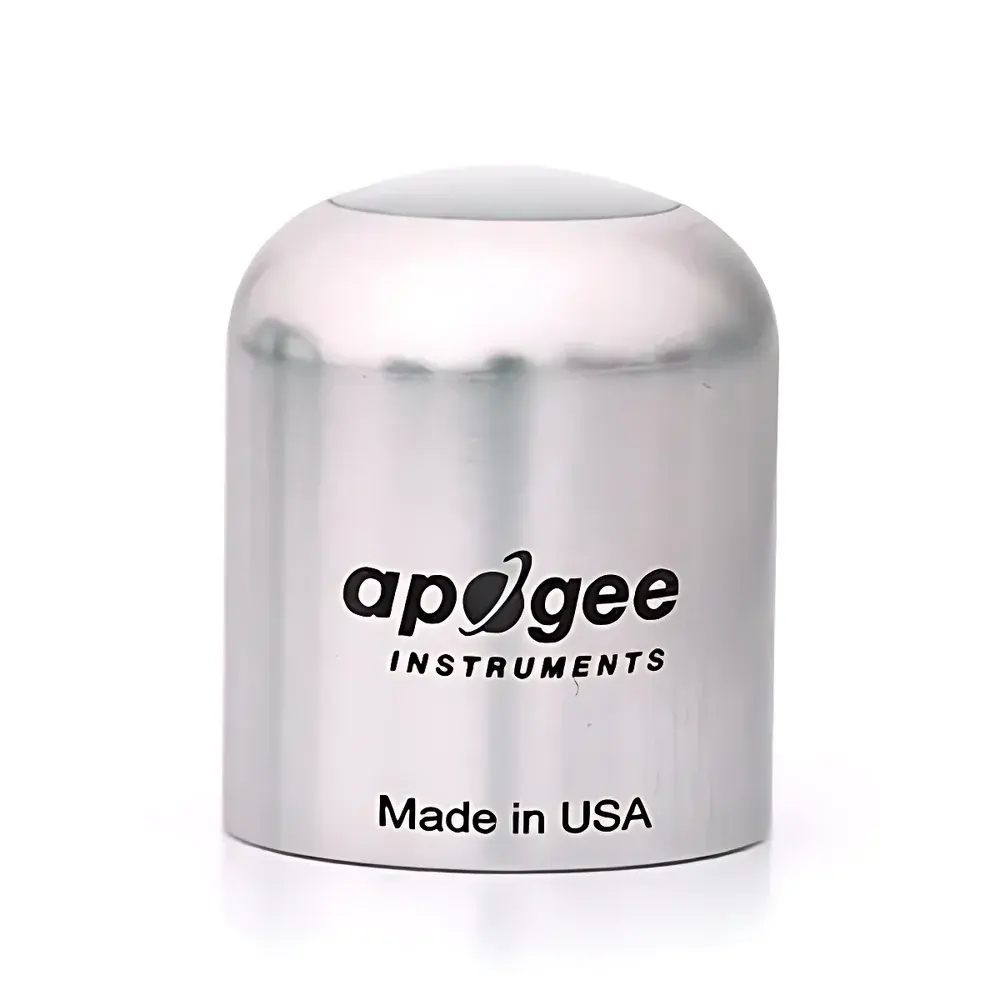
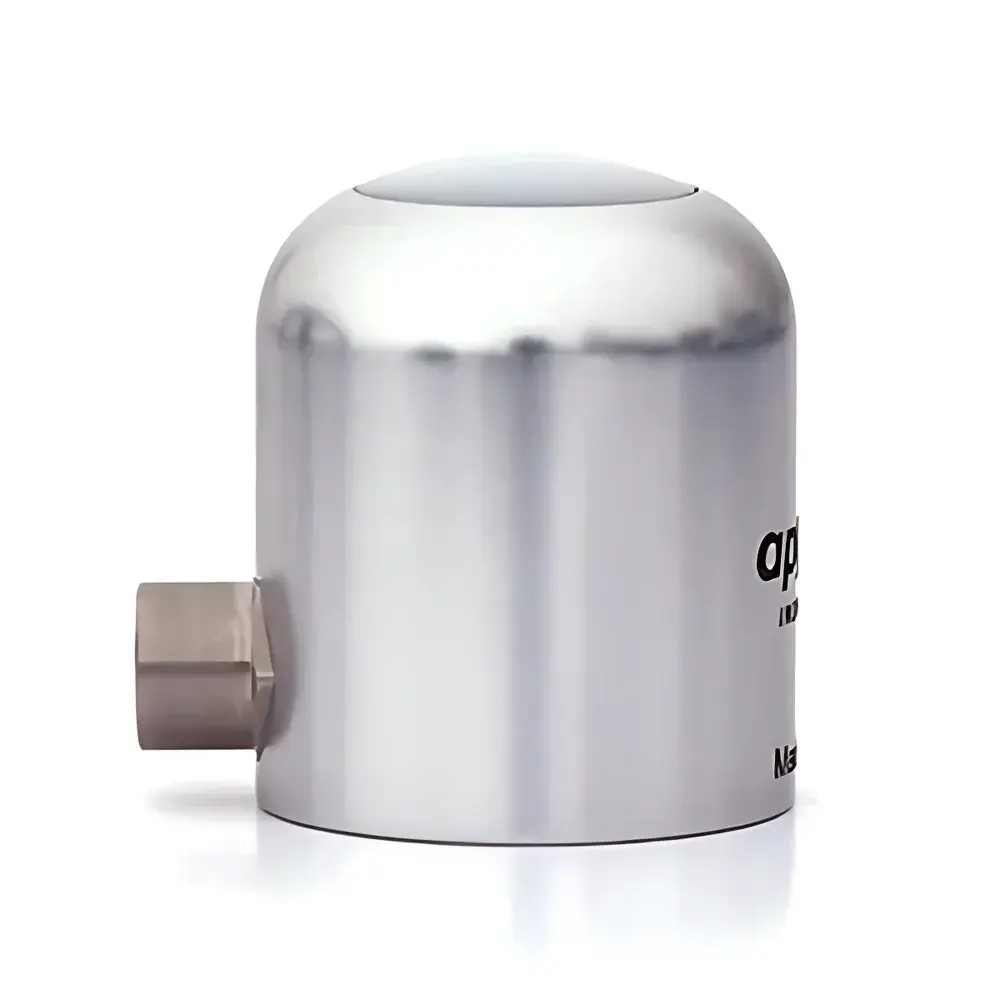
Apogee SU-200-SS / SU-202-SS / SU-205-SS UV Radiation Sensors
| Brand | Apogee |
|---|---|
| Origin | USA |
| Model | SU-200-SS / SU-202-SS / SU-205-SS |
| Spectral Range | 300–400 nm |
| Output Types | 0–10 mV (SU-200-SS), 0–2.5 V (SU-202-SS), 0–5 V (SU-205-SS) |
| Calibration Unit | W·m⁻² (irradiance) |
| Measurement Range | 0–100 W·m⁻² |
| Spectral Bandwidth | 300–400 nm |
| Wavelength Accuracy | ±5% |
| Stray Light Rejection | ±1% |
| Operating Temperature | −35 to +85 °C |
| Relative Humidity Range | 0–100% RH |
| Housing IP Rating | IP68 |
| Cable Length | 5 m |
| Sensor Diameter × Height | Φ30.5 × 37 mm |
| Weight | 140 g |
| Long-Term Drift | <2% per year |
| Nonlinearity | <1% |
| Directional Response | ±2% at 45°, ±5% at 75° |
| Temperature Coefficient | 0.1% / °C |
| Calibration Uncertainty | ±10% |
Overview
The Apogee SU-200-SS, SU-202-SS, and SU-205-SS are precision-calibrated ultraviolet (UV) radiation sensors engineered for quantitative measurement of biologically and photochemically relevant UV-A irradiance (300–400 nm). Unlike broadband photodiode-based meters with unfiltered spectral response, these sensors incorporate a proprietary optical filter stack and temperature-stabilized silicon photodiode array to deliver spectrally selective, radiometrically traceable output in SI-compliant units (W·m⁻²). Each model is factory-calibrated against NIST-traceable standards under controlled collimated illumination, ensuring metrological integrity across environmental, agricultural, materials science, and photobiology applications. The sensors operate on the principle of absolute irradiance detection—converting incident photon flux within the designated UV-A band into a linear analog voltage signal proportional to irradiance intensity. Their compact, marine-grade stainless-steel housing and IP68-rated connector enable continuous deployment in harsh outdoor environments—including open-field solar monitoring, greenhouse UV management, and accelerated weathering test chambers—without degradation in optical or electrical performance.
Key Features
- Radiometric calibration traceable to NIST standards, with documented uncertainty of ±10% (k=2) across the full 0–100 W·m⁻² range
- Optimized UV-A spectral response (300–400 nm) with sharp cut-on/cut-off edges and minimal out-of-band sensitivity (<1% stray light contribution)
- Three output configurations: self-powered 0–10 mV (SU-200-SS), regulated 0–2.5 V (SU-202-SS), and high-sensitivity 0–5 V (SU-205-SS) for compatibility with data loggers, PLCs, and SCADA systems
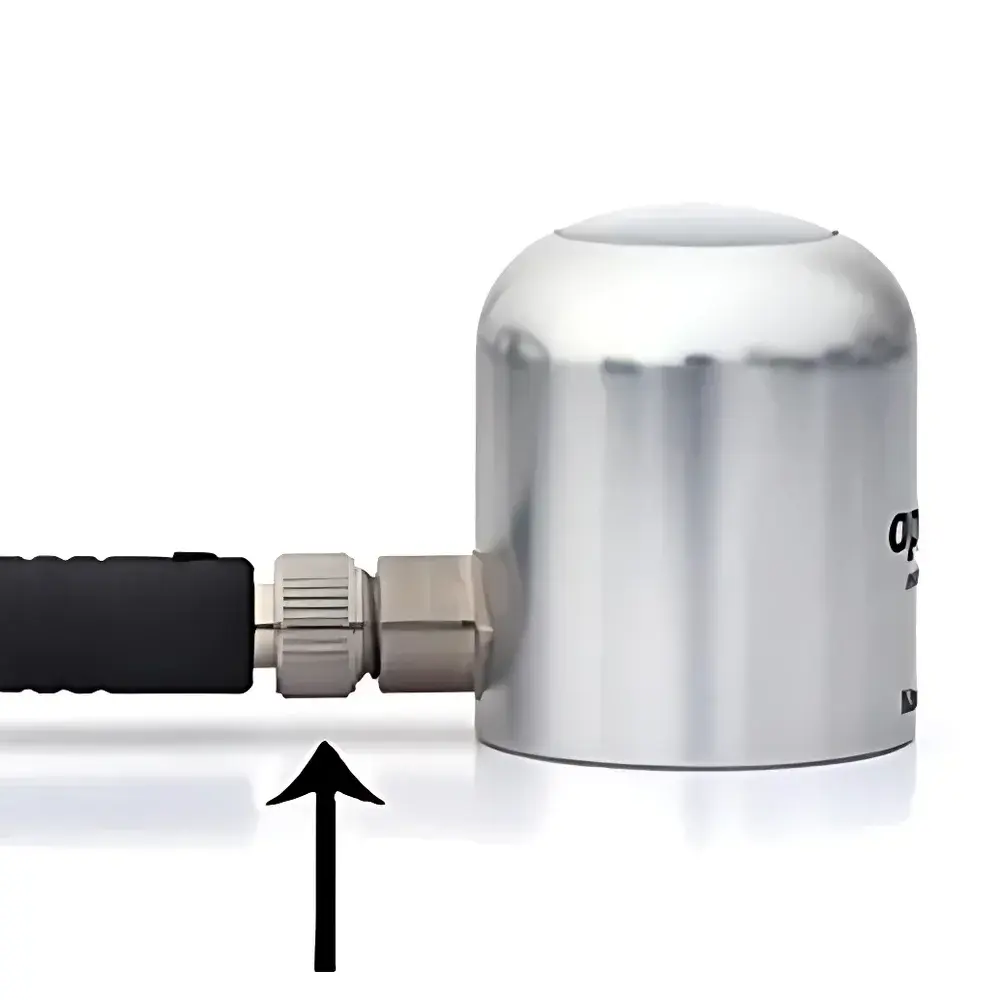
- IP68-rated marine-grade stainless-steel housing and 5-meter tinned-copper shielded cable with integrated 30 cm detachable IP68 connector for simplified recalibration and field maintenance
- Thermal compensation circuitry minimizing drift to <0.1% / °C and long-term stability of <2% per year under continuous operation
- Directional cosine response optimized to ±2% at 45° zenith angle and ±5% at 75°, meeting ISO 9060:2018 Class C specifications for broadband solar irradiance sensors
- Operating range of −35 to +85 °C and 0–100% RH, validated for condensing and saline environments without hermetic seal failure
Sample Compatibility & Compliance
These sensors are designed for direct irradiance measurement on planar surfaces exposed to natural or artificial UV sources—including xenon arc lamps, UV-LED arrays, mercury-vapor lamps, and terrestrial sunlight. They require no sample preparation or consumables and are compatible with standard mounting hardware (e.g., leveling bases, albedo plates, and cosine correctors). All models comply with IEC 61215-2 (photovoltaic module qualification), ASTM G177 (solar spectral distribution tables), and ISO 17166:2019 (CIE S 014/E:2006 photobiological safety). While not intended for regulatory compliance testing under FDA 21 CFR Part 11 or GLP, their calibration certificates include full traceability metadata (reference standard ID, calibration date, environmental conditions), supporting audit readiness in quality-controlled laboratories and ISO/IEC 17025-accredited facilities.
Software & Data Management
The SU-series sensors interface seamlessly with industry-standard data acquisition platforms—including Campbell Scientific CR series loggers, HOBO UX120, Onset U30, and LabVIEW-compatible DAQ systems—via analog voltage input channels. Apogee provides free Excel-based calibration coefficient calculators and MATLAB/Python script templates for real-time unit conversion (e.g., W·m⁻² → µmol·m⁻²·s⁻¹ using defined quantum efficiency factors). Raw voltage outputs are linear within <1% nonlinearity; no firmware or embedded software resides in the sensor itself, eliminating cybersecurity concerns and firmware obsolescence risks. For integration into LIMS or cloud-based monitoring systems, users may apply two-point linear scaling (slope/offset) using the provided calibration coefficients—fully compliant with ISO/IEC 17025 clause 5.4.2 on measurement traceability and uncertainty propagation.
Applications
- UV-A dose monitoring in horticultural lighting systems to optimize photomorphogenic responses (e.g., anthocyanin synthesis, stomatal regulation)
- Accelerated material degradation studies per ASTM D4329 and ISO 4892-3, quantifying UV transmission through polymer films, coatings, and packaging substrates
- Outdoor UV index validation and solar spectral modeling in atmospheric science networks
- In-line UV curing process control in industrial printing, adhesive dispensing, and conformal coating lines
- Photostability assessment of pharmaceuticals and cosmetics per ICH Q1B guidelines
- Calibration reference for UV radiometers used in ISO/IEC 17025-accredited testing laboratories
FAQ
Are these sensors suitable for measuring UV-B (280–315 nm) or UV-C (100–280 nm) irradiance?
No. The SU-200/202/205 series is spectrally limited to 300–400 nm and exhibits negligible responsivity below 300 nm. For UV-B or UV-C applications, Apogee offers the SU-100 series (UV-B) and SU-400 series (broadband UV-C), each with dedicated optical filtering and calibration.
Can the sensor be used underwater or submerged continuously?
The IP68 rating confirms protection against prolonged immersion at depths up to 1 meter for 30 minutes. However, extended submersion (>1 hr) is not recommended due to potential long-term diffusion of moisture past the cable gland under hydrostatic pressure.
Is recalibration required annually?
Apogee recommends recalibration every 2 years under normal field use. Annual verification against a reference sensor is advised where measurement uncertainty budgets demand ≤5% expanded uncertainty. Recalibration services include full spectral responsivity mapping and updated NIST-traceable certificates.
What is the minimum sampling interval supported?
The sensor’s electrical time constant is <10 ms. When paired with a 16-bit ADC sampling at ≥10 Hz, it supports high-frequency UV transients—such as pulsed UV-LED output or cloud-edge enhancement events—without aliasing or slew-rate limitation.
Do these sensors meet FDA or EU MDR requirements for medical device environmental monitoring?
While not certified as medical devices, the SU-series meets the electromagnetic compatibility (EMC) and environmental robustness criteria outlined in IEC 60601-1-2 and EN 61326-1 for ancillary monitoring equipment. Integration into Class IIa/b medical systems requires risk analysis per ISO 14971 and verification of signal chain integrity by the OEM.



