
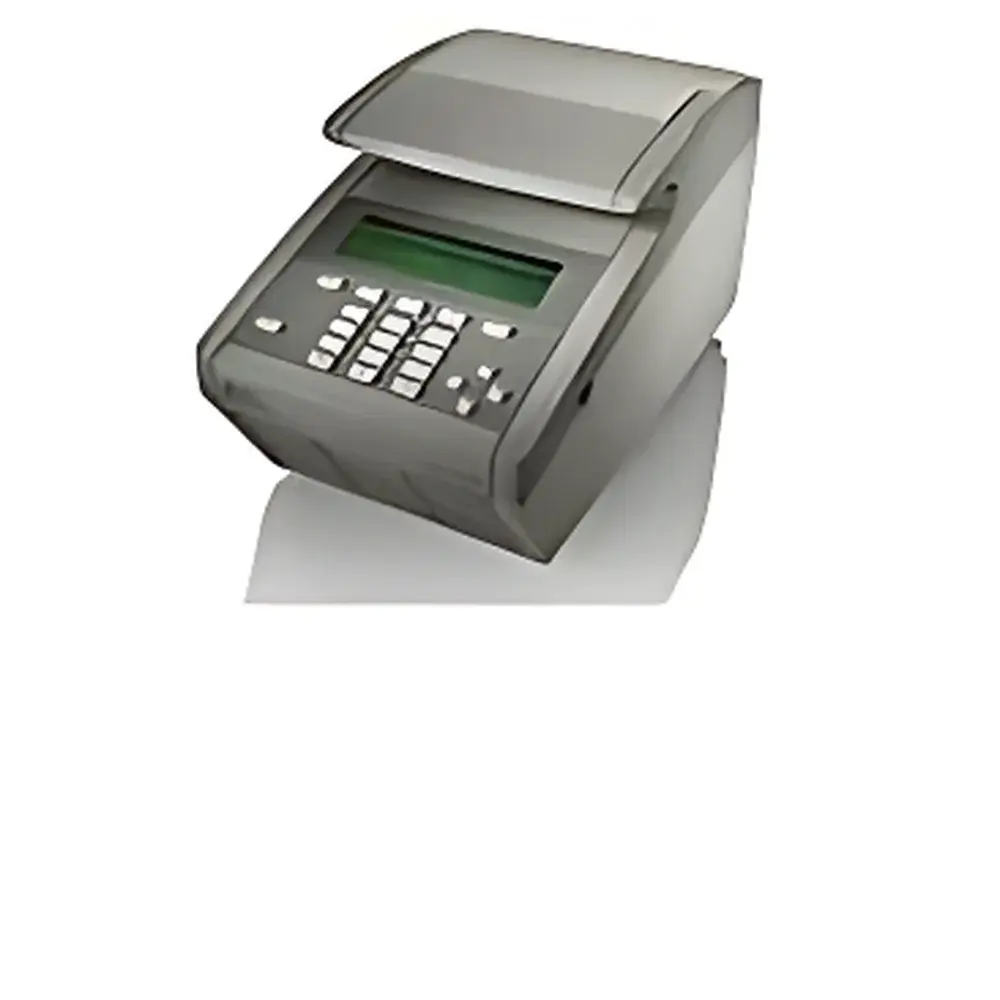
Applied Biosystems 2720 Thermal Cycler
| Brand | Applied Biosystems |
|---|---|
| Model | 2720 |
| Sample Capacity | 96-well |
| Heating Rate | 2.7 °C/s |
| Temperature Accuracy | ±0.1 °C |
| Well-to-Well Uniformity | ±0.5 °C |
| Operating Temperature Range | 4.0–99.9 °C |
| Heat Lid Temperature | 105 °C |
| Memory Capacity | 100 protocols |
| Tm Calculation | Built-in |
| Power Failure Recovery | Auto-resume |
| NIST-Traceable Calibration | Yes |
| Diagnostic Self-Test | Integrated |
Overview
The Applied Biosystems 2720 Thermal Cycler is a benchtop polymerase chain reaction (PCR) instrument engineered for precision, reproducibility, and operational continuity in molecular biology laboratories. Utilizing Peltier-based thermoelectric heating and cooling technology, the 2720 delivers rapid, symmetric thermal transitions across a 96-well aluminum block—enabling robust DNA amplification under tightly controlled thermal profiles. Its architecture reflects Applied Biosystems’ legacy in thermal cycling design: compact footprint (21 × 36 cm), rear-mounted exhaust for high-density bench placement, and a heat lid maintained at 105 °C to eliminate mineral oil overlay requirements. The system operates within a validated temperature range of 4.0–99.9 °C, with real-time sample temperature feedback displayed to 0.1 °C resolution. All thermal calibrations are traceable to the U.S. National Institute of Standards and Technology (NIST), supporting compliance with ISO/IEC 17025 and internal quality assurance protocols.
Key Features
- Peltier-driven thermal control with 2.7 °C/s ramp rate (block) and 1.0 °C/s average sample ramp rate—optimized for standard and fast-cycling PCR protocols
- 96-well aluminum block with ±0.5 °C well-to-well uniformity (measured at 95 °C, 30 s post-equilibration), ensuring inter-well reproducibility critical for quantitative and multiplex applications
- Integrated heat lid operating at 105 °C, enabling oil-free PCR setup and minimizing evaporation across extended cycles
- Onboard memory storing up to 100 user-defined protocols—including pre-PCR denaturation, cycling segments (up to 25 cycles), and post-amplification hold steps—with optional password protection to prevent accidental overwrites
- Real-time thermal diagnostics suite: self-tests verify ramp speed accuracy, temperature stability, and block homogeneity—generating pass/fail logs for GLP documentation
- Power failure resilience: automatic resume functionality restores interrupted runs upon power restoration, preserving experimental integrity without manual intervention
Sample Compatibility & Compliance
The 2720 supports standard 0.2 mL thin-wall PCR tubes and 96-well plates compliant with ANSI/SLAS microplate standards. Its thermal performance meets key industry benchmarks: temperature accuracy of ±0.1 °C (35–100 °C), validated per ASTM E2876-22 for thermal cyclers. Firmware and hardware design align with FDA 21 CFR Part 11 readiness—audit trail generation, electronic signature support, and protocol versioning are enabled via optional software upgrades. The instrument satisfies essential requirements for ISO 13485 environments and supports laboratory accreditation under CLIA and CAP guidelines when operated within documented SOPs.
Software & Data Management
The 2720 features an intuitive alphanumeric LCD interface (7 × 40 character display) with dynamic graphical indicators for real-time thermal status. Protocol editing includes automatic Tm calculation based on nearest-neighbor thermodynamics, annealing temperature optimization, and time/temperature auto-extension logic. All methods retain date/time stamps and user identifiers. Data export is supported via RS-232 serial interface to external PCs running Windows-compatible loggers. While the base unit lacks Ethernet or USB connectivity, its ASCII-formatted output enables integration into LIMS environments through middleware. Audit trails—including method modification history, calibration events, and diagnostic execution logs—are stored locally and exportable for regulatory review.
Applications
The 2720 serves as a foundational platform for routine and advanced nucleic acid amplification workflows: standard endpoint PCR, colony screening, genotyping, cDNA synthesis, and library preparation for Sanger sequencing. Its thermal consistency supports primer validation studies, gradient-free optimization of annealing temperatures, and multi-target amplification where inter-well variance must remain below ±0.5 °C. In teaching laboratories, its reliability and straightforward interface reduce training overhead; in QC/QA settings, its NIST-traceable calibration and diagnostic logging facilitate compliance with ISO 17025 clause 6.4.1 (equipment verification). The system is routinely deployed in food safety testing (e.g., pathogen detection per AOAC guidelines), environmental microbiology, and veterinary diagnostics.
FAQ
Does the 2720 support gradient PCR?
No—the 2720 is a fixed-temperature uniform-block thermal cycler and does not provide thermal gradient functionality.
Is the heat lid pressure-adjustable?
No—the lid applies consistent downward force via spring-loaded mechanism; no manual pressure calibration is required or supported.
Can protocols be transferred between multiple 2720 units?
Yes—protocols can be exported as ASCII text files and imported onto other 2720 instruments using compatible terminal software.
What maintenance is required for long-term thermal accuracy?
Annual verification using NIST-traceable reference probes is recommended; routine cleaning of the block surface and lid contact area with isopropanol ensures optimal thermal coupling.
Is firmware upgrade capability available?
Firmware updates are distributed by Thermo Fisher Scientific (successor to Applied Biosystems) via authorized service channels; end users cannot perform field upgrades.



