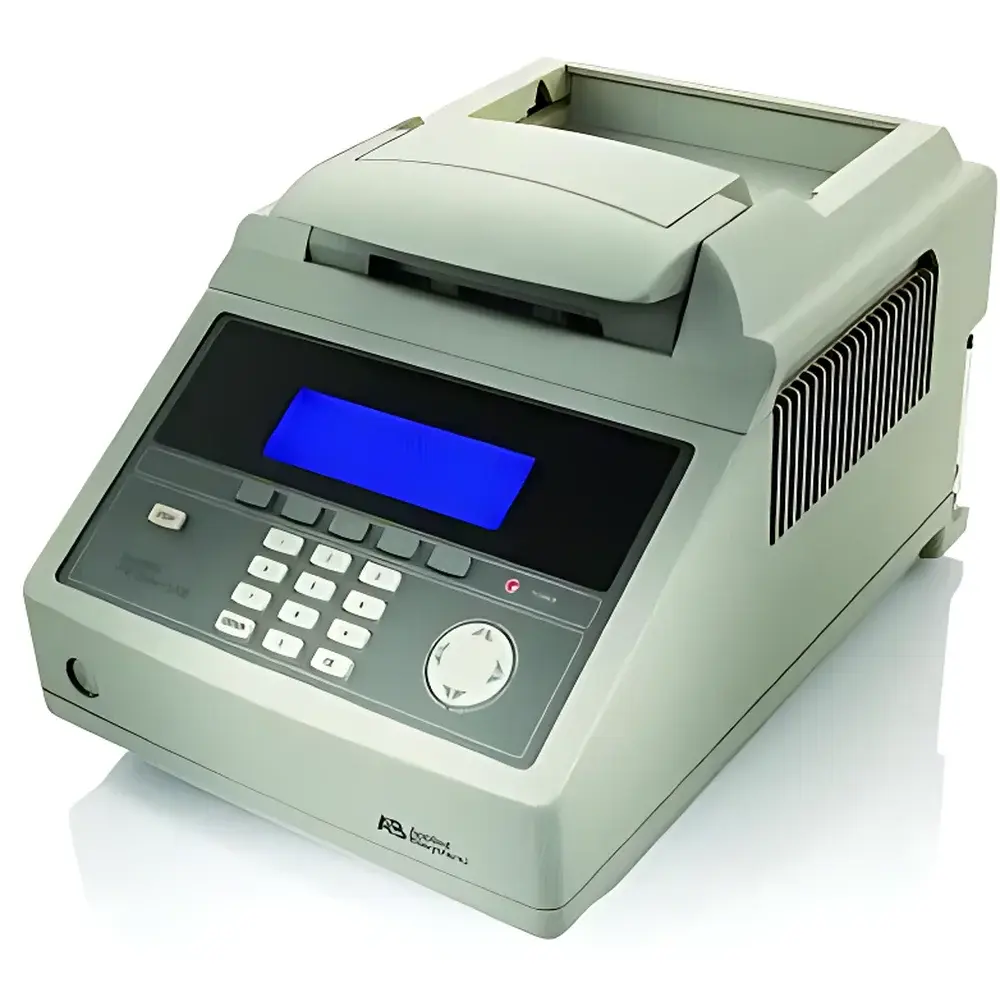
Applied Biosystems GeneAmp® 9700 PCR System
| Brand | Applied Biosystems |
|---|---|
| Model | GeneAmp® 9700 |
| Origin | USA |
| Temperature Accuracy | ±0.25°C (35–100°C) |
| Temperature Range | 4–99°C |
| Ramp Rate | 3.5°C/sec (55–95°C) |
| Block Uniformity | ±0.5°C (35–100°C, 30 sec hold) |
| Heat Lid Temperature | 105°C |
| Display Resolution | 0.1°C (computed sample temperature) |
| Dimensions | 40.6 × 30 × 26 cm |
| Weight | 12.7 kg |
| Sample Formats | Interchangeable blocks — 60-well (0.5 mL), 96-well (0.2 mL), dual 96-well, dual 384-well |
| Software | GeneAmp 9700 Network Software (multi-instrument control) |
| Compliance | Designed for GLP/GMP environments |
Overview
The Applied Biosystems GeneAmp® 9700 PCR System is a high-performance, modular thermal cycler engineered for precision nucleic acid amplification across diverse research, clinical, and quality control applications. Based on Peltier-driven solid-state heating and cooling technology, the system delivers rapid, reproducible thermal transitions essential for stringent PCR protocols—including touchdown, gradient-free two-step, and long-range amplification. Its core architecture centers on a thermally optimized aluminum block with active heat-sink regulation and real-time feedback control, ensuring stable thermal profiles even during extended cycling. Unlike fixed-block instruments, the GeneAmp 9700 implements a user-swappable block design, enabling seamless adaptation between common microplate formats without hardware recalibration or firmware modification. This modularity supports laboratory scalability and method harmonization across assay development, validation, and routine testing workflows.
Key Features
- Interchangeable thermal blocks: Supports 60-well (0.5 mL), standard 96-well (0.2 mL), dual 96-well, and dual 384-well configurations—each block engineered for optimal thermal mass distribution and contact uniformity.
- High-fidelity temperature control: Achieves ±0.25°C accuracy across 35–100°C and ±0.5°C uniformity over the full block surface within 30 seconds of setpoint stabilization.
- Intuitive graphical interface: 7-inch VGA touchscreen with context-sensitive soft keys and real-time cycle progress visualization—including dynamic temperature trace overlay and elapsed time estimation.
- Programmable heat lid: Maintains a consistent 105°C lid temperature to prevent condensation and eliminate the need for mineral oil overlay—critical for low-volume reactions and automated liquid handling integration.
- Network-capable architecture: GeneAmp 9700 Network Software enables centralized scheduling, remote monitoring, and synchronized protocol execution across up to 16 instruments via Ethernet (TCP/IP).
- Robust mechanical design: All blocks feature corrosion-resistant anodized aluminum or gold-plated surfaces; thermal interfaces are validated for >100,000 cycle durability under ISO 13485-aligned stress testing.
Sample Compatibility & Compliance
The GeneAmp 9700 accommodates standard PCR consumables—including skirted and unskirted 96-well plates, 0.2 mL strip tubes, and individual 0.5 mL tubes—without adapter requirements. Block-specific thermal calibration files are embedded in firmware and auto-loaded upon block insertion, preserving traceability per ISO/IEC 17025 clause 6.4.2. The system meets electrical safety standards IEC 61010-1 and EMC compliance per FCC Part 15 Class A. When operated with validated software extensions and connected to a 21 CFR Part 11–compliant data archive (e.g., LabWare LIMS or Thermo Fisher SampleManager), the platform supports audit-trail generation, electronic signatures, and role-based access control—fulfilling key requirements for GLP, GCP, and regulated QC environments.
Software & Data Management
GeneAmp 9700 Network Software (v3.2+) provides a Windows-based client-server framework supporting multi-user login, protocol versioning, and instrument status dashboards. Each run logs timestamped metadata—including block serial number, firmware revision, ambient temperature, and thermal profile deviation metrics—to a local SQLite database. Export options include CSV, XML, and PDF reports with digital signature fields. Raw thermal data (time vs. temperature per well position) is retained for retrospective analysis and root-cause investigation. The software architecture permits integration with enterprise systems via HL7 or RESTful API adapters, enabling automatic result forwarding to ELN platforms such as Benchling or LabArchives.
Applications
- High-fidelity DNA amplification for Sanger sequencing template preparation
- Quantitative endpoint PCR in gene expression screening and SNP genotyping
- Pre-NGS library amplification requiring minimal bias and high duplication fidelity
- Diagnostic assay development under CLIA-waived or CAP-accredited conditions
- Process validation studies where thermal reproducibility must meet ASTM E2500-13 criteria for equipment qualification
- Education and core facility deployment where format flexibility and multi-user scheduling are operational priorities
FAQ
What block types are supported natively without firmware updates?
The system supports four factory-calibrated block configurations: 60-well (0.5 mL), 96-well (0.2 mL aluminum or gold-plated), dual 96-well, and dual 384-well. No firmware update is required upon physical block replacement.
Does the GeneAmp 9700 support gradient PCR?
No—this model does not incorporate thermal gradient capability. For gradient applications, consider the Veriti® or ProFlex™ series.
Can the instrument be validated for GMP use?
Yes—when paired with documented IQ/OQ protocols (available from third-party vendors), calibrated reference thermometers (e.g., Fluke 1524), and 21 CFR Part 11–enabled software extensions, it satisfies equipment qualification requirements per Annex 15 and USP .
Is remote diagnostics supported?
Basic remote status polling and error log retrieval are enabled via SNMP v2c; advanced diagnostics require on-site service technician access using proprietary diagnostic utilities.
What is the maximum ramp rate achievable across all blocks?
The specified 3.5°C/sec applies only to the 96-well 0.2 mL aluminum block under defined ambient conditions (20–25°C). Ramp rates decrease by ~12–18% with higher-mass blocks (e.g., dual 384-well) due to thermal inertia constraints.
Related Products