
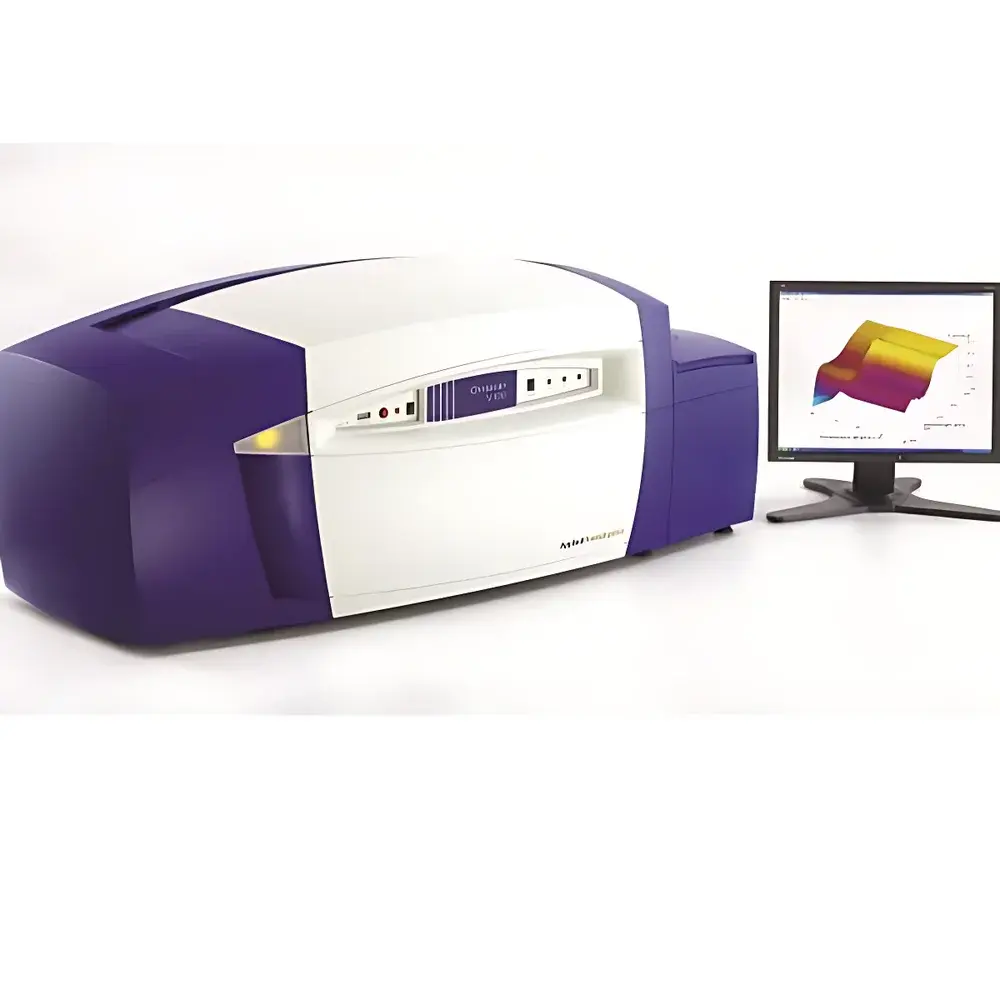
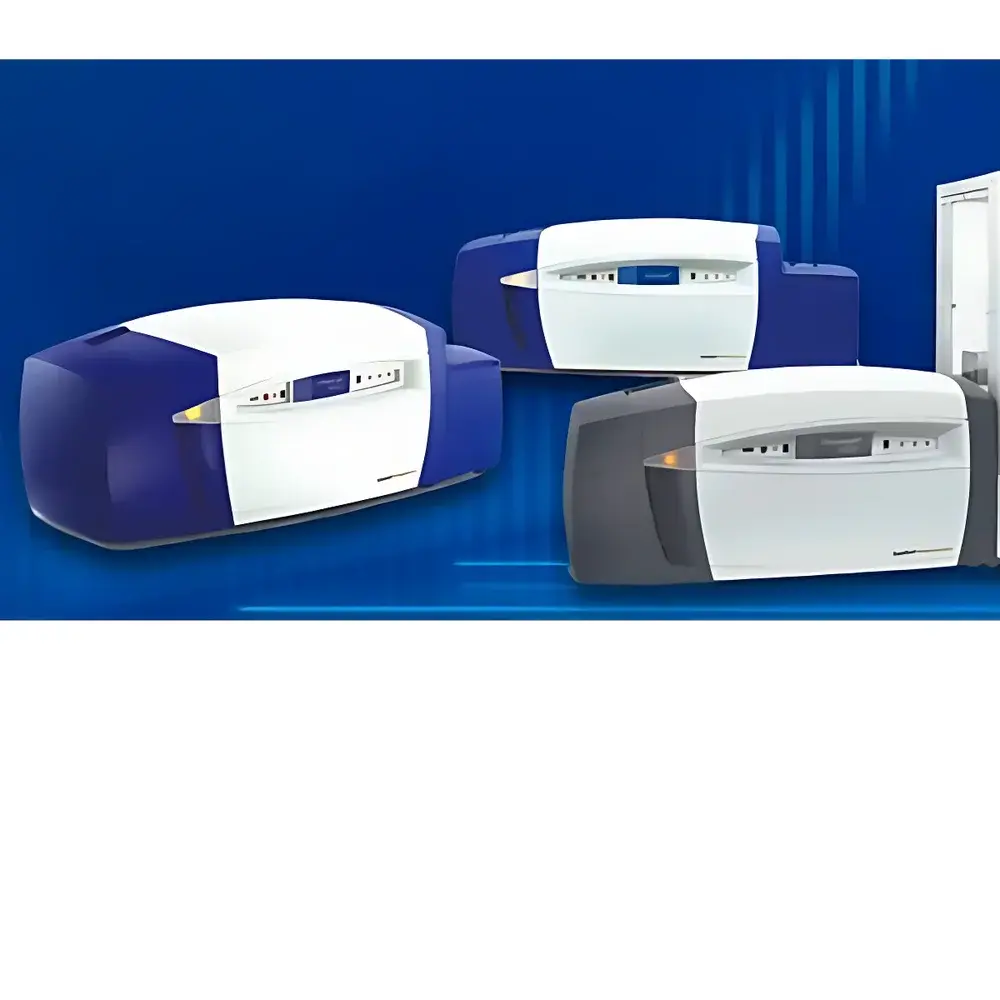
Applied Photophysics Chirascan Circular Dichroism Spectrometer
| Brand | Applied Photophysics |
|---|---|
| Origin | United Kingdom |
| Instrument Type | Circular Dichroism (CD) Spectrometer |
| Model Designation | Chirascan |
| Compliance | CE, UKCA |
| Optical Path | Dual-beam, photoelastic modulator (PEM)-based |
| Wavelength Range | 170–900 nm |
| Temperature Control Range | −40 °C to +120 °C (with optional cryostat & Peltier units) |
| Data Acquisition Rate | Up to 500 points/sec |
| Signal-to-Noise Ratio | <0.005 mdeg (at 220 nm, 1 nm bandwidth, 1 s time constant) |
Overview
The Applied Photophysics Chirascan Circular Dichroism (CD) Spectrometer is a high-performance, dual-beam CD instrument engineered for precision structural analysis of chiral biomolecules and synthetic compounds in solution. Based on the fundamental principle of differential absorption of left- and right-circularly polarized light, the Chirascan employs a photoelastic modulator (PEM) to rapidly alternate polarization states, enabling accurate, real-time measurement of ellipticity (in millidegrees, mdeg) across the far-UV to near-IR spectral range (170–900 nm). Its optical architecture minimizes stray light and photomultiplier tube (PMT) noise, delivering exceptional signal-to-noise performance—critical for low-concentration protein samples, membrane-bound systems, or weakly absorbing chiral small molecules. Designed for rigorous academic and industrial research environments, the Chirascan meets the metrological demands of quantitative secondary structure estimation, folding thermodynamics, and ligand-binding kinetics under controlled thermal, chemical, or temporal conditions.
Key Features
- Dual-beam optical design with automatic baseline correction and real-time reference monitoring
- High-stability PEM operating at resonant frequency (50 kHz) for optimal modulation depth and long-term phase stability
- Integrated temperature control module supporting Peltier-based operation from −40 °C to +120 °C; compatible with liquid nitrogen cryostats for sub-ambient studies
- Modular platform supporting seamless integration of auxiliary techniques: UV-Vis absorption, fluorescence emission, fluorescence anisotropy, magnetic CD (MCD), optical rotatory dispersion (ORD), and circularly polarized luminescence (CPL)
- Stopped-flow and titration accessories enabling millisecond-resolved kinetic measurements and equilibrium binding analysis
- Automated sample changers (up to 96-position) and robotic liquid handling interfaces for high-throughput screening in drug discovery workflows
Sample Compatibility & Compliance
The Chirascan accommodates standard 0.1–10 mm pathlength quartz cuvettes—including microvolume cells (as low as 5 µL), capillary flow cells, and solid-sample holders for film or crystal measurements. It supports aqueous, organic, and mixed-solvent systems across pH 1–14, with compatibility for aggressive denaturants (e.g., guanidine HCl, urea), detergents (e.g., SDS, DPC), and reducing agents. All firmware and data acquisition software comply with Good Laboratory Practice (GLP) and Good Manufacturing Practice (GMP) documentation requirements. Audit trails, electronic signatures, and user-access controls align with FDA 21 CFR Part 11 and ISO/IEC 17025 standards. Instrument calibration is traceable to NIST-certified quartz standards and validated per ASTM E289–22 (Standard Test Method for Calibration of Circular Dichroism Spectrometers).
Software & Data Management
Chirascan instruments operate via the proprietary CDControl™ software suite, providing intuitive method setup, live spectral visualization, and automated data reduction pipelines. The software includes built-in algorithms for secondary structure deconvolution (e.g., CONTIN/LL, SELCON3, CDSSTR), thermal melt analysis (Tm, ΔH, ΔG), and global fitting of multi-wavelength kinetic datasets. Raw data are stored in vendor-neutral, ASCII-compatible formats (.txt, .csv) alongside metadata-rich XML headers containing instrument configuration, environmental logs, and operator annotations. Integration with third-party platforms—including MATLAB, Python (via PyChirascan API), and commercial data analysis suites (OriginLab, GraphPad Prism)—ensures reproducibility and interoperability within institutional data management frameworks.
Applications
- Quantitative determination of α-helix, β-sheet, and random coil content in proteins and peptides
- Monitoring conformational transitions during thermal, chemical, or pressure-induced denaturation
- Characterizing nucleic acid secondary structures (A-, B-, Z-DNA; G-quadruplexes; RNA hairpins)
- Enantioselective binding assays for chiral pharmaceuticals, catalysts, and supramolecular hosts
- Time-resolved studies of protein folding intermediates using stopped-flow CD
- Structural validation of biologics (mAbs, Fc-fusions, bispecifics) in formulation development
- Chirality assessment of metal–organic frameworks (MOFs), polymeric nanoparticles, and chiral nanomaterials
FAQ
What is the minimum sample concentration required for reliable CD measurements?
For typical globular proteins in the far-UV region (190–250 nm), concentrations of 0.02–0.2 mg/mL in 0.1–0.2 mm pathlength cells yield robust signal-to-noise ratios. Lower concentrations are feasible with signal averaging or microvolume accessories.
Can the Chirascan measure membrane proteins solubilized in detergent micelles?
Yes—its extended wavelength range and low-stray-light optics accommodate turbid or scattering samples. Optional polarization scrambling correction and background subtraction routines mitigate artifacts from micellar systems.
Is remote operation supported for unattended overnight experiments?
All Chirascan systems support secure LAN/WAN connectivity via TCP/IP. Scheduled runs, email alerts upon completion, and real-time spectral preview are enabled through CDControl™’s remote client module.
How is instrument performance verified over time?
Routine verification uses NIST-traceable quartz standards and reference proteins (e.g., lysozyme, bovine serum albumin). The software includes automated validation protocols compliant with ISO 9001 internal audit requirements.
Are application notes and peer-reviewed methodology references available?
Applied Photophysics maintains an open-access repository of >120 peer-reviewed protocols, including JACS, Nature Communications, and Analytical Chemistry publications—indexed by sample type, buffer condition, and experimental objective.




