
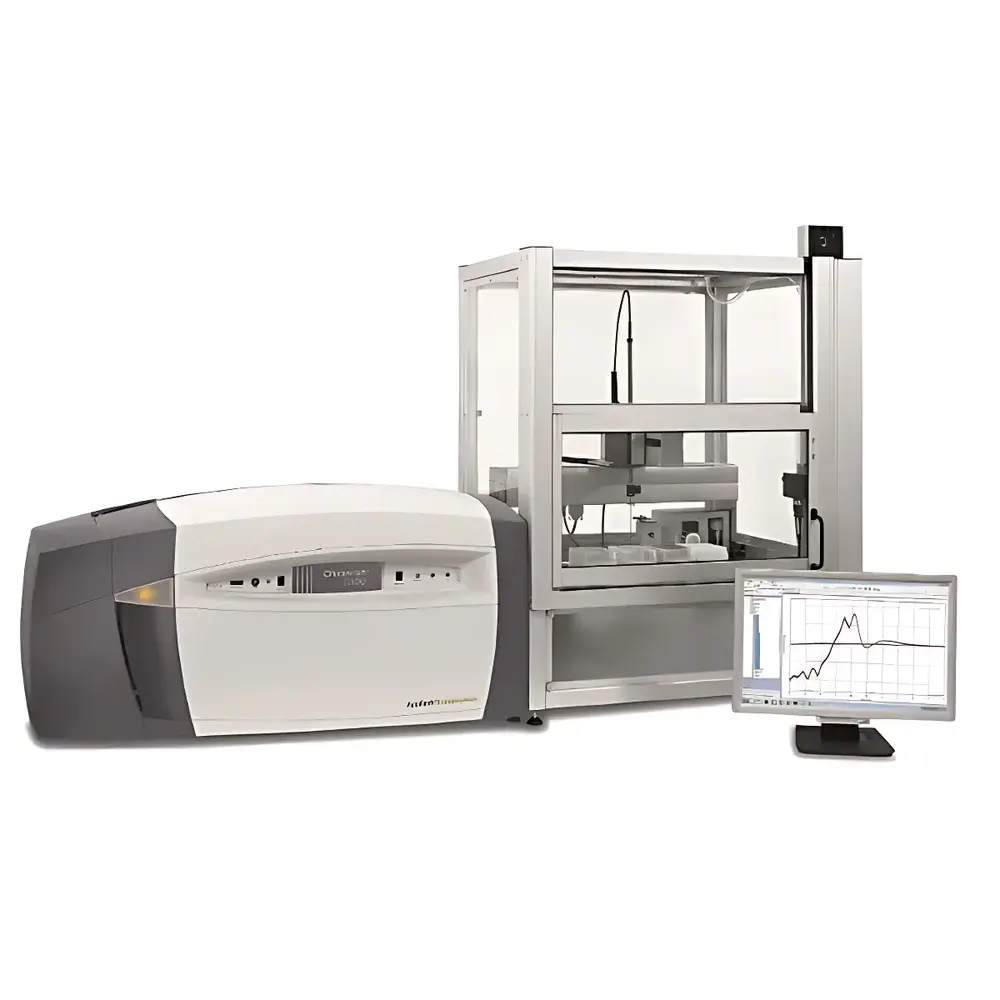
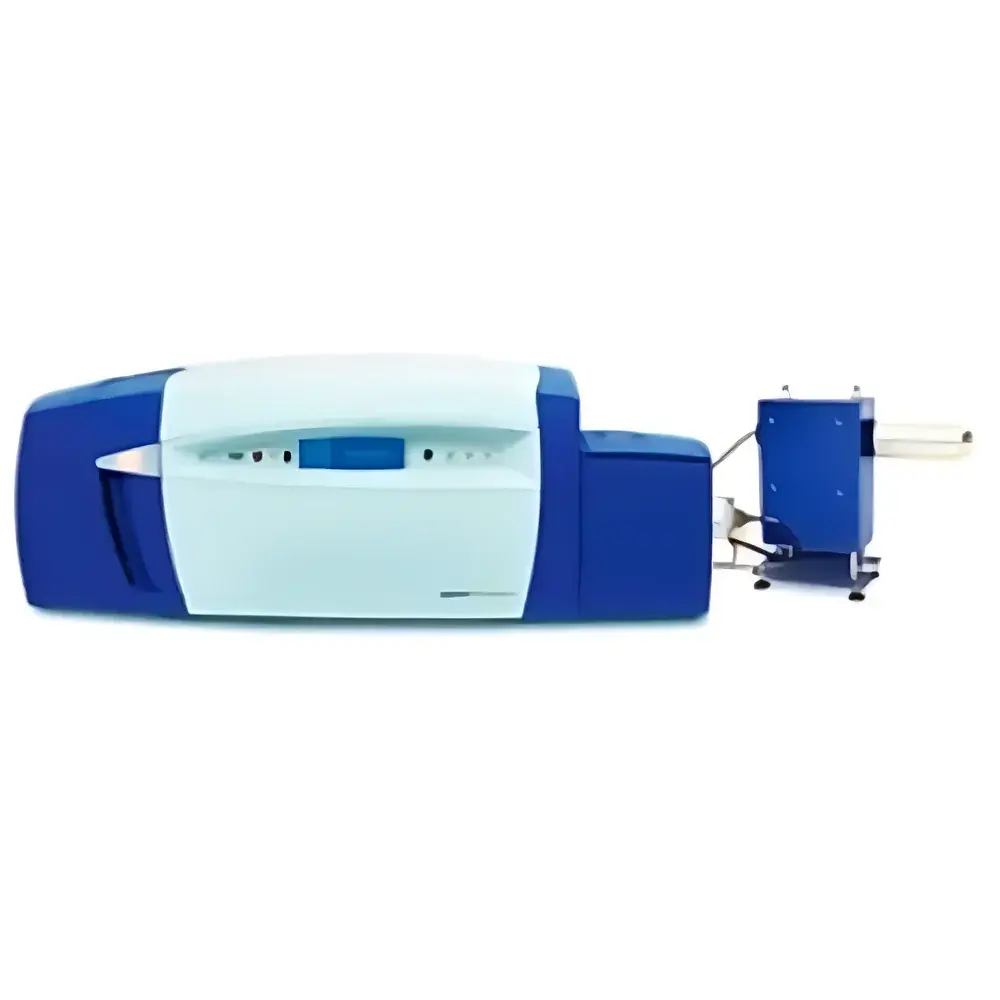
Applied Photophysics Chirascan CPL Circularly Polarized Luminescence Spectrometer
| Brand | Applied Photophysics |
|---|---|
| Origin | United Kingdom |
| Manufacturer Type | Authorized Distributor |
| Product Category | Imported Instrument |
| Model | Chirascan CPL |
| Instrument Type | Circular Dichroism / Circularly Polarized Luminescence Spectrometer |
| Optical Path Configurations | 90° and 180° fluorescence detection modes |
| Excitation Range | 170–900 nm (deep-UV capable with N₂ purge) |
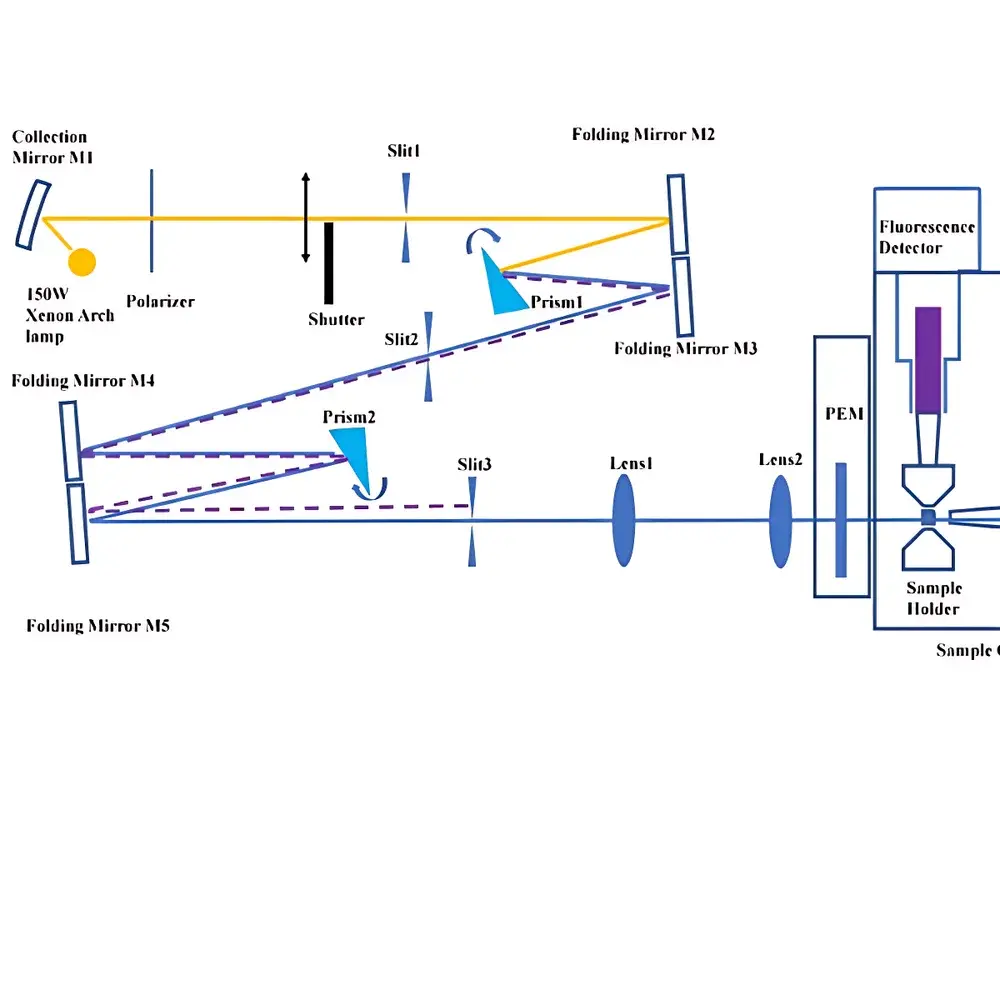
| Monochromator | F/7 double-prism design |
| Polarization Optics | Dual high-fidelity polarization prisms |
| Data Acquisition | Digital signal processing (DSP) architecture with adaptive integration time control |
| Sample Compatibility | Liquids, powders, films, gels, turbid suspensions, and opaque solids |
| Compliance | Designed for GLP/GMP-aligned workflows |
Overview
The Applied Photophysics Chirascan CPL Circularly Polarized Luminescence Spectrometer is a dual-mode, research-grade spectroscopic platform engineered specifically for the quantitative measurement of circularly polarized luminescence (CPL) and complementary circular dichroism (CD) signals. Unlike conventional CD spectrometers—which probe differential absorption of left- and right-circularly polarized light in chiral ground states—the Chirascan CPL system captures the enantioselective emission characteristics of excited-state chiral luminophores. This capability enables direct interrogation of stereochemical integrity, conformational dynamics, and exciton coupling in emissive chiral systems under photoexcitation. Built upon the proven optical architecture of the Chirascan CD platform, the CPL variant integrates purpose-designed polarization optics, deep-UV-optimized excitation pathways, and a fully digital signal acquisition chain to deliver high-fidelity, reproducible CPL spectra across the 170–900 nm range. Its modular design supports both solution-phase and solid-state measurements without optical reconfiguration, making it suitable for academic laboratories, pharmaceutical R&D groups, and materials science facilities engaged in chiral optoelectronics or asymmetric photocatalysis.
Key Features
- Dual optical path configuration: Selectable 90° (front-face) or 180° (transmission) detection geometry—optimized for low-Raleigh-scatter CPL measurement of opaque, scattering, or highly absorbing samples including powders, inks, thin films, and biological aggregates.
- F/7 double-prism monochromator: Delivers high photon throughput and spectral resolution across UV-Vis-NIR, enabling enhanced signal-to-noise ratio (SNR) even at low quantum yield conditions.
- High-fidelity dual polarization prism assembly: Minimizes depolarization artifacts and extends usable bandwidth while maintaining >99.5% polarization purity across the operational spectrum.
- Digital signal processing (DSP) core: Replaces legacy analog filtering with real-time, distortion-free digitization and adaptive integration time control—automatically extending dwell time for weak emitters and shortening it for intense signals.
- Deep-UV excitation capability: Achieves stable operation down to 170 nm using segmented nitrogen purging—reducing gas consumption by up to 40% versus continuous purge systems while maintaining baseline stability.
- Modular external source interface: Standard SMA and kinematic mounts allow seamless integration of tunable lasers, pulsed LEDs, or supercontinuum sources for time-resolved or wavelength-selective excitation studies.
- Front-surface solid-sample stage with adjustable incidence angle: Enables precise alignment and stray-light suppression for heterogeneous or rough-surfaced solids.
Sample Compatibility & Compliance
The Chirascan CPL accommodates a broad spectrum of sample formats without compromise: aqueous or organic solutions in quartz cuvettes; lyophilized or crystalline powders on reflective substrates; spin-coated polymer films; hydrogels; and turbid colloidal dispersions. Its 90° front-face geometry eliminates transmission path limitations imposed by sample opacity or absorption coefficient, ensuring quantitative CPL intensity calibration across material classes. All firmware and optional data management modules are developed in alignment with Good Laboratory Practice (GLP) and current Good Manufacturing Practice (cGMP) expectations. When deployed with validated software configurations, the system supports full 21 CFR Part 11 compliance—including electronic signatures, audit trails, user access controls, and immutable raw data archiving—making it suitable for regulated environments such as pharmaceutical chiral assay development or QC release testing of enantiopure emitters.
Software & Data Management
Controlled via the proprietary CDPro-CPL software suite, the instrument provides intuitive method setup, real-time spectral preview, and batch-processing workflows. Raw intensity data (IL, IR) and derived CPL dissymmetry factors (glum = 2(IL − IR)/(IL + IR)) are stored in vendor-neutral HDF5 format, ensuring long-term readability and interoperability with third-party analysis tools (e.g., Python-based spectral deconvolution or machine learning pipelines). The software includes built-in baseline correction algorithms, polarization artifact compensation routines, and reference-standard normalization protocols traceable to NIST-certified chiral standards. Optional modules enable automated temperature-controlled stage synchronization, kinetic CPL mapping, and multi-dimensional correlation analysis (e.g., excitation-emission-CPL matrices).
Applications
The Chirascan CPL serves critical functions in multiple advanced research domains: characterization of chiral lanthanide complexes for circularly polarized OLEDs; mechanistic studies of asymmetric photocatalytic reactions involving triplet excited states; structural validation of chiral supramolecular assemblies in solution and thin-film phases; development of CPL-active bio-probes for enantioselective cellular imaging; and fundamental investigation of exciton chirality transfer in π-conjugated polymers. Its ability to resolve subtle glum values (±10−5 sensitivity under optimized conditions) supports structure–property correlation studies essential to next-generation chiral photonic materials.
FAQ
What is the minimum detectable glum value under standard operating conditions?
Typical instrumental sensitivity is ±2 × 10⁻⁴ for 1 mM solutions of benchmark Eu(III) complexes measured at 2 nm bandwidth and 1 s integration per point.
Can the system perform simultaneous CD and CPL measurements?
No—CD and CPL modes require distinct optical configurations and detector alignments; however, rapid mode switching (<60 s) and shared sample positioning ensure consistent comparative analysis.
Is nitrogen purging mandatory for deep-UV operation?
Yes—operation below 190 nm requires inert atmosphere purging; the segmented purge design minimizes gas usage while maintaining optical path integrity.
Does the system support time-resolved CPL measurements?
Not natively—but the external source interface and TTL-triggered acquisition allow integration with nanosecond/picosecond laser systems for gated detection when paired with compatible detectors.
Are calibration standards provided with the instrument?
A set of traceable chiral reference compounds (including [Eu(hfc)3] and sodium ammonium tartrate) is included for g-factor validation and system performance verification.



