
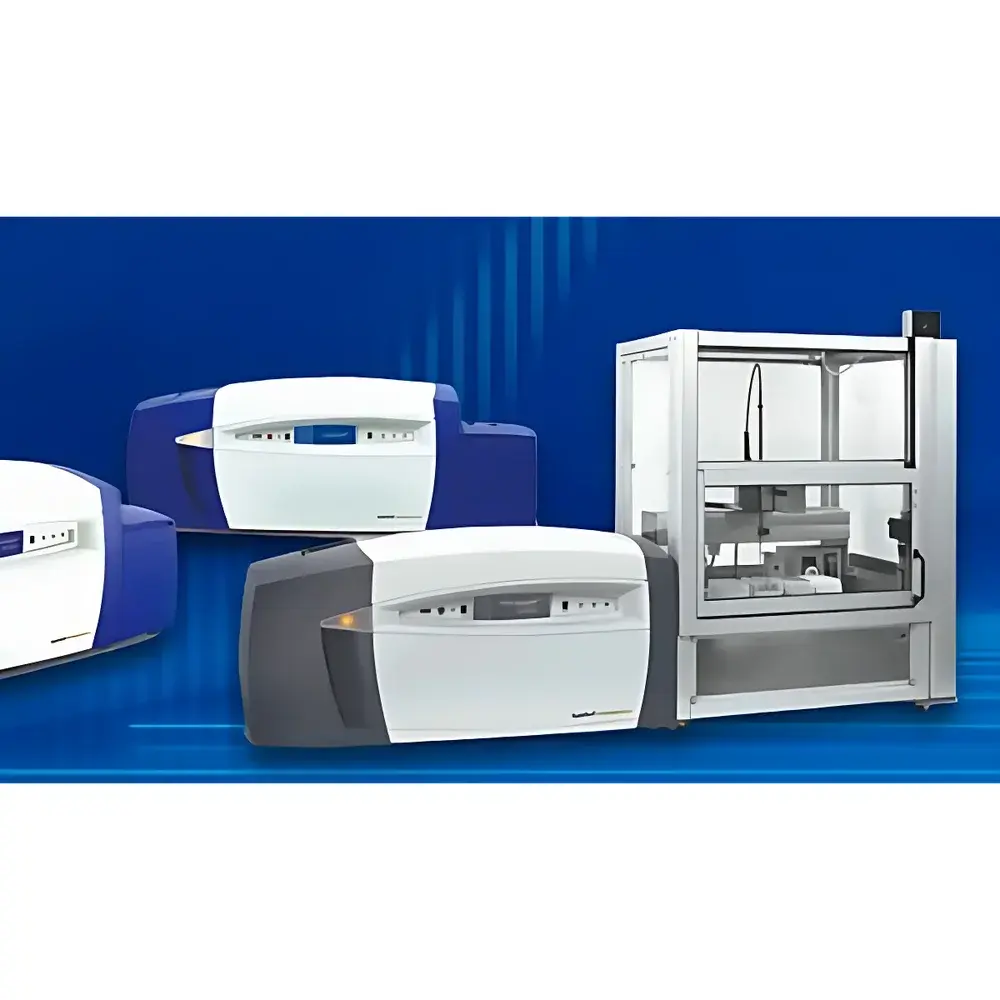
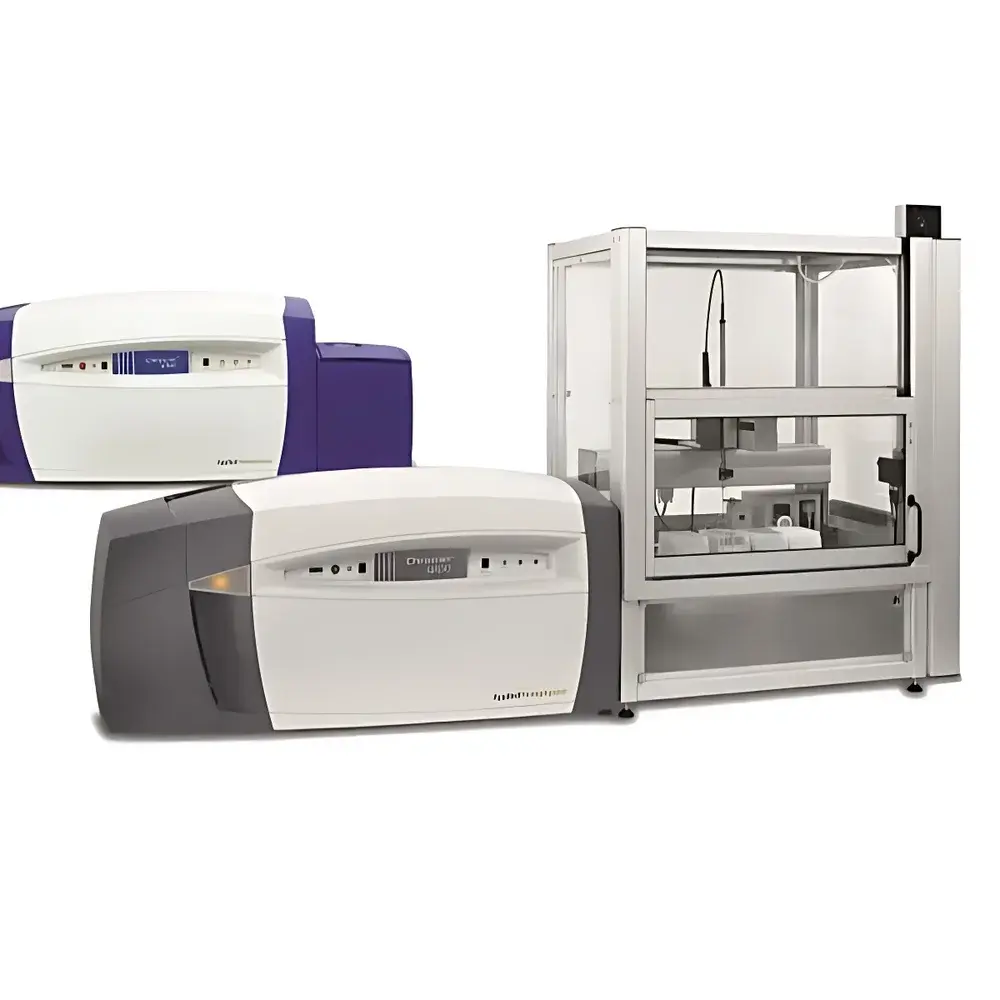
Applied Photophysics Chirascan Q100 CD Automated Circular Dichroism Spectrometer
| Brand | Applied Photophysics |
|---|---|
| Origin | United Kingdom |
| Instrument Type | Circular Dichroism (CD) Spectrometer |
| Model | Chirascan Q100 CD |
| Detection Range | 170–1700 nm |
| Optical Design | Dual Rochon Prism Monochromator |
| Detector Options | LAAPD (1200 nm), InGaAs (up to 1700 nm) |
| Automation Level | Fully Integrated, Unattended Operation |
| Compliance | Designed for GLP/GMP-aligned biophysical characterization |
Overview
The Applied Photophysics Chirascan Q100 CD Automated Circular Dichroism Spectrometer is a high-performance, research-grade instrument engineered for quantitative analysis of biomolecular secondary and tertiary structure in solution. It operates on the fundamental principle of circular dichroism—measuring the differential absorption of left- and right-circularly polarized light—as a direct probe of chiral asymmetry in proteins, peptides, nucleic acids, and synthetic chiral molecules. Its dual Rochon prism monochromator architecture delivers superior photon flux across an exceptionally broad spectral range (170–1700 nm), enabling robust signal-to-noise performance in both far-UV (170–250 nm) for α-helix/β-sheet quantification and near-UV/visible (250–320 nm) for aromatic side-chain and disulfide bond environments. Extended-range detection—via liquid nitrogen-cooled avalanche photodiode (LAAPD) and thermoelectrically cooled InGaAs detectors—supports advanced applications including temperature-dependent CD (thermal denaturation), ligand-binding stoichiometry, and structural monitoring of membrane proteins in detergent micelles or nanodiscs.
Key Features
- Fully automated sample handling with programmable Peltier-controlled cuvette holder (±0.1 °C stability) supporting temperature ramps from −10 °C to +110 °C
- High-throughput capability: integrated 96-well plate reader option with microvolume pathlength correction algorithms
- Dual-detector architecture enabling seamless spectral stitching without manual intervention or hardware reconfiguration
- Real-time signal averaging with adaptive integration time control to maintain optimal signal dynamic range across wavelength sweeps
- Optical path purged with nitrogen or argon to eliminate ozone absorption below 190 nm, ensuring fidelity in far-UV measurements
- Modular design compliant with ISO 9001 manufacturing standards; all optical components traceably calibrated against NIST-traceable reference materials
Sample Compatibility & Compliance
The Chirascan Q100 CD accommodates standard quartz cuvettes (0.1–10 mm pathlength), capillaries, and custom flow cells for kinetic studies. It supports aqueous buffers, organic solvents (e.g., TFE, acetonitrile), and viscous formulations common in biopharmaceutical development—including monoclonal antibodies, fusion proteins, and peptide therapeutics. Data acquisition and processing workflows are structured to support regulatory submissions under ICH Q5E, USP , and FDA 21 CFR Part 11 requirements. Audit trails, electronic signatures, and version-controlled method templates are natively supported through the CDControl software suite, facilitating GLP and GMP audit readiness. Instrument qualification documentation (IQ/OQ/PQ protocols) is provided per ASTM E2500-13 guidelines.
Software & Data Management
CDControl v5.x provides a validated, Windows-based platform for method development, real-time visualization, and post-acquisition analysis. It includes built-in algorithms for secondary structure deconvolution (e.g., CONTIN/LL, SELCON3, CDSSTR), thermal melt curve fitting (two-state, three-state, or empirical sigmoid models), and baseline correction using polynomial or spline interpolation. Raw data are stored in vendor-neutral .cd format (ASCII-based, self-documenting metadata headers), fully compatible with third-party tools such as MATLAB, Python (via cdtools library), and commercial packages like OriginLab and GraphPad Prism. All processing steps—including smoothing, buffer subtraction, and unit conversion (mdeg → Δε)—are logged with timestamps and operator IDs to ensure full traceability.
Applications
- Structural comparability assessment in biosimilar development (ICH Q5B/Q5E)
- Thermal and chemical denaturation profiling (Tm, ΔH, Cm) for candidate selection and formulation optimization
- Monitoring conformational changes during refolding, aggregation, or ligand titration experiments
- Validation of cryo-EM or X-ray crystallography-derived models via solution-phase structural constraints
- Quality control of therapeutic proteins across manufacturing batches (release testing per USP )
- Characterization of non-natural polymers and chiral nanomaterials where conventional spectroscopic methods lack sensitivity
FAQ
What is the minimum sample volume required for far-UV CD measurements?
Typical far-UV measurements (190–250 nm) require 300–400 µL in a 0.1-mm pathlength cell; volume can be reduced to 120 µL using microcuvettes with enhanced optical alignment.
Can the Chirascan Q100 CD perform time-resolved CD experiments?
Yes—when coupled with an optional stopped-flow accessory (SF-61DX), it achieves millisecond time resolution for folding/unfolding kinetics and photo-induced conformational transitions.
Is the instrument suitable for regulated biopharmaceutical laboratories?
Yes—the system meets key elements of 21 CFR Part 11, including role-based access control, electronic signatures, and immutable audit trails; validation support packages are available upon request.
How is detector switching managed across the 170–1700 nm range?
Automatic detector selection is triggered by wavelength thresholds; transition points are pre-calibrated and include overlap regions for intensity normalization to ensure spectral continuity.
Does the software support batch processing of multiple spectra for comparability studies?
Yes—CDControl includes a dedicated “Comparability Module” that computes root-mean-square deviation (RMSD), correlation coefficients, and confidence intervals across datasets, aligned to ICH Q5E statistical guidance.




