
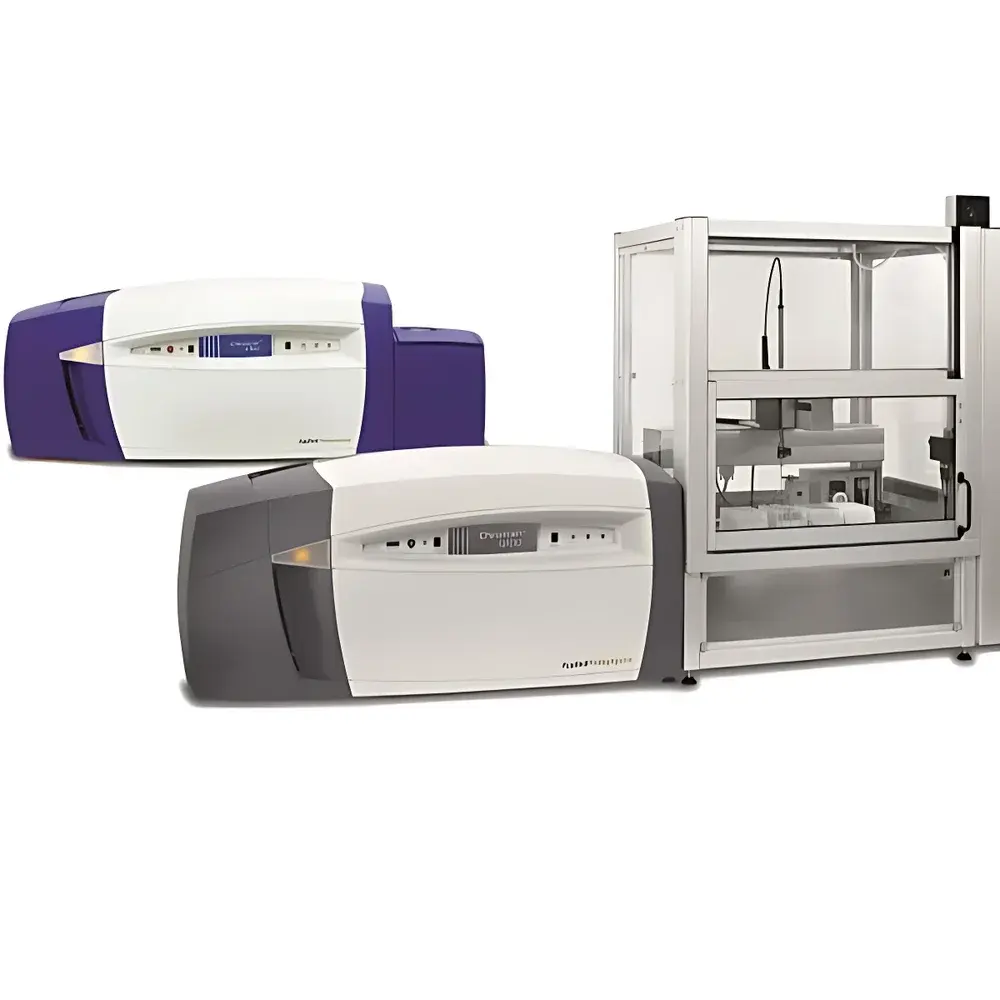
Applied Photophysics Chirascan V100 Circular Dichroism Spectrometer
| Brand | Applied Photophysics |
|---|---|
| Origin | United Kingdom |
| Manufacturer Type | Authorized Distributor |
| Product Category | Imported Instrument |
| Model | Chirascan V100 |
| Instrument Type | Circular Dichroism (CD) Spectrometer |
| Price Range | USD 170,000 – 390,000 (estimated FOB UK) |
Overview
The Applied Photophysics Chirascan V100 Circular Dichroism (CD) Spectrometer is a high-performance, research-grade instrument engineered for quantitative analysis of chiral molecular structure and conformational dynamics in solution. Based on the fundamental principle of differential absorption of left- and right-circularly polarized light, the Chirascan V100 delivers high signal-to-noise ratio CD spectra across the far-UV to near-UV/visible range (typically 168–750 nm), enabling rigorous characterization of secondary and tertiary structures in biomacromolecules—including proteins, peptides, nucleic acids, and synthetic chiral compounds. Designed and manufactured in the UK by Applied Photophysics Ltd—a company co-founded in 1971 by Nobel Laureate Professor George Porter—the Chirascan platform represents over five decades of continuous innovation in CD instrumentation architecture, optical stability, and polarization modulation fidelity. The V100 iteration integrates modern optomechanical design with thermally stable optics, low-stray-light monochromators, and precision photomultiplier tube (PMT) detection to ensure reproducible, artifact-free spectral acquisition under both static and time-resolved experimental conditions.
Key Features
- High-throughput dual-beam optical path with real-time polarization modulation via photoelastic modulator (PEM), minimizing baseline drift and enhancing measurement accuracy
- Extended spectral range: 168–750 nm (far-UV capability enabled by vacuum-purged or nitrogen-flushed optical compartment)
- Temperature-controlled sample compartment supporting Peltier-based units (±0.1 °C stability) and optional cryostat integration down to –40 °C
- Modular architecture allowing seamless integration of auxiliary techniques: UV-Vis absorption, fluorescence intensity, fluorescence anisotropy, magnetic CD (MCD), optical rotatory dispersion (ORD), and circularly polarized luminescence (CPL)
- Stopped-flow and titration accessories compatible with kinetic CD measurements (millisecond to hour timescales)
- Automated high-throughput sampling via 96-well plate handler or syringe-driven liquid handling systems for screening applications
Sample Compatibility & Compliance
The Chirascan V100 accommodates standard quartz cuvettes (pathlengths from 0.1 mm to 10 mm), capillary cells, and microvolume cells (down to 5 µL volume). It supports aqueous, organic, and mixed solvent systems—subject to optical transmission constraints in the far-UV region. Instrument operation complies with ISO/IEC 17025 general requirements for competence of testing and calibration laboratories. Data acquisition and processing workflows align with GLP and GMP expectations for structural biophysics studies, including full audit trail support, electronic signature capability, and metadata-rich file export (e.g., ASCII, JCAMP-DX, CSV). While not FDA 21 CFR Part 11-certified out-of-the-box, the system can be validated per user-defined SOPs for regulated environments such as pharmaceutical preclinical development.
Software & Data Management
Controlled via the proprietary CDTools software suite (Windows-based), the Chirascan V100 provides intuitive experiment setup, real-time spectral preview, automated baseline correction, and batch-processing capabilities. CDTools supports advanced data analysis including secondary structure deconvolution (e.g., CONTINLL, SELCON3, CDSSTR algorithms), thermal denaturation curve fitting, and global kinetic modeling. All raw and processed data are stored with embedded instrument configuration metadata, timestamping, and user-defined annotations. Export formats include publication-ready vector graphics (SVG, EPS), tabular data for third-party statistical packages (R, Python, Origin), and interoperable spectral databases compliant with IUPAC-recommended conventions.
Applications
- Protein folding/unfolding thermodynamics and kinetics
- Secondary structure quantification (α-helix, β-sheet, random coil) in recombinant and native proteins
- Conformational changes induced by ligand binding, pH shifts, or post-translational modifications
- Chirality assessment of small-molecule pharmaceutical candidates and asymmetric synthesis intermediates
- Structural stability profiling of monoclonal antibodies and biosimilars
- Mechanistic studies of DNA–ligand interactions, G-quadruplex formation, and RNA folding pathways
- Characterization of metalloprotein coordination geometry and redox-state-dependent structural transitions
FAQ
What is the minimum sample concentration required for reliable CD measurement in the far-UV region?
Typical protein concentrations range from 0.02 to 0.5 mg/mL in 0.1–1 mm pathlength cells, depending on molecular weight and extinction coefficient.
Can the Chirascan V100 perform time-resolved CD measurements?
Yes—when coupled with stopped-flow or rapid mixing accessories, it achieves millisecond temporal resolution for folding/unfolding kinetics.
Is remote operation supported?
Instrument control and monitoring are possible via local network; however, direct cloud-based remote access is not natively implemented and requires site-specific IT infrastructure validation.
Does the system support compliance with pharmacopeial methods (e.g., USP )?
While no single pharmacopeia monograph mandates CD specifically, the Chirascan V100 meets technical criteria outlined in USP for spectroscopic method validation when configured and qualified per laboratory SOPs.
What maintenance intervals are recommended for optimal long-term performance?
Annual optical alignment verification, biannual PEM recalibration, and routine cleaning of cuvette holders and purge lines are advised per the manufacturer’s service schedule.





