
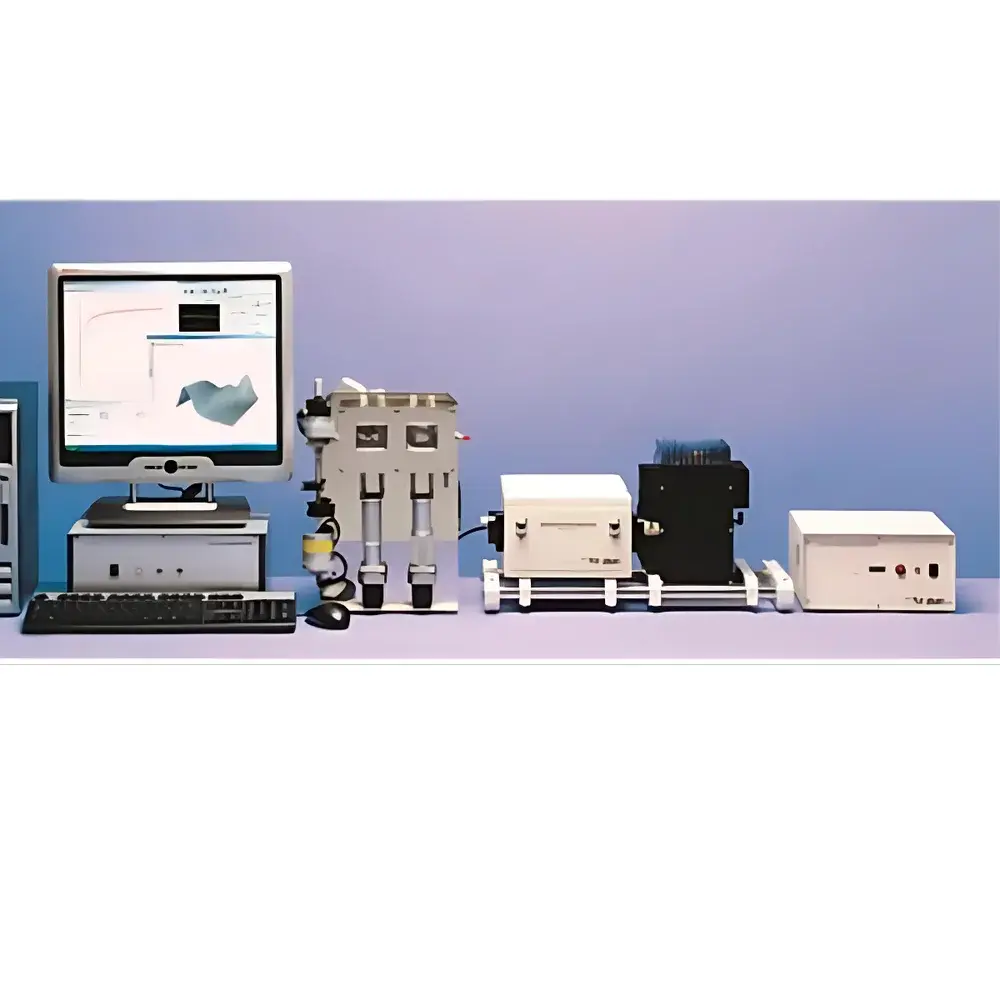
Applied Photophysics SX20 Stopped-Flow Absorption and Fluorescence Spectrometer
| Brand | Applied Photophysics |
|---|---|
| Origin | United Kingdom |
| Model | SX20 |
| Instrument Type | Stopped-Flow CD/Fluorescence/Absorption Spectrometer |
| Compliance | Designed for GLP/GMP-aligned laboratories |
| Software | Pro-Data acquisition and kinetic analysis suite (FDA 21 CFR Part 11 compliant audit trail optional) |
| Detector Options | Photodiode array, dual photomultiplier tubes, fluorescence polarization module, CD-compatible stopped-flow cell |
| Mixing Systems | Single-, double-, or triple-syringe configurations |
| Temperature Control | ±0.1 °C over 5–40 °C range |
| Data Acquisition Rate | Up to 100 kHz (depending on detector configuration) |
Overview
The Applied Photophysics SX20 Stopped-Flow Absorption and Fluorescence Spectrometer is a high-performance, modular kinetic instrument engineered for the quantitative investigation of fast liquid-phase reactions in the millisecond to second timescale. Unlike conventional steady-state spectrometers, the SX20 implements precision stopped-flow methodology—where two or more reactant solutions are rapidly mixed under computer-controlled conditions, then flow is abruptly halted to initiate real-time optical monitoring of transient species formation and decay. The system supports simultaneous or sequential detection across multiple spectral domains: UV-Vis absorption, steady-state and time-resolved fluorescence, fluorescence anisotropy, and circular dichroism (CD) in stopped-flow mode. Its optical architecture integrates high-stability xenon arc or pulsed LED excitation sources, low-stray-light monochromators, and thermoelectrically cooled detectors—enabling high signal-to-noise ratio measurements even for low-concentration biological samples such as enzymes, nucleic acids, and membrane proteins. The SX20 is not a general-purpose spectrophotometer; it is a purpose-built kinetic platform designed for mechanistic elucidation—not endpoint quantification.
Key Features
- Sub-2-millisecond dead time achievable with optimized syringe and mixing geometry, enabling resolution of early reaction intermediates
- Modular optical path design supporting interchangeable detection modes: single-wavelength absorbance, diode-array spectroscopy, dual-channel fluorescence intensity, polarization-resolved fluorescence, and CD-enabled stopped-flow
- Temperature-controlled observation cell (5–40 °C, ±0.1 °C stability) with Peltier-based regulation and integrated calibration verification
- Pro-Data software suite with real-time data visualization, global fitting algorithms (e.g., sequential and parallel kinetic models), residual mapping, and parameter uncertainty estimation
- Compliance-ready configuration options including electronic signatures, full audit trail logging, and 21 CFR Part 11–compliant user access control (optional)
- Expandable fluidics architecture: up to three independent syringes for multi-step mixing protocols (e.g., pre-mixing followed by trigger addition)
Sample Compatibility & Compliance
The SX20 accommodates aqueous and organic solvent-based samples across a broad concentration range (nM to mM), with minimal sample consumption per experiment (typically 30–60 µL per shot). It is routinely deployed for studies of protein folding/unfolding kinetics, enzyme catalytic cycles (including burst-phase analysis), ligand-binding association/dissociation, nucleic acid conformational switching, and photoinduced electron transfer processes. All optical cells—including quartz cuvettes, flow cells, and CD-compatible demountable cells—are traceable to NIST standards and certified for spectral linearity per ISO 17025 requirements. The instrument meets electromagnetic compatibility (EMC) directives (IEC 61326-1) and carries CE marking for laboratory use in the EU. For regulated environments, optional IQ/OQ documentation packages and validation support are available to align with GxP, USP , and ISO/IEC 17025 quality management frameworks.
Software & Data Management
Acquisition and analysis are unified within Pro-Data—a native Windows application developed exclusively for Applied Photophysics kinetic platforms. The software provides synchronized control of fluidics, temperature, excitation source, and detector gating. Kinetic traces are stored in HDF5 format with embedded metadata (timestamp, instrument configuration, calibration references, user annotations). Batch processing supports automated curve fitting using nonlinear least-squares algorithms with user-defined reaction schemes (e.g., A → B → C, or A + B ⇌ AB → P). Export options include CSV, ASCII, and MATLAB-compatible .mat files. Audit trail functionality records all parameter changes, data deletions, and analysis modifications with user ID and timestamp—fully configurable to meet FDA 21 CFR Part 11 and EU Annex 11 requirements when enabled.
Applications
- Pre-steady-state kinetics of serine proteases and kinases, including acylation/deacylation rate constants
- Real-time monitoring of DNA hairpin formation and triplex dissociation under physiological salt conditions
- Time-resolved CD analysis of secondary structural transitions during thermal or chemical denaturation
- Fluorescence anisotropy decay to determine rotational correlation times of protein-ligand complexes
- Multi-wavelength absorbance tracking of heme redox state interconversion in cytochrome c oxidase
- Quench-flow compatible operation for coupling with rapid-freeze sampling and subsequent EPR or cryo-EM analysis
FAQ
What is the minimum observable dead time for the SX20 system?
Typical dead time is 1.2 ms with standard configuration; down to 0.8 ms with low-volume mixing head and optimized tubing.
Can the SX20 perform true time-resolved fluorescence lifetime measurements?
No—it is not a TCSPC or streak-camera system; however, it supports multi-wavelength fluorescence intensity transients with microsecond-level temporal resolution via high-speed digitization.
Is CD detection possible in stopped-flow mode?
Yes—when equipped with the optional CD stopped-flow cell and polarization-modulated optics, enabling real-time secondary structure kinetics.
Does the system support automated cleaning and priming protocols?
Yes—Pro-Data includes programmable fluidic routines for syringe rinsing, line flushing, and cell purging between experiments.
Are service contracts and remote diagnostics available internationally?
Yes—Applied Photophysics offers tiered support plans with remote access capability, on-site engineering visits, and annual performance verification services worldwide.
Related Products





