
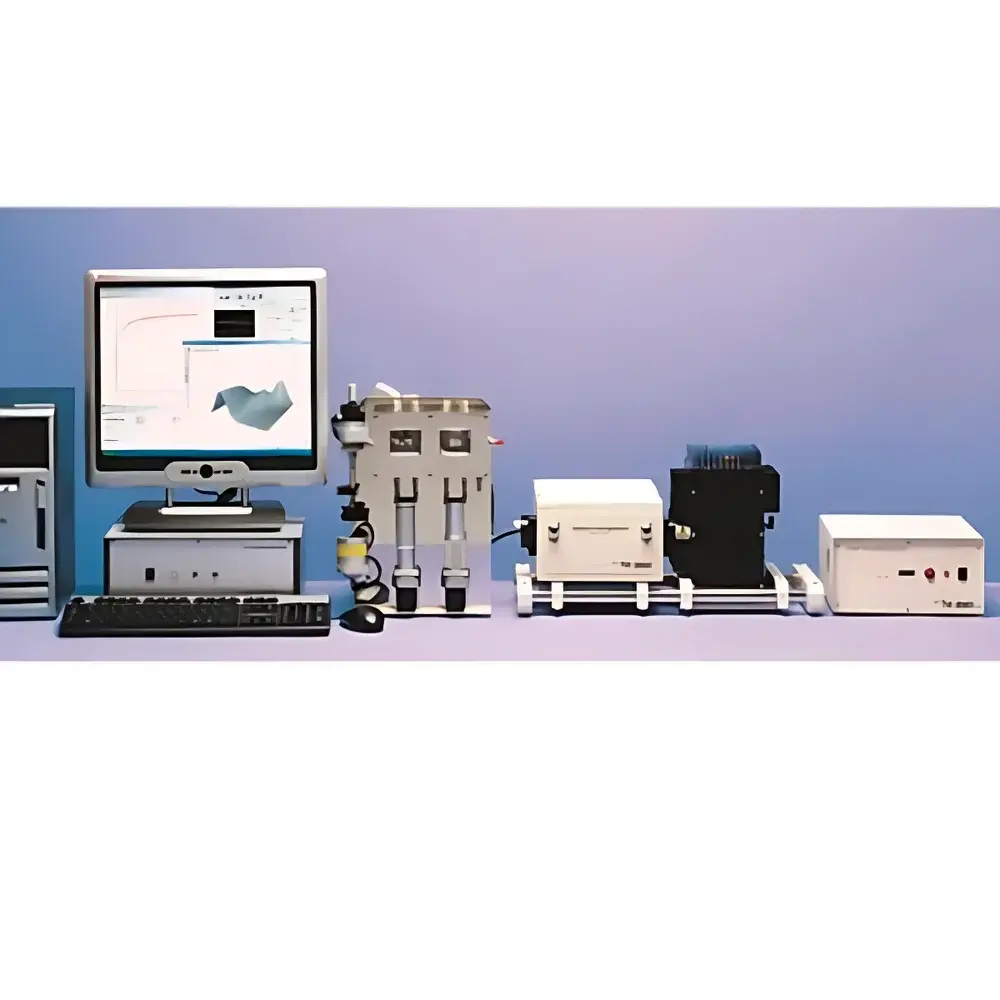
Applied Photophysics SX20 Stopped-Flow Reaction Analyzer with Circular Dichroism Detection
| Brand | Applied Photophysics |
|---|---|
| Origin | United Kingdom |
| Model | SX20 |
| Instrument Type | Circular Dichroism (CD) Stopped-Flow Spectrometer |
| Detection Principle | Far-UV to Near-UV CD spectroscopy (170–450 nm) |
| Flow Precision | ≤1% RSD per injection |
| Dead Time | <1.0 ms (with optimized cell and drive system) |
| Temperature Control Range | 4–80 °C (±0.1 °C stability) |
| Data Acquisition Rate | Up to 20,000 points/sec (CD signal at single wavelength) |
| Compliance | ASTM E2915, ISO/IEC 17025–compliant operation framework, supports 21 CFR Part 11–ready audit trail via KineticStudio software |
Overview
The Applied Photophysics SX20 Stopped-Flow Reaction Analyzer with Circular Dichroism (CD) detection is a high-precision, modular rapid-mixing spectrophotometric platform engineered for the quantitative investigation of biomolecular folding/unfolding kinetics, enzyme catalytic mechanisms, ligand-binding dynamics, and conformational transitions in chiral macromolecules. Unlike conventional UV-Vis or fluorescence stopped-flow systems, the SX20 integrates a dual-beam, photoelastic modulator (PEM)-based CD optical path—enabling time-resolved measurement of secondary and tertiary structural changes with sub-millisecond temporal resolution. Its core principle relies on the rapid mixing of two or more reactant solutions under precisely controlled laminar flow, followed by immediate cessation of flow (stopped-flow) into a quartz observation cell where CD signals are acquired synchronously with reaction progression. This architecture ensures minimal dispersion, reproducible dead times (<1.0 ms), and high signal-to-noise ratio across the far-UV range (170–260 nm), critical for monitoring α-helix and β-sheet formation in proteins and nucleic acids.
Key Features
- Modular stopped-flow base unit with dual-syringe or triple-syringe configuration for up to three reactants, each independently programmable for volume, speed, and delay timing
- Integrated CD optics featuring a high-stability PEM, MgF₂ optical train, and cooled photomultiplier tube (PMT) detector optimized for low-light CD signal fidelity
- Temperature-controlled sample compartment (4–80 °C) with Peltier-based regulation and real-time feedback (±0.1 °C)
- Low-dead-volume quartz flow cell (standard 0.5 mm pathlength; optional 0.1 mm for high-absorbance samples) with magnetic stirrer compatibility for extended kinetic windows
- Real-time data acquisition at up to 20 kHz sampling rate, synchronized with mixer actuation and temperature logging
- Rugged stainless-steel fluidic manifold with chemically resistant fluoropolymer seals; compatible with aqueous buffers, organic co-solvents (e.g., TFE, acetonitrile), and low-pH formulations
Sample Compatibility & Compliance
The SX20 accommodates a broad range of biophysical samples including purified proteins (0.01–500 µM), oligonucleotides, synthetic peptides, metalloenzymes, and membrane protein-detergent complexes. Sample volumes per experiment range from 20–200 µL, minimizing reagent consumption without compromising kinetic fidelity. All fluidic pathways meet ISO 8573–1 Class 2 purity standards for compressed air-driven operation. The instrument’s mechanical and electronic design conforms to IEC 61010–1 safety requirements for laboratory equipment. When operated with KineticStudio v5.x and validated SOPs, the system supports GLP/GMP-aligned workflows—including electronic signatures, user access tiers, and full audit trail generation compliant with FDA 21 CFR Part 11 Annex 11 expectations.
Software & Data Management
KineticStudio software provides an integrated environment for method development, real-time visualization, global fitting, and statistical validation. It supports multi-wavelength CD kinetic traces, singular value decomposition (SVD) analysis for component resolution, and nonlinear regression against mechanistic models (e.g., consecutive, parallel, or induced-fit binding schemes). Raw data are stored in vendor-neutral HDF5 format with embedded metadata (mixer parameters, temperature logs, lamp intensity, PEM status). Export options include CSV, ASCII, and direct MATLAB/Python API integration via documented REST endpoints. Software validation packages—including IQ/OQ documentation, traceability matrices, and performance qualification protocols—are available upon request for regulated laboratories.
Applications
The SX20 CD stopped-flow system is routinely deployed in academic and industrial settings for: protein folding/unfolding kinetics under denaturant or thermal jump conditions; real-time monitoring of heme protein redox transitions; characterization of RNA aptamer–ligand association rates; evaluation of chaperone-assisted folding pathways; and mechanistic studies of G-quadruplex formation/dissociation. Its CD-specific sensitivity enables discrimination between structurally similar intermediates indistinguishable by absorbance alone—such as molten globule vs. pre-molten globule states. In pharmaceutical development, it supports forced degradation studies of therapeutic proteins and comparability assessments across biosimilar manufacturing batches.
FAQ
What is the minimum dead time achievable with the SX20 CD system?
Typical dead time is <1.0 ms under optimized conditions (low-viscosity buffer, 0.1 mm pathlength cell, high-speed drive); actual value depends on syringe size, mixing geometry, and detector response latency.
Can the SX20 be upgraded to include fluorescence or absorbance detection modules?
Yes—the platform supports field-installable add-on modules for simultaneous CD/fluorescence or CD/absorbance detection using shared flow cell and timing architecture.
Is the system compatible with aggressive solvents such as trifluoroethanol (TFE) or hexafluoroisopropanol (HFIP)?
All wetted parts (syringes, valves, tubing, cell gaskets) are constructed from chemically inert materials (e.g., PEEK, FFKM, fused silica); solvent compatibility must be verified case-by-case per Material Compatibility Guide v3.2.
Does KineticStudio support global analysis of multi-wavelength CD kinetic datasets?
Yes—built-in global fitting engine allows simultaneous refinement of rate constants and spectral components across ≥3 wavelengths, with error propagation and confidence interval estimation.
How is temperature calibrated and maintained during rapid kinetic experiments?
A platinum resistance thermometer (Pt100) embedded in the cell block provides continuous feedback to a digital PID controller; calibration is traceable to NIST-certified references and performed annually per maintenance schedule.





