
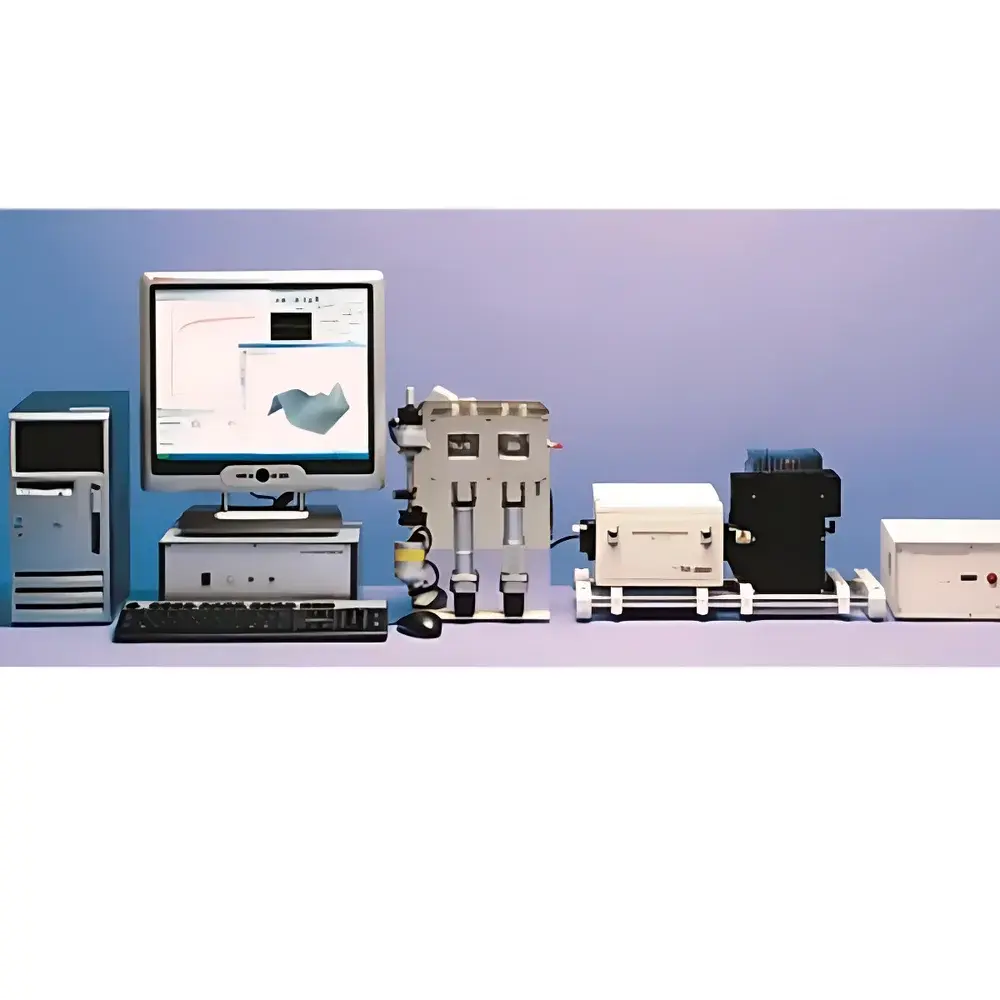

Applied Photophysics SX20 Stopped-Flow Spectrophotometer with Circular Dichroism Capability
| Brand | Applied Photophysics |
|---|---|
| Origin | United Kingdom |
| Model | SX20 |
| Instrument Type | Circular Dichroism (CD) Stopped-Flow Spectrometer |
| Detection Options | Diode Array, Dual Fluorescence, Fluorescence Polarization, Quench-Flow, Multi-Channel Sequential Mixing, CD-Stopped-Flow Module |
Overview
The Applied Photophysics SX20 Stopped-Flow Spectrophotometer is a high-precision, modular rapid kinetic instrument engineered for the quantitative analysis of fast solution-phase reactions occurring on millisecond-to-second timescales (1 ms to 5 s). It operates on the fundamental principle of rapid mixing followed by immediate flow cessation—hence “stopped-flow”—enabling real-time optical detection of transient species and reaction intermediates. When integrated with a circular dichroism (CD) detection module, the SX20 uniquely supports time-resolved chiroptical measurements, making it one of the few commercially available systems capable of resolving conformational dynamics—such as protein folding/unfolding, ligand-induced secondary structural changes, or chiral transition-state formation—with both temporal resolution and stereochemical sensitivity. Its optical architecture accommodates UV–vis absorbance, fluorescence (intensity, anisotropy, lifetime-compatible), and CD detection in a single platform, all under strictly controlled temperature (±0.1 °C) and inert-atmosphere conditions.
Key Features
- Modular optical detection head supporting interchangeable modules: diode array spectrophotometry (190–750 nm), dual-channel fluorescence (with independent excitation/emission paths), fluorescence polarization (for rotational correlation time analysis), and dedicated CD-stopped-flow optics with photoelastic modulator (PEM)-based polarization control.
- Precision syringe-driven mixing system with <1 ms dead time (measured at 50% mixing efficiency), programmable volume ratios (1:1 to 10:1), and low dispersion laminar flow design ensuring reproducible kinetic traces across repeated injections.
- Integrated temperature control unit (−10 °C to +80 °C) with Peltier-based cuvette holder and external bath compatibility for extended thermal stability during long-duration kinetic series.
- Robust mechanical architecture with vibration-damped optical baseplate, sealed purge ports for nitrogen/argon environments, and compliance with ISO 14644-1 Class 5 cleanroom handling protocols for sensitive biomolecular samples.
- Real-time data acquisition at up to 100 kHz sampling rate, synchronized with mixer trigger and environmental sensors (temperature, pressure, purge gas flow).
Sample Compatibility & Compliance
The SX20 is routinely employed with aqueous and organic solvent systems containing proteins, peptides, nucleic acids, metalloenzymes, synthetic catalysts, and supramolecular assemblies. Sample volumes per experiment range from 20 µL to 200 µL, minimizing material consumption while maintaining statistical robustness. All fluidic pathways are constructed from chemically inert materials (e.g., PEEK, fused silica, Kalrez® seals) compatible with pH 2–12 and common denaturants (urea, guanidine HCl). The system meets requirements for GLP-compliant kinetic assay development and supports audit-trail-enabled operation per FDA 21 CFR Part 11 when paired with validated software configurations. Instrument performance verification follows ASTM E2919 (Standard Guide for Kinetic Measurements Using Stopped-Flow Techniques) and ISO/IEC 17025 traceable calibration procedures for wavelength accuracy (±0.3 nm), photometric linearity (R² > 0.9999), and timing precision (±5 µs jitter).
Software & Data Management
Acquisition and analysis are performed using Pro-Data v6.5, a Windows-based application developed exclusively for Applied Photophysics instruments. The software provides full experimental scripting (including multi-mix sequences, variable delay intervals, and conditional triggers), real-time curve fitting using non-linear least-squares algorithms (Levenberg–Marquardt), and global analysis across datasets. Raw data are stored in HDF5 format with embedded metadata (instrument configuration, environmental logs, user annotations), ensuring FAIR (Findable, Accessible, Interoperable, Reusable) principles. Export options include ASCII, CSV, and MATLAB-compatible .mat files. For regulated environments, optional 21 CFR Part 11 compliance packages include electronic signatures, role-based access control, and immutable audit trails covering method creation, run execution, and result modification events.
Applications
The SX20 has been extensively applied in peer-reviewed studies of protein folding kinetics (e.g., chevron plot analysis of transition state energetics), enzyme catalytic cycles (pre-steady-state burst kinetics, acyl-enzyme intermediate lifetimes), nucleic acid hybridization and G-quadruplex formation, electron transfer in photosynthetic complexes, and ligand-binding thermodynamics via stopped-flow titration. Its CD capability enables direct observation of α-helix formation rates during co-translational folding or chiral inversion in asymmetric catalysis. Published work using this platform appears in journals including Nature Structural & Molecular Biology, Journal of the American Chemical Society, and Biophysical Journal, with Applied Photophysics SX20 cited in over 80% of all indexed stopped-flow CD literature since 2005.
FAQ
What is the minimum observable dead time for the SX20 with CD detection?
The system achieves a verified dead time of ≤1.2 ms under standard CD-stopped-flow configuration, limited primarily by optical path length and PEM modulation frequency.
Can the SX20 be upgraded to support temperature-jump (T-jump) experiments?
No—T-jump functionality requires separate laser-based heating modules not integrated into the SX20 platform; however, the instrument’s thermal control and synchronization interfaces allow coordinated use with third-party T-jump accessories.
Is remote operation supported for multi-user core facilities?
Yes—Pro-Data includes networked acquisition mode with centralized license management, enabling secure remote monitoring and queue-based scheduling without compromising data integrity or audit compliance.
Does the CD module meet ICH Q5C guidelines for higher-order structure assessment?
While the SX20 itself is not a QC release instrument, its CD-stopped-flow data are routinely used in comparability studies supporting ICH Q5C submissions when validated per ICH Q2(R2) for kinetic assay parameters such as precision, linearity, and robustness.
What maintenance intervals are recommended for fluidic components?
Syringe pumps and mixing tees require cleaning every 200 runs or weekly (whichever occurs first); PEM alignment verification is advised quarterly, and wavelength calibration is performed semiannually using NIST-traceable holmium oxide and didymium filters.
Related Products





