
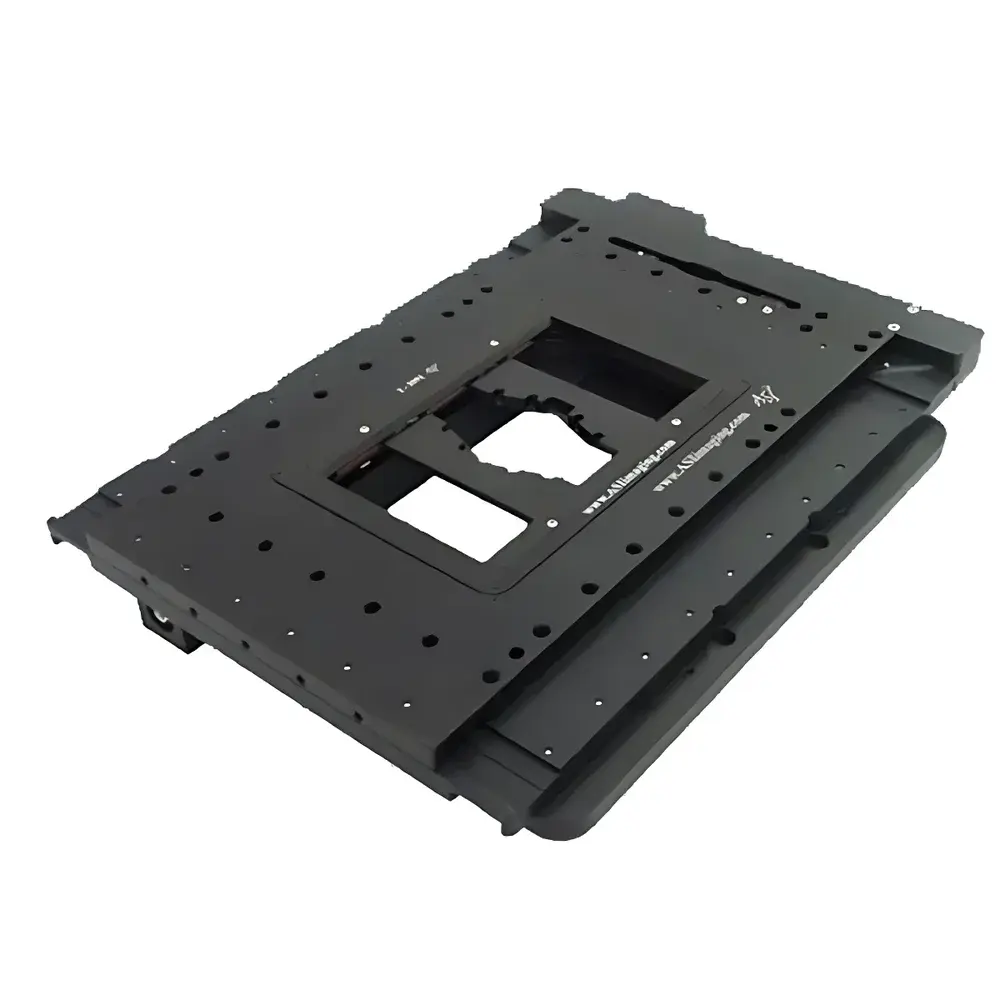
Applied Scientific Instrumentation (ASI) MS-2000 Series High-Precision Motorized Microscope Translation Stages
| Brand | Applied Scientific Instrumentation (ASI) |
|---|---|
| Origin | USA |
| Product Type | Motorized Translation Stage |
| Drive Mechanism | Closed-loop DC servo motor with high-resolution encoder and precision ball screw |
| XY Resolution | 22 nm |
| Bidirectional Repeatability | ±700 nm |
| Z-Axis Options | Piezoelectric stages with 150 µm, 300 µm, or 500 µm travel |
| Compatible Mounting Standard | K-type (160 × 110 mm aperture) |
| Controller | MS-2000-WK multi-axis motion controller with analog joystick, rotary knob, TTL sync, programmable trajectories, and position memory |
Overview
The ASI MS-2000 Series represents a class of high-precision, modular motorized translation stages engineered for demanding optical microscopy applications—including live-cell imaging, super-resolution microscopy, automated tile scanning, and quantitative fluorescence assays. Designed and manufactured in Eugene, Oregon, these stages operate on the principle of closed-loop servo positioning, integrating zero-backlash micro-gear DC motors, high-resolution optical encoders, and ground-precision ball screws to deliver sub-micron positional fidelity across X, Y, and optionally Z axes. The system architecture is optimized for thermal stability, mechanical rigidity, and electromagnetic compatibility—critical attributes when integrated into vibration-sensitive optical paths or time-lapse experiments requiring long-term positional integrity. Unlike open-loop stepper-based alternatives, ASI’s servo-driven platforms maintain traceable position feedback at all times, enabling compliance with GLP/GMP documentation requirements where audit trails and reproducibility are mandated.
Key Features
- Modular three-axis capability: XY stages (e.g., MS-2000FT, MS-2500, US-2000) integrate seamlessly with ASI’s piezoelectric Z-focus modules (e.g., PZM-2000, IPZ-3000FT), supporting nanometer-scale axial control for confocal or TIRF applications.
- K-type standardized aperture (160 × 110 mm) ensures broad compatibility with commercial inverted and upright microscopes from Leica, Nikon, Olympus, and Zeiss—including DMI6000, Eclipse Ti, BX61WI, Axio Observer, and AxioImager platforms.
- MS-2000-WK controller provides hardware-level motion coordination: analog joystick for intuitive XY navigation, rotary knob for Z-positioning, real-time digital position display, software-defined speed profiling, and non-volatile position memory upon power loss.
- Programmable trajectory execution supports automated workflows such as mosaic acquisition, Z-stack collection, and multi-point time-lapse protocols—all synchronized via TTL triggers to camera, laser shutter, or environmental chamber controllers.
- Low-drift mechanical design minimizes thermal expansion effects; aluminum alloy chassis with anodized finish ensures dimensional stability over extended operation cycles typical in 24/7 imaging core facilities.
Sample Compatibility & Compliance
The MS-2000 platform family accommodates standard biological sample carriers—including 25 × 75 mm glass slides, 35–150 mm Petri dishes, SBS-compliant multi-well plates (via Z-INSERT series), and custom microfluidic chambers. Its flat, unobstructed upper surface and ultra-low profile (as low as 28 mm for MS-2000FT) facilitate side-access mounting of perfusion systems, electrodes, or temperature-controlled stage inserts (e.g., Okolab, Tokai Hit, Pecon). All stages comply with ISO 9001-certified manufacturing processes. When configured with the MS-2000-WK controller and enabled audit-trail logging, the system meets FDA 21 CFR Part 11 requirements for electronic records and signatures in regulated life science environments. Mechanical interfaces adhere to ANSI/ASME B46.1 surface finish standards, and electrical subsystems conform to IEC 61000-6-3 EMC emission limits.
Software & Data Management
ASI provides native drivers for MATLAB, Python (PySerial/PyVISA), LabVIEW, and Micro-Manager, enabling full programmatic control without proprietary middleware. The ASIStage software suite offers GUI-based path planning, coordinate referencing (absolute vs. relative), and macro scripting for complex experimental sequences. All motion parameters—including velocity profiles, acceleration limits, soft/hard limits, and encoder calibration offsets—are stored in non-volatile memory and can be exported as JSON or CSV for version-controlled configuration management. Position logs include timestamps with microsecond resolution and are compatible with HDF5-based data pipelines used in high-content screening. For integration into LIMS or ELN ecosystems, RESTful API endpoints support HTTP POST commands for stage movement and status polling.
Applications
These stages serve as foundational motion components in advanced imaging modalities: automated whole-slide scanning for digital pathology; drift-corrected single-molecule tracking using particle image velocimetry (PIV); multi-position time-lapse studies of organoid development; and multi-color, multi-z-plane acquisitions in light-sheet microscopy. In industrial metrology, variants like the GTS-series gantry stages and MS-8000 large-aperture platforms support semiconductor wafer inspection under Nikon L300 or Olympus MX61 microscopes—leveraging through-stage illumination and vacuum chucks for reflective substrate handling. Rotational modules (PRS-1000) extend functionality to polarization-resolved imaging and tomographic reconstruction setups requiring continuous angular sampling.
FAQ
Which microscope models are natively supported?
Leica DMI3000–DMI6000, Nikon Eclipse TE2000/Ti, Olympus IX70–IX81/BX51–BX61, Zeiss Axiovert 200/Axio Observer, and upright platforms including Leica DM6000, Olympus AX70, and Zeiss AxioImager.
Can the MS-2000 series be integrated into existing custom-built optical tables?
Yes—the compact footprint (e.g., MS-2000S: 216 × 226 × 65.6 mm), standardized M4 and M6 mounting holes, and K-type aperture enable direct integration into user-assembled optical benches or OEM instruments.
Is Z-axis piezo integration mandatory for super-resolution techniques?
While not mandatory, ASI’s piezoelectric Z-modules (e.g., PZ-2000FT) provide 150–500 µm travel with <1 nm step resolution and sub-50 pm RMS noise—essential for precise focus stabilization in STED, PALM, or SIM implementations.
How does the closed-loop servo architecture improve long-term experiment reliability?
Unlike open-loop systems subject to missed steps or thermal drift, ASI’s encoder-based feedback continuously corrects positional error in real time—ensuring ±700 nm bidirectional repeatability over thousands of cycles without recalibration.
Are firmware updates and technical documentation publicly accessible?
Yes—firmware binaries, datasheets, mechanical drawings (STEP/IGES), and API reference manuals are available through ASI’s secure customer portal after device registration, with revision history tracked per ISO 13485 guidelines.




