
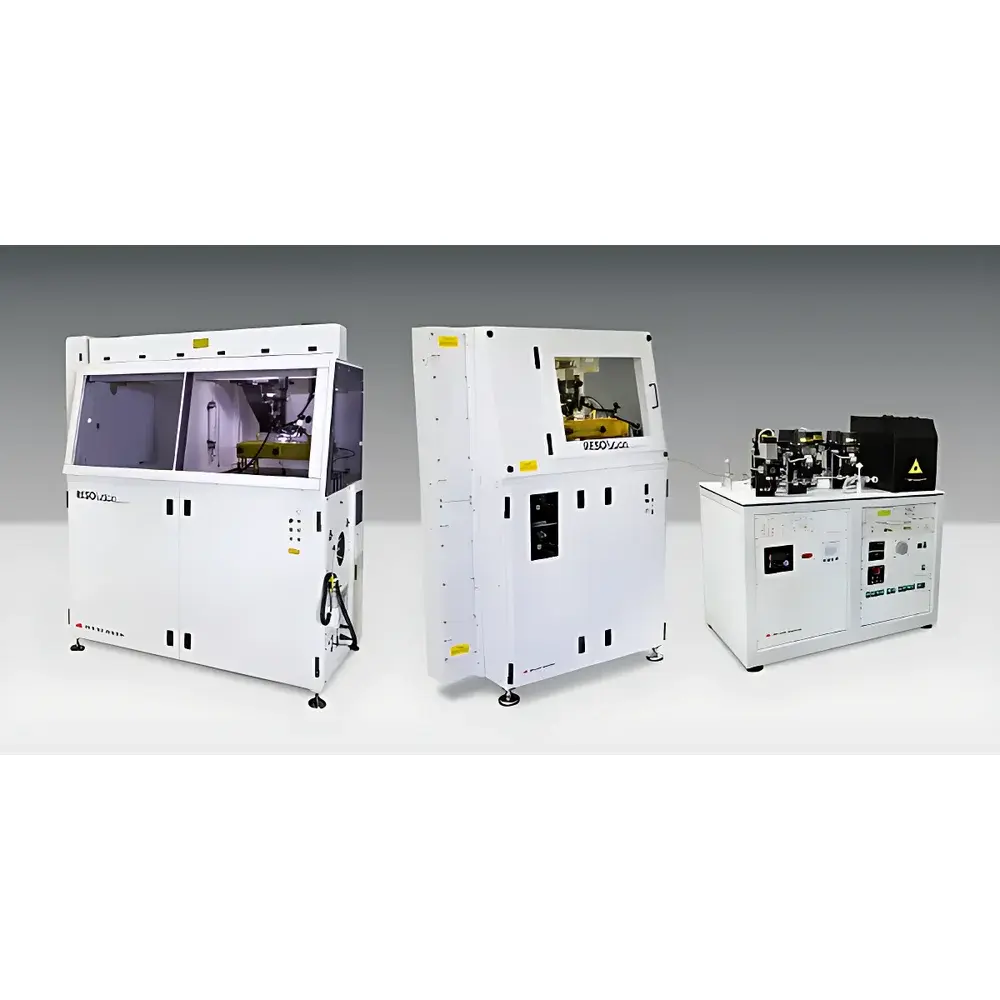
Applied Spectra RESOchron SE/LR U-Th-He Dual-Dating System
| Brand | Applied Spectra |
|---|---|
| Origin | USA |
| Manufacturer Type | Authorized Distributor |
| Origin Category | Imported |
| Model | RESOchron SE/LR |
| Instrument Type | Rare Gas Isotope Ratio Mass Spectrometer |
| Pricing | Upon Request |
Overview
The Applied Spectra RESOchron SE/LR is a fully integrated, in-situ, computer-controlled microanalytical platform engineered for high-throughput (U-Th)/He thermochronology and complementary U-Pb geochronology. It combines laser ablation with optical interferometry or X-ray microtomography–based pit volume quantification and rare gas mass spectrometry to deliver precise, reproducible dual-dating results without reliance on alpha-ejection correction—a critical limitation of conventional single-grain He analysis. The system builds upon decades of technical heritage from the RESOlution LA-ICP-MS and Alphachron™ helium measurement platforms, unifying sample ablation, geometry-resolved He release quantification, and isotopic analysis into a single automated workflow. Its core measurement principle hinges on spatially resolved laser ablation of mineral grains (e.g., zircon, apatite, rutile, monazite) under ultra-high vacuum, followed by quantitative transfer of liberated 4He to an Alphachron™-configured noble gas mass spectrometer for high-sensitivity isotope ratio determination. Simultaneously, ablated aerosols are coupled to an ICP-MS for concurrent U, Th, and Pb isotopic analysis—enabling direct correlation of (U-Th)/He ages with U-Pb crystallization ages at sub-micrometer spatial resolution.
Key Features
- Fully automated, in-situ (U-Th)/He and U-Pb analysis on individual mineral grains without physical grain separation or dissolution
- Integrated optical interferometry or X-ray microtomography for real-time, non-destructive 3D measurement of ablation pit geometry—yielding rigorously defined crystal volume and surface area
- No alpha-ejection correction required due to precise geometric constraint of He diffusion domain
- Computer-controlled laser ablation system optimized for low-volume, high-reproducibility removal of mineral material (typically 5–20 µm diameter pits)
- Dual-path coupling: ablated He directed to Alphachron™-configured noble gas IRMS; aerosol routed to external ICP-MS for U/Th/Pb isotopic ratios
- High-vacuum sample chamber with programmable temperature control for thermal history simulation and degassing optimization
- Compliant architecture supporting audit trails, user access control, and electronic signatures per FDA 21 CFR Part 11 requirements for regulated laboratories
Sample Compatibility & Compliance
The RESOchron SE/LR accommodates standard polished thin sections, grain mounts, and epoxy-embedded mineral separates. It is validated for analysis of zircon, apatite, rutile, monazite, titanite, and allanite—minerals routinely used in low- to medium-temperature thermochronology. All hardware and software modules conform to ISO/IEC 17025:2017 general requirements for the competence of testing and calibration laboratories. Data acquisition and processing workflows support GLP/GMP-aligned documentation, including full metadata logging (laser parameters, pit dimensions, gas transfer times, detector integration periods), and traceable calibration against NIST SRM 610 and USGS GSD-1G reference materials. System validation protocols align with ASTM D7504 (standard test method for helium isotope ratio analysis in geological samples) and IUGS recommended practices for thermochronometric data reporting.
Software & Data Management
RESOchron Control Suite provides unified instrument orchestration, real-time ablation monitoring, and synchronized data acquisition from both mass spectrometers. The software implements automated background subtraction, peak-stripping for isobaric interferences (e.g., 40Ar+ on 40Ca+), and matrix-matched standard bracketing for U/Th/Pb quantification. Age calculation modules integrate He diffusion models (e.g., Dodson’s equation), alpha-ejection corrected age equations (where applicable), and Monte Carlo uncertainty propagation across all input parameters—including pit volume error, gas blank contribution, and counting statistics. Export formats include CSV, Excel, and ISA-Tab-compliant metadata packages compatible with EarthChem and SESAR repositories. Audit logs record every user action, parameter change, and calibration event with timestamp and operator ID.
Applications
- Reconstructing paleoclimate conditions during formation of Fe-rich fluvial placer deposits
- Quantifying thermal evolution history of hydrocarbon source rocks in sedimentary basins
- Assessing hydrocarbon charge timing and trap integrity in petroleum systems
- Evaluating thermal maturity and fluid flow pathways in geothermal reservoirs
- Constraining fault displacement histories and timing of ore-forming events
- Modeling heat and fluid transport in candidate nuclear waste repositories
- Deciphering tectonic uplift and landscape denudation rates using detrital zircon/apatite (U-Th)/He profiles
- Calibrating hydrothermal alteration chronologies in epithermal and porphyry systems
- Linking diamond stability fields to regional exhumation histories in cratonic settings
FAQ
What distinguishes RESOchron from conventional (U-Th)/He lab protocols?
It eliminates manual grain selection, chemical etching, and furnace-based He extraction—replacing them with in-situ laser ablation, geometrically constrained volume measurement, and direct noble gas MS detection.
Can RESOchron analyze sub-20 µm mineral grains?
Yes—the system achieves reliable He quantification from grains as small as 15 µm in diameter, provided sufficient U/Th concentration and adequate ablation yield.
Is external ICP-MS hardware required?
Yes; the RESOchron SE/LR interfaces with commercially available ICP-MS instruments (e.g., Thermo Scientific Neptune Plus, Nu Instruments Apex HR) via standardized aerosol transfer lines.
Does the system support multi-collector detection for He isotopes?
The Alphachron™ module is configured as a single-collector noble gas IRMS optimized for 4He/3He ratio precision; 3He measurements require optional secondary ionization source integration.
How is data traceability ensured for regulatory submissions?
Full electronic audit trail, role-based access control, digital signature capability, and raw data archiving comply with 21 CFR Part 11 and ISO 17025 documentation requirements.




