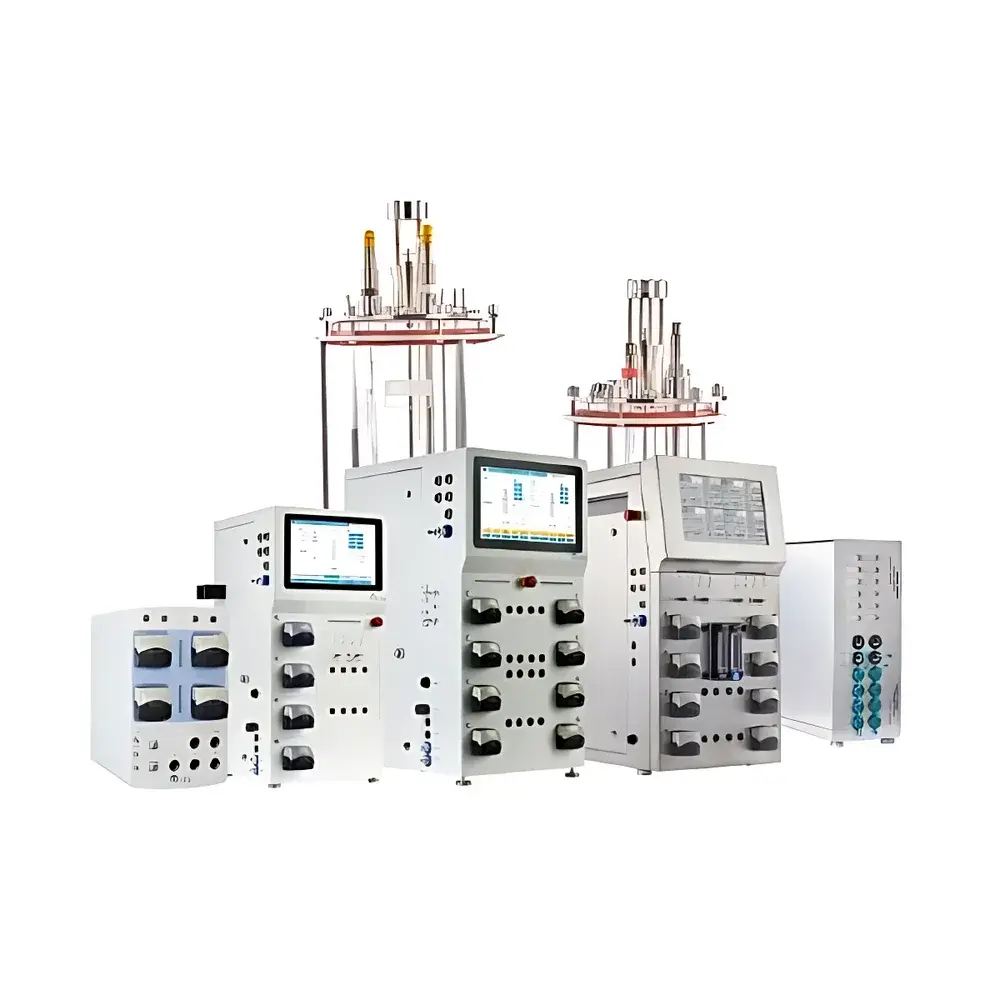
Applitech AbioBundle Glass Vessel Bioreactor Series
| [Brand | Applitech |
|---|---|
| Origin | Guangdong, China |
| Manufacturer Type | Manufacturer |
| Product Category | Domestic |
| Model | AbioBundle Glass Vessel Bioreactor |
| Pricing | Upon Request] |
Overview
The Applitech AbioBundle Glass Vessel Bioreactor Series is a modular, scalable, and GMP-aligned bioprocess platform engineered for precision cell culture and microbial fermentation across R&D, process development, and small-scale manufacturing. Designed on core principles of sterility assurance, reproducible mass transfer, and real-time physiological control, the system employs glass vessel construction (borosilicate 3.3) with electropolished 316L stainless steel top plates and non-welded sanitary interfaces—ensuring compliance with ISO 13485, ASME BPE, and cGMP design expectations for single-use and reusable bioprocessing equipment. The series comprises three architecture tiers: M-Series (microscale parallel reactors), E-Series (modular benchtop systems with dual- or quad-vessel configurations), and P-Series (PLC-based industrial control architecture). All variants support aerobic and anaerobic cultivation of mammalian cells, stem cells, insect cells, plant cells, fungi, and bacteria—including high-density fed-batch, perfusion, and continuous modes. Working volumes span from 50 mL to 16 L, enabling seamless scale-down modeling and technology transfer from lab to pilot scale.
Key Features
- Glass vessel construction: Borosilicate 3.3 glass with superior thermal shock resistance, chemical inertness, and optical clarity for visual inspection and in-situ monitoring
- Sanitary mechanical design: Top plate fabricated from electropolished 316L stainless steel; non-product-contact surfaces mirror-polished; zero welded joints in wetted zones
- Modular control architecture: m-Control (embedded ARM-based), ePlus-Control / eDual-Control (12″ or 13.3″ capacitive touch HMI), and p-Control (Siemens S7 PLC platform) — each supporting configurable I/O expansion
- Integrated process control: Real-time monitoring and closed-loop regulation of pH, dissolved oxygen (DO), temperature, agitation speed, liquid level, foam, and total gas flow (TGF)
- Gas delivery flexibility: Up to 6 mass flow controllers (MFCs) per vessel; programmable gas routing between overlay and sparger lines; sparger options include micro-porous sintered metal, ring-type, and custom geometry
- Advanced actuation: Servo-driven agitation with mechanical seal or optional magnetic coupling; up to 4 variable-speed peristaltic pumps per vessel with individual prime buttons; PID-controlled feed strategies linked to balance input
- Web-native operation: Browser-based UI (WebUI) enables remote configuration, live parameter visualization, and event-triggered alarms via SMS, email, or WeChat (optional)
- Data integrity compliance: Built-in local storage with timestamped audit trails; role-based access control (23 user accounts, 3-tier password protection); optional 21 CFR Part 11-compliant electronic signatures via AbioExpert GMP software
Sample Compatibility & Compliance
The AbioBundle platform accommodates diverse biological systems including CHO, HEK293, CAP-T, Sf9, Vero, and primary human cells, as well as E. coli, S. cerevisiae, and filamentous fungi. Its sterilizable glass vessels and autoclavable sensors meet USP and requirements for extractables/leachables profiling. The eDual-Control and p-Control variants are designed to align with ISAS88 (batch control standard) and GAMP5 guidance for validated automation systems. Electrical safety complies with IEC 61000-6-2/6-4 and CE marking directives. All contact materials conform to USP Class VI and FDA 21 CFR 177.2600 for food-contact polymers.
Software & Data Management
Standard configuration includes AbioPIMS Lite or AbioExpert Lite—lightweight SCADA clients supporting real-time trending, alarm logging, and CSV export. Optional upgrades provide full process information management: AbioPIMS Standard/Advanced/GMP versions enable cross-site data federation, ELN integration, and automated report generation per ISO/IEC 17025. AbioExpert supports third-party analytical device integration (e.g., Nova Biomedical blood gas analyzers, Kaiser Raman probes) via OPC UA and Modbus TCP. AppliSoftec software suite is validated for use in GLP and GMP environments, with electronic record retention, change control workflows, and 21 CFR Part 11 audit trail capabilities in GMP editions.
Applications
- Monoclonal antibody and recombinant protein expression optimization in CHO and HEK293 cells
- Viral vector production (AAV, lentivirus) under controlled shear and oxygenation conditions
- Stem cell expansion in perfusion mode with biomass feedback control (via optional AbioBiomass module)
- Microbial strain screening and fermentation media development using parallel M-Series reactors
- Process characterization studies (DoE) requiring multi-parameter interaction analysis
- Technology transfer support: identical control logic and sensor calibration protocols across M/E/P platforms reduce scale-up risk
- cGMP-compliant small-batch manufacturing of clinical trial materials (Phase I–II)
FAQ
What is the maximum working volume supported by the AbioBundle E-Series?
Up to 16 L per vessel, with optional tank extensions enabling configurations up to 15 L in standard single-wall or jacketed formats.
Does the system support sterile sampling and inoculation?
Yes—integrated aseptic ports with diaphragm valves and steam-sterilizable septa are available as factory options.
Can the AbioBundle be integrated into an existing MES or LIMS infrastructure?
Yes—via OPC UA, MQTT, or RESTful API interfaces; AbioPIMS Advanced and GMP editions include pre-built connectors for Siemens Opcenter, Thermo Fisher SampleManager, and LabVantage.
Is validation documentation provided with the system?
Factory-supplied IQ/OQ protocols, FAT/SAT reports, and material traceability dossiers are included; URS support and PQ assistance are available upon request.
What electrode types are compatible with the pH and DO measurement modules?
Standard analog and digital (smart) electrodes from Hamilton, Mettler Toledo, and Ingold are supported; all channels accept 4–20 mA, 0–10 V, and RS485 Modbus RTU inputs.
Related Products