
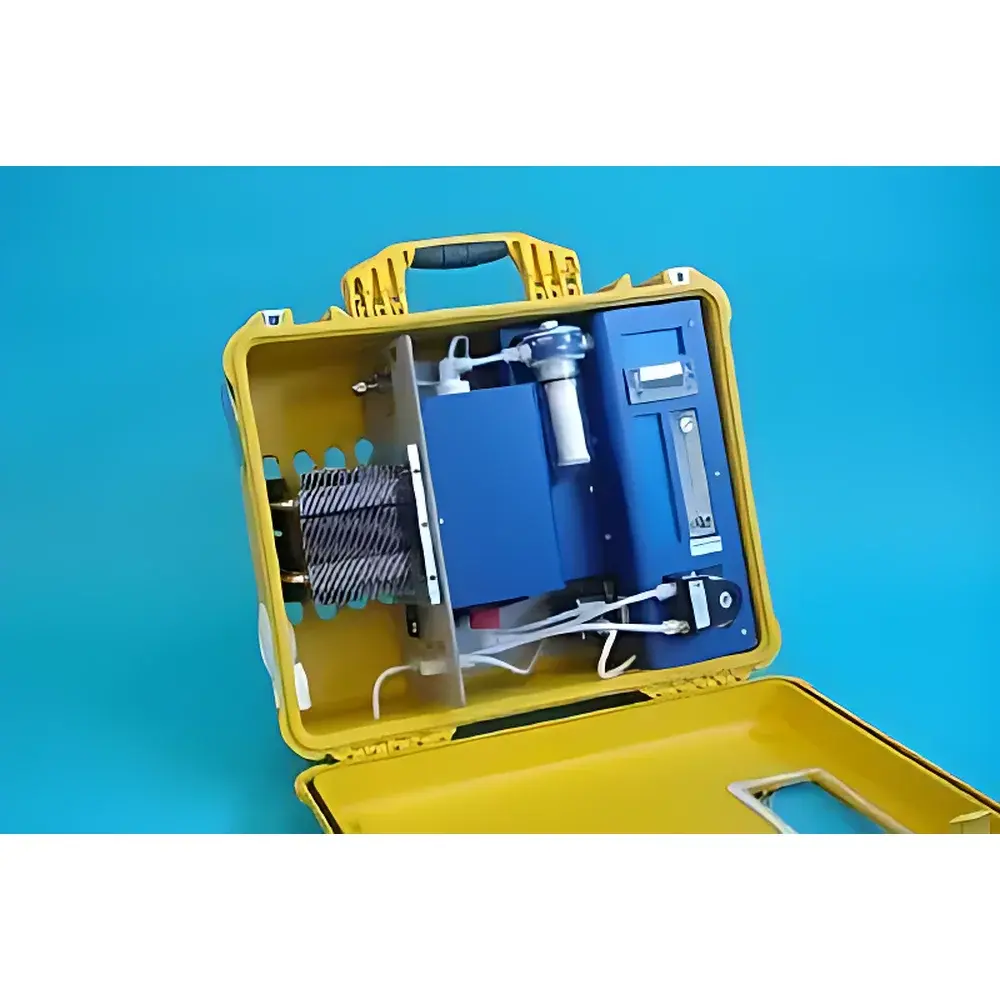
APS Handheld Gas Sampling System
| Origin | Netherlands |
|---|---|
| Manufacturer Type | Distributor |
| Origin Category | Imported |
| Model | APS |
| Pricing | Upon Request |
Overview
The APS Handheld Gas Sampling System is a compact, field-deployable instrument engineered for precise, temperature-controlled gas sampling in environmental monitoring and industrial process applications. At its core, the system employs thermoelectric (Peltier) cooling to actively regulate dew point—ensuring consistent sample conditioning prior to analysis by downstream analyzers such as FTIR, GC, or electrochemical sensors. Unlike passive desiccant-based dryers, the APS maintains dynamic thermal equilibrium via microprocessor-driven feedback control of the Peltier cooler, delivering stable dew points between 1 °C and 15 °C (default setpoint: 4 °C). This active condensation management mitigates water vapor interference—critical for trace-level VOC, SO₂, NOₓ, and H₂S measurements where humidity-induced signal drift or sensor poisoning is a known analytical risk. The integrated heated sample path (from inlet to cooler outlet) prevents wall condensation and preserves volatile compound integrity across variable ambient conditions.
Key Features
- Microprocessor-controlled Peltier cooling module with closed-loop dew point regulation (1–15 °C range, factory-default 4 °C)
- Heated gas pathway throughout the entire internal flow path—minimizing cold spots and adsorption losses
- Integrated ball valve at inlet for rapid calibration verification using certified standard gases
- AMP11E diaphragm pump for precise, pulse-free flow control (typical operating range: 0.1–2.0 L/min, adjustable via front-panel interface)
- Automatic pump activation triggered by real-time cooler temperature deviation beyond ±0.5 °C tolerance—ensuring thermal stability during extended operation
- Optically clear observation window for visual inspection of the inline rotameter and electronic control board
- Optional AUF particulate filter (0.3 µm retention) at inlet to protect sensitive analyzers from aerosol and dust ingress
- Optional ACP-ASR25 peristaltic pump for continuous removal of condensed liquid from the sample stream—preventing blockage and cross-contamination
Sample Compatibility & Compliance
The APS is compatible with ambient air, stack emissions, landfill gas, biogas, and industrial process streams containing non-corrosive or mildly corrosive components (e.g., CO₂, CH₄, O₂, N₂, H₂O, VOCs). It is not rated for use with halogenated hydrocarbons, strong oxidizers (e.g., Cl₂, O₃), or hydrogen sulfide concentrations exceeding 100 ppm without optional corrosion-resistant wetted materials. The system supports compliance with ISO 16000-23 (indoor air—determination of formaldehyde and other carbonyls), EPA Method TO-15 (VOCs in ambient air), and EN 14662 (ambient air quality—measurement of benzene). Its design facilitates GLP-aligned documentation when paired with validated data loggers and audit-trail-enabled software (see Software & Data Management).
Software & Data Management
While the APS operates autonomously via embedded firmware, it interfaces seamlessly with third-party SCADA systems and laboratory data management platforms via analog 4–20 mA outputs (cooler temperature, flow rate) and digital RS-232/RS-485 ports. Optional firmware upgrade enables time-stamped event logging—including dew point setpoint changes, pump activation events, and thermal fault alerts—for traceability under FDA 21 CFR Part 11 (when deployed in regulated environments with appropriate validation). All configuration parameters are retained through power cycles, and firmware updates are performed via secure USB connection using manufacturer-provided configuration utility.
Applications
- Mobile ambient air quality monitoring (AQMS) campaigns requiring on-site dew point stabilization
- Pre-analyzer conditioning for portable FTIR and PID instruments in fugitive emission surveys
- Continuous stack gas sampling in waste-to-energy plants and cement kilns
- Biogas upgrading facility QA/QC—removing moisture prior to methane purity analysis
- Calibration gas delivery systems where humidity-sensitive reference standards must be maintained
- Indoor air investigations targeting aldehydes, terpenes, and other semi-volatile organics prone to aqueous-phase partitioning
FAQ
What is the maximum allowable inlet gas temperature?
The APS accepts inlet gases up to 50 °C continuously; transient excursions to 60 °C are permissible for ≤5 minutes without performance degradation.
Can the APS operate unattended for extended periods?
Yes—when powered via 12 V DC (e.g., vehicle battery or solar-charged system), it supports continuous operation for >72 hours with optional external data logger integration.
Is the system suitable for explosive atmospheres?
No—the APS is not ATEX or IECEx certified; it must be used only in non-hazardous locations per IEC 60079-0.
How often does the AUF filter require replacement?
Under typical urban ambient air conditions, replacement is recommended every 3–6 months; frequency increases in high-particulate environments such as construction zones or agricultural settings.
Does the system include NIST-traceable calibration documentation?
Factory calibration certificates (including dew point and flow verification against NIST-traceable references) are provided with each unit; on-site recalibration services are available upon request.







