
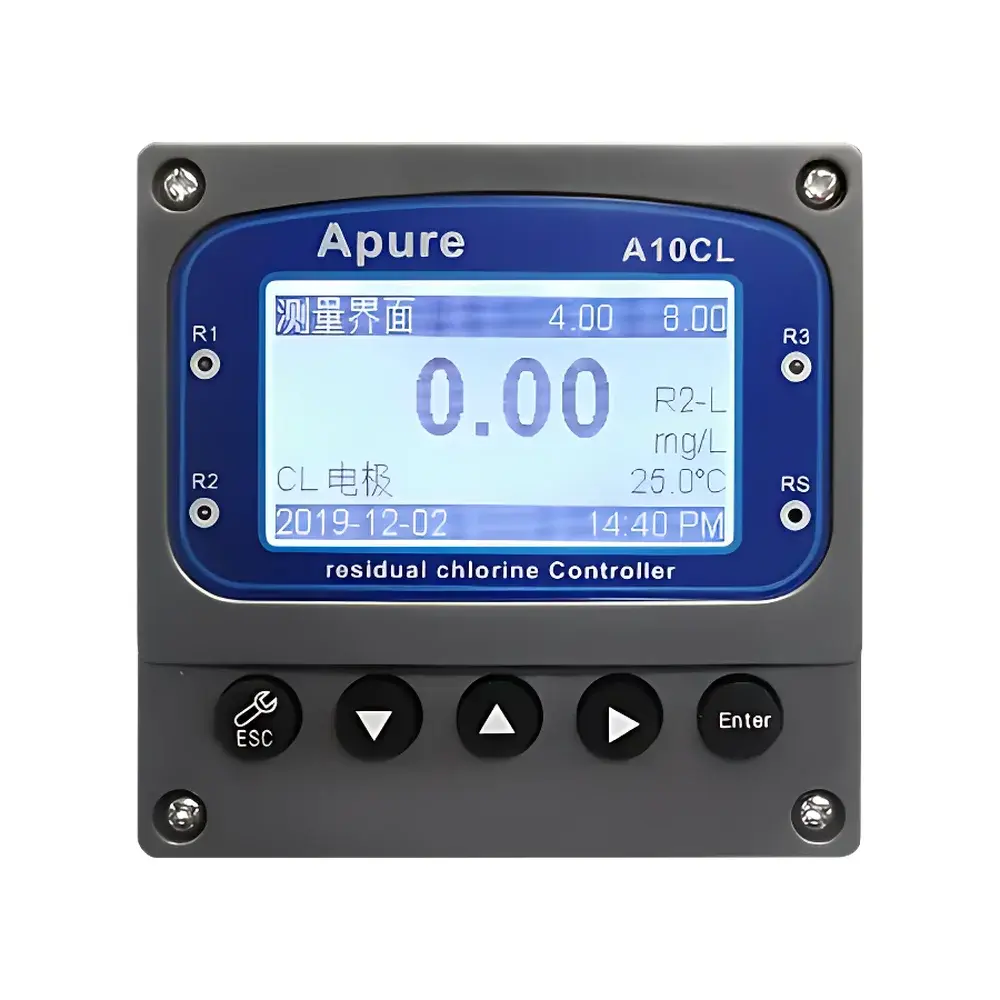
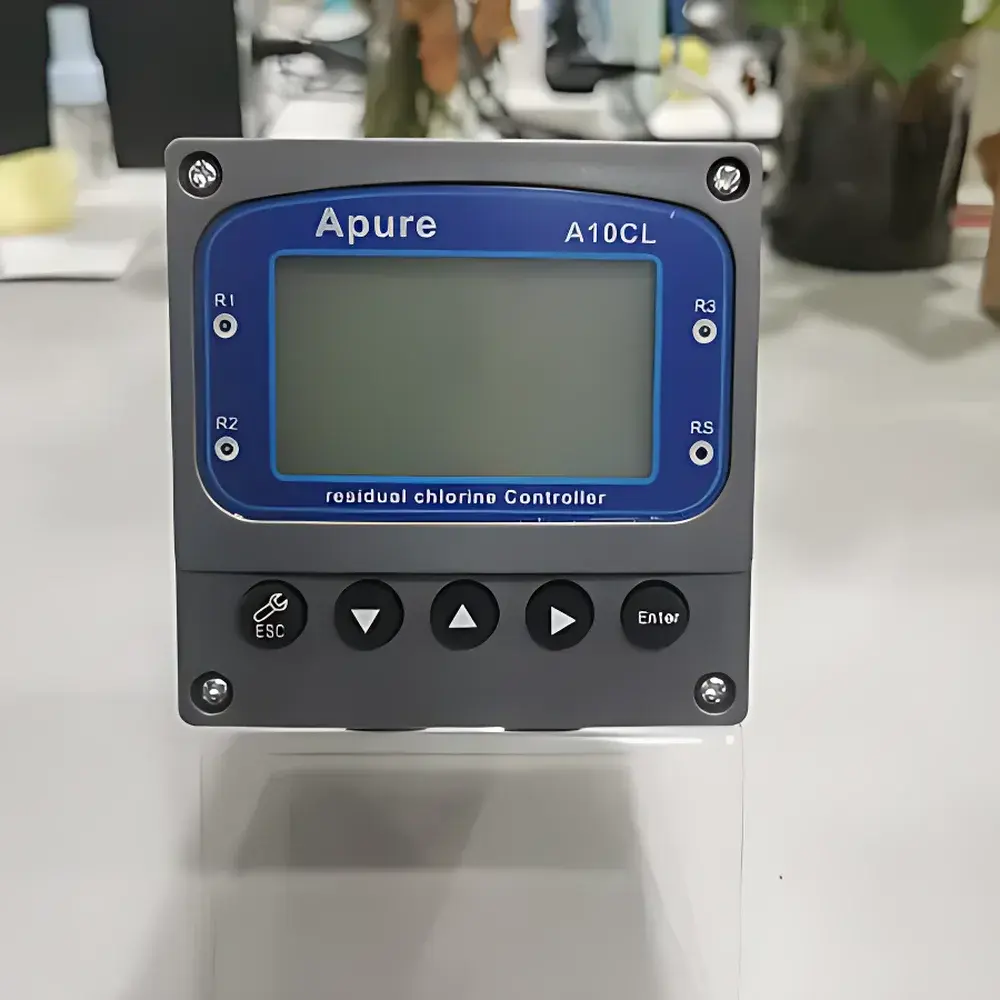
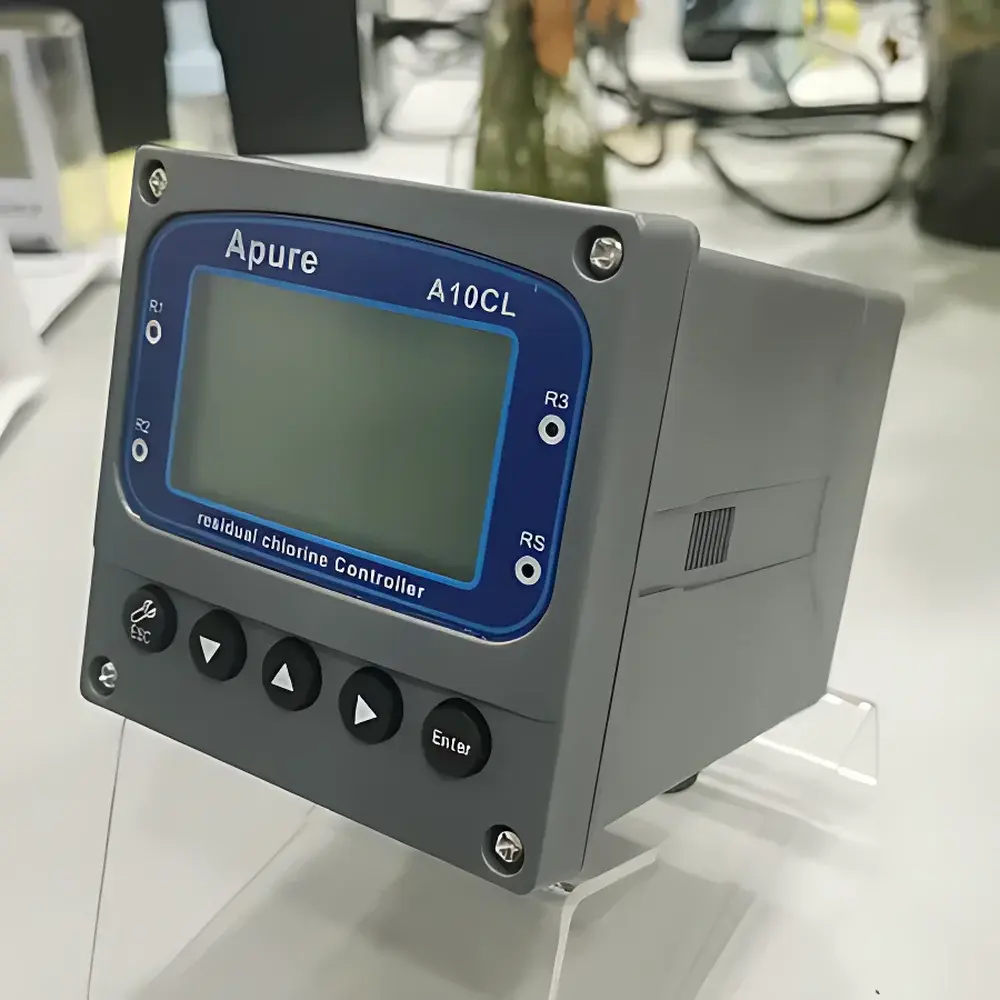
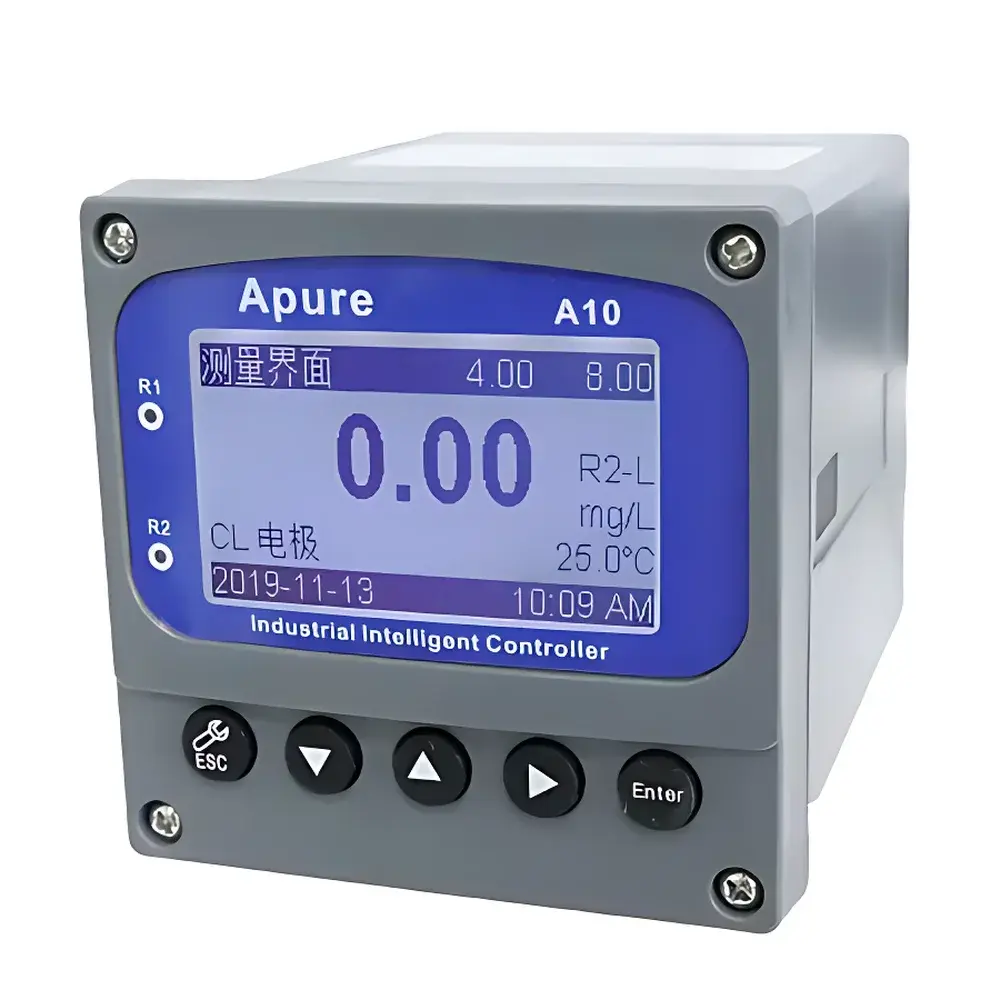
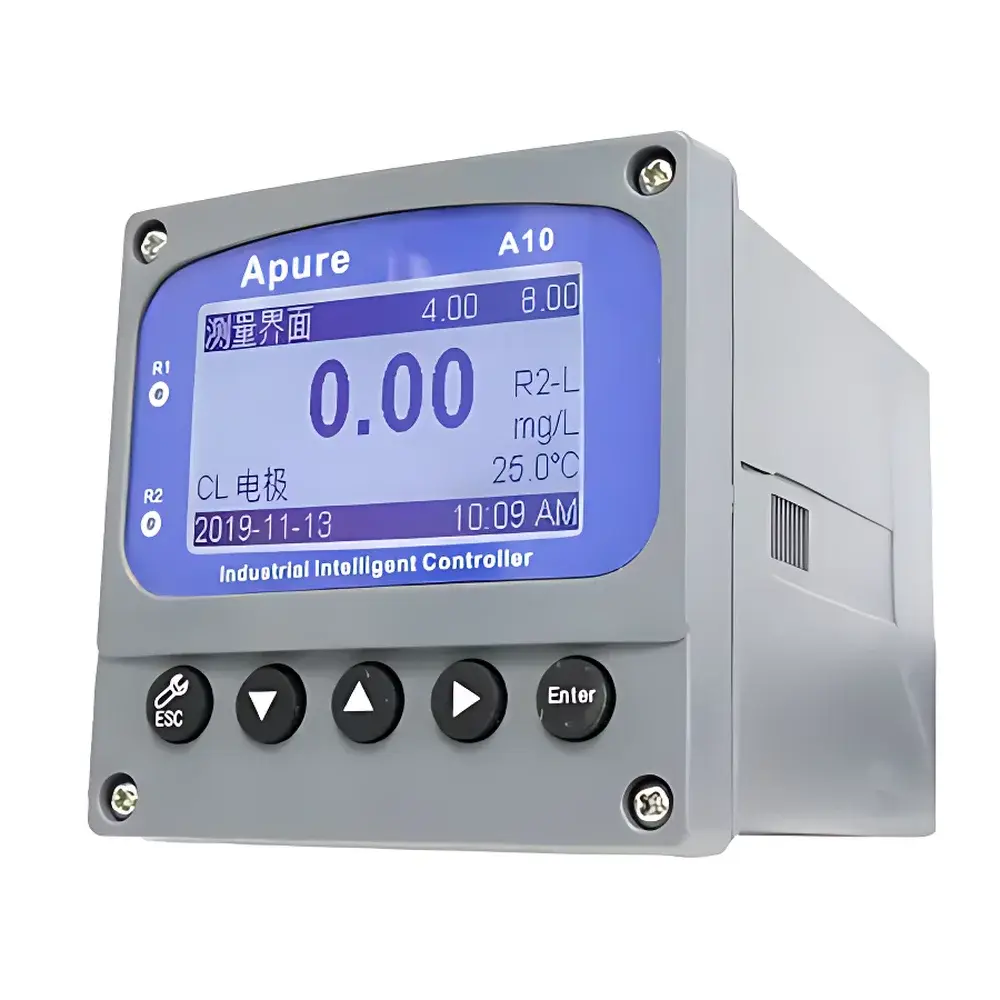
APURE A10CL-AA1 Residual Chlorine Controller
| Brand | APURE |
|---|---|
| Origin | Shanghai, China |
| Manufacturer Type | Direct Manufacturer |
| Product Category | Domestic (China-made) |
| Model | A10CL-AA1 |
| Instrument Type | Online Controller |
| Measurement Parameter | Free Residual Chlorine |
| Measurement Range | 0.00–20.00 ppm |
| Accuracy | ±0.01 ppm |
| Resolution | 0.01 ppm |
| Stability | ≤0.02 ppm/24 h |
| Temperature Compensation | 0–100 °C (Manual / PT1000 / NTC10K) |
| Output Signal | Isolated 4–20 mA (Max Load: 500 Ω) |
| Alarm Output | Dual SPDT Relays (3 A / 250 V AC, NO contact) |
| Power Supply | AC 220 V or DC 24 V |
| Power Consumption | ≤5 W |
| Operating Environment | 0–60 °C, ≤85% RH |
| Dimensions (H×W×D) | 96×96×132 mm |
| Panel Cutout | 92.5×92.5 mm |
| Ingress Protection | IP65 |
Overview
The APURE A10CL-AA1 Residual Chlorine Controller is an industrial-grade online monitoring instrument engineered for continuous, real-time measurement of free residual chlorine concentration in aqueous process streams. Designed to meet the stringent requirements of municipal water treatment, power plant cooling circuits, pharmaceutical clean utilities, food & beverage production lines, and chemical process water systems, the A10CL-AA1 operates on electrochemical amperometric or membrane-based sensing principles—commonly deployed in certified online chlorine analyzers compliant with ISO 7393-2 and ASTM D1253 standards. Its dual-channel capability integrates simultaneous temperature measurement with automatic or manual temperature compensation, ensuring measurement integrity across dynamic thermal conditions. The controller features a robust front-panel interface with configurable language support (English/Chinese), intuitive menu navigation, and password-protected parameter access—enabling secure, operator-level configuration without engineering intervention.
Key Features
- Multi-mode temperature compensation: Supports PT1000 platinum resistance, NTC10K thermistor, and user-defined manual input for precise thermal correction across 0–100 °C.
- Isolated 4–20 mA analog output with galvanic isolation up to 1500 VAC, minimizing signal degradation in electrically noisy industrial environments.
- Dual programmable relays: Independently assignable as high/low alarms with adjustable hysteresis to prevent chattering during setpoint proximity—critical for dosing pump control and safety interlocks.
- High-resolution display and context-sensitive on-screen prompts guide users through calibration, setup, and diagnostic routines without external documentation.
- Secure access architecture: Three-tier password management restricts calibration, relay logic, and system configuration to authorized personnel only.
- Compact DIN-rail mountable housing rated IP65, suitable for wall or panel installation in wet or dust-prone utility rooms and control cabinets.
Sample Compatibility & Compliance
The A10CL-AA1 is intended for use with potable water, filtered process water, low-turbidity effluent, and recirculated cooling water—provided sample conductivity remains within 20–2000 µS/cm and suspended solids are below 10 mg/L. It is not designed for seawater, highly oxidizing solutions (>50 ppm ClO₂), or wastewater with heavy organic fouling. While the device itself does not carry CE, UKCA, or UL certification out-of-box, its electrical design conforms to IEC 61000-6-2 (immunity) and IEC 61000-6-4 (emissions). When integrated into validated water quality monitoring systems, it supports compliance with US EPA Method 334.0, ISO 7393-2 (chlorine determination), and pharmacopeial water specifications (USP , EP 2.2.43) under documented operational qualification (OQ) protocols.
Software & Data Management
The A10CL-AA1 operates as a standalone embedded controller with no external software dependency. All configuration, calibration history, and alarm event logs are stored locally in non-volatile memory. Relay activation timestamps, measured values at 1-second intervals (buffered for 72 hours), and sensor stability diagnostics are accessible via front-panel navigation. For integration into SCADA or DCS platforms, the isolated 4–20 mA output provides traceable analog representation of residual chlorine concentration, fully compatible with industry-standard data acquisition modules. Optional Modbus RTU (RS-485) communication can be enabled via firmware update—supporting read-only access to live readings, temperature, relay status, and calibration due dates per FDA 21 CFR Part 11 audit-trail requirements when paired with compliant host systems.
Applications
- Municipal drinking water distribution: Continuous verification of disinfectant residual at entry points, booster stations, and zone boundaries.
- Power generation: Monitoring chlorination efficacy in once-through and closed-loop cooling water systems to prevent biofouling of condensers and heat exchangers.
- Pharmaceutical purified water (PW) and water-for-injection (WFI) loops: Ensuring post-sanitization chlorine residuals remain within validated limits prior to dechlorination.
- Food processing rinse water: Verifying chlorine concentration meets HACCP critical limits for surface sanitation without over-dosing that may affect product organoleptics.
- Swimming pool and spa recirculation systems: Maintaining regulatory-compliant free chlorine levels while minimizing operator intervention.
FAQ
What measurement principle does the A10CL-AA1 employ?
It utilizes an amperometric chlorine-selective electrode with a gas-permeable membrane and internal electrolyte—standard for online free chlorine analyzers meeting ISO 7393-2 performance criteria.
Can the device measure total chlorine or combined chlorine?
No—the A10CL-AA1 is calibrated and validated exclusively for free residual chlorine (HOCl/OCl⁻); total chlorine requires separate reagent-based analysis (e.g., DPD method).
Is temperature compensation mandatory for accurate readings?
Yes—chlorine sensor response is inherently temperature-dependent; the unit will not achieve ±0.01 ppm accuracy without active compensation using PT1000, NTC10K, or verified manual input.
Does the controller support automatic calibration?
No—calibration is manual and performed using standardized chlorine standard solutions (e.g., 1.00 ppm and 5.00 ppm KClO₃ or NaOCl traceable to NIST SRM); auto-calibration is not implemented.
What maintenance intervals are recommended for field operation?
Electrode membrane replacement every 6–12 months; electrolyte refill every 3 months; zero/slope calibration biweekly under stable conditions or daily in variable-quality influent.







