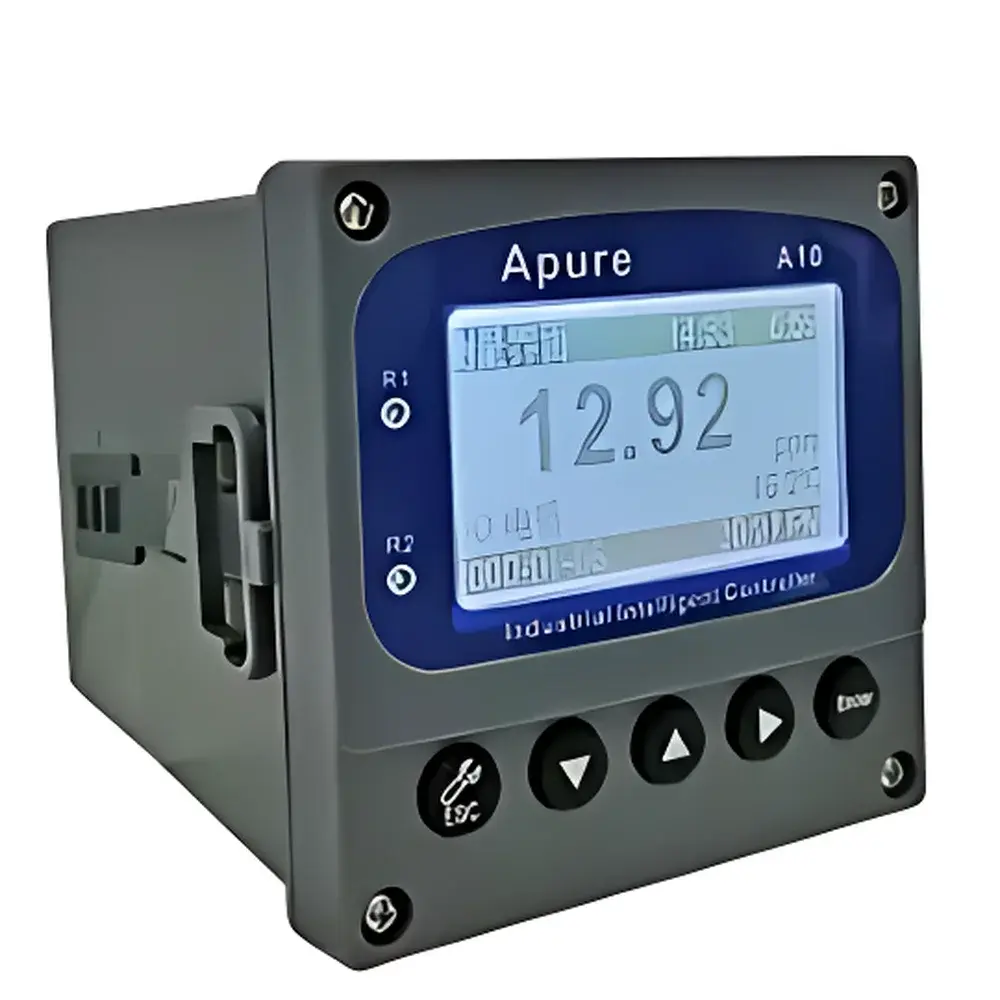
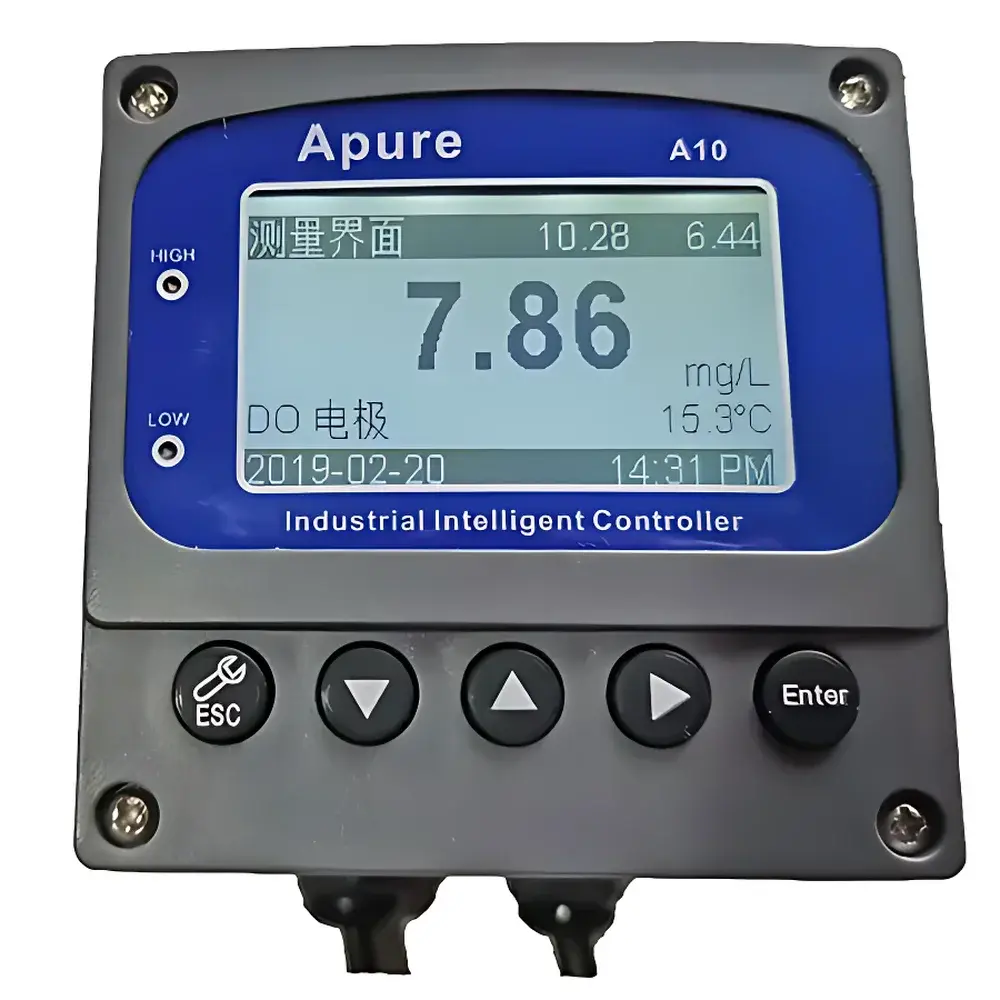
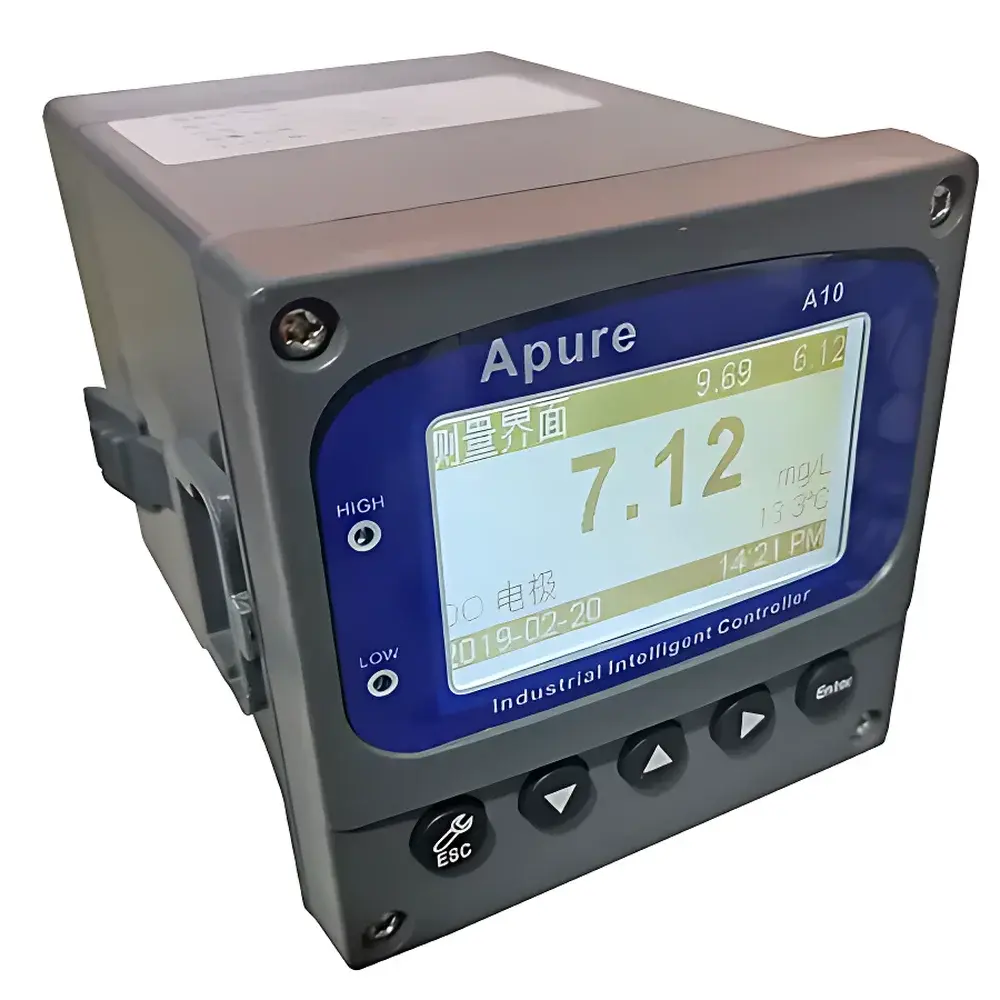
Apure A10DO-AA1 Online Dissolved Oxygen Analyzer
| Brand | Apure |
|---|---|
| Origin | Shanghai, China |
| Manufacturer Type | OEM Manufacturer |
| Regional Classification | Domestic (China) |
| Model | A10DO-AA1 |
| Price | USD 105 (FOB Shanghai) |
| Measurement Range | 0.00–20.00 ppm |
| Resolution | 0.01 ppm |
| Stability | ≤ 0.02 ppm/24 h |
| Temperature Compensation | 0–100 °C (manual or automatic via PT1000/NTC10K sensor) |
| Output Interfaces | Dual isolated 4–20 mA outputs (configurable for DO and temperature), RS485 optional |
| Relay Outputs | 2 programmable SPDT relays (3 A / 250 V AC, NO contact), adjustable hysteresis |
| Power Supply | AC 220 V ±10% / DC 24 V ±10%, ≤ 5 W |
| Enclosure Dimensions | 96 × 96 × 132 mm (H × W × D) |
| Panel Cutout | 92.5 × 92.5 mm |
| Operating Environment | 0–60 °C, ≤ 85 % RH (non-condensing) |
Overview
The Apure A10DO-AA1 Online Dissolved Oxygen Analyzer is an industrial-grade electrochemical measurement system engineered for continuous, real-time monitoring of dissolved oxygen (DO) concentration in aqueous process streams. It employs a polarographic (Clark-type) or galvanic membrane sensor principle—depending on the configured probe variant—to generate a stable, linear current proportional to the partial pressure of molecular oxygen diffusing through a selective gas-permeable membrane. This analog signal is conditioned, digitally processed, and compensated for temperature-induced solubility variations using integrated PT1000 or NTC10K inputs—or manually entered values—ensuring traceable accuracy across dynamic thermal conditions typical in municipal wastewater treatment, potable water distribution, and industrial bioreactor applications. Designed for panel-mount integration in control rooms or field cabinets, the A10DO-AA1 complies with IEC 61000-6-2 (immunity) and IEC 61000-6-4 (emission) standards, supporting uninterrupted operation under electrically noisy plant environments.
Key Features
- Dual isolated 4–20 mA analog outputs: independently assignable to DO concentration (0–20.00 ppm) and process temperature (0–100 °C), each protected against ground loops and common-mode interference
- Configurable relay logic: two SPDT relays with user-defined setpoints, adjustable hysteresis (0.01–5.00 ppm), and fail-safe state assignment for alarm or control actuation
- Multi-mode temperature compensation: automatic compensation using external PT1000 or NTC10K sensors, or manual entry—enabling calibration traceability per ISO 5814 and ASTM D888
- Bilingual operator interface: factory-default Chinese UI with seamless toggle to English; menu-driven navigation with contextual prompts reduces training overhead and minimizes configuration errors
- Secure access control: hierarchical password protection (three privilege levels) restricts parameter modification, calibration, and relay reassignment to authorized personnel only
- Robust mechanical design: IP65-rated front panel, DIN 43700-compliant 96 × 96 mm form factor, and wide-input power supply (AC 220 V or DC 24 V) ensure compatibility with global utility infrastructure
Sample Compatibility & Compliance
The A10DO-AA1 is intended for use with clean to moderately fouling aqueous solutions—including activated sludge effluent, clarified drinking water, cooling tower makeup, and fermentation broth—provided compatible DO probes (e.g., Apure DO-100 series) are installed with appropriate flow cells or immersion housings. It meets CE marking requirements under the Low Voltage Directive (2014/35/EU) and EMC Directive (2014/30/EU). While not intrinsically safe, the analyzer may be deployed in non-hazardous Zone 2/Class I Division 2 areas when paired with certified barrier systems. Its measurement methodology aligns with foundational principles outlined in ISO 5814:2012 (water quality — determination of dissolved oxygen — electrochemical probe method) and supports audit-ready documentation for facilities operating under ISO 9001, ISO 14001, or municipal regulatory frameworks such as EPA Clean Water Act reporting protocols.
Software & Data Management
The A10DO-AA1 operates without embedded firmware-based data logging; instead, it delivers real-time analog and digital signals optimized for integration into existing SCADA, DCS, or PLC architectures. The RS485 interface supports Modbus RTU protocol (slave ID configurable, 9600–19200 bps), enabling bidirectional communication for remote setpoint adjustment, relay status polling, and diagnostic flag retrieval. All configuration changes—including calibration coefficients, temperature compensation mode, and relay thresholds—are timestamped and stored in non-volatile memory. Though the device itself does not provide FDA 21 CFR Part 11-compliant electronic records, its deterministic output behavior and hardware-level write protection support validation pathways for GMP-aligned water-for-injection (WFI) or purified water (PW) monitoring systems when deployed within validated instrument networks.
Applications
- Municipal wastewater treatment: continuous DO monitoring in aerobic digesters, oxidation ditches, and secondary clarifiers to optimize aeration energy consumption and maintain nitrification efficiency
- Drinking water distribution: residual oxygen verification post-chlorination or ozonation, ensuring corrosion control and taste/odor management compliance
- Industrial cooling water systems: early detection of low DO conditions that promote microbiologically influenced corrosion (MIC) in heat exchangers and condensers
- Food & beverage processing: DO control in carbonated beverage fillers, brewing fermenters, and sterile water rinse loops to prevent oxidative degradation of sensitive compounds
- Pharmaceutical water systems: support for USP purified water and water-for-injection specifications where dissolved oxygen serves as a surrogate indicator of system integrity and deaeration performance
FAQ
What sensor technologies are compatible with the A10DO-AA1?
The analyzer accepts standard analog mV or µA signals from polarographic (electrochemical) or galvanic DO probes with built-in thermistors. Apure recommends pairing it with its DO-100 series membrane electrodes, which feature replaceable membranes and electrolyte cartridges for extended service life.
Does the A10DO-AA1 support automatic calibration?
No—calibration is performed externally at the probe level using zero-oxygen (sodium sulfite) and saturated-air (100% air-saturated water at known temperature) standards. The analyzer retains calibration slope and offset values but does not execute automated sequence routines.
Can the device operate on battery backup during AC power failure?
Not natively—the unit requires continuous AC 220 V or DC 24 V input. However, integration with an external UPS or 24 V DC battery bank is fully supported due to its low 5 W power draw and wide DC voltage tolerance.
Is the 4–20 mA output intrinsically safe?
No—the outputs are isolated but not intrinsically safe rated. For hazardous area installations, connection through approved Zener barriers or galvanic isolators is mandatory per IEC 60079-11.
How is long-term stability verified in routine maintenance?
Stability is assessed by performing duplicate air-saturation checks at fixed temperatures every 30 days. Drift exceeding ±0.02 ppm over 24 hours triggers probe membrane replacement or electrolyte refill per manufacturer’s preventive maintenance schedule.