
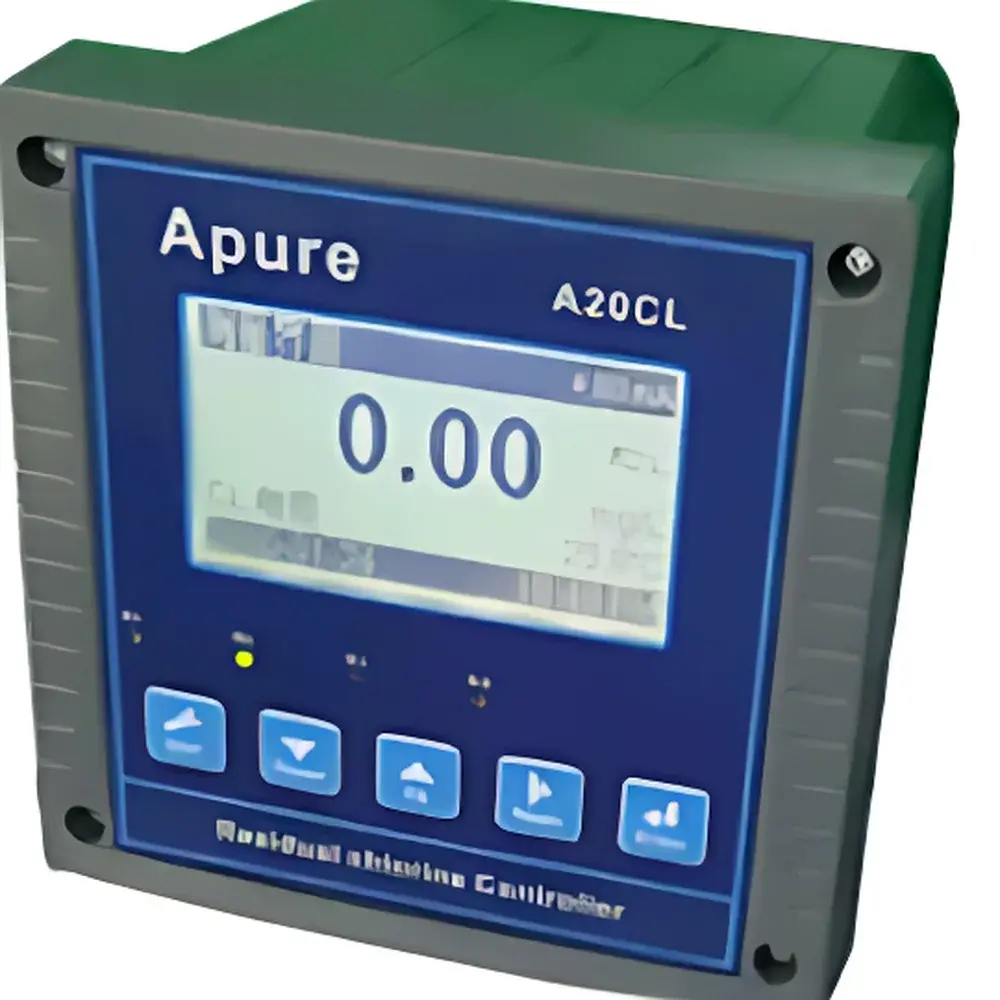
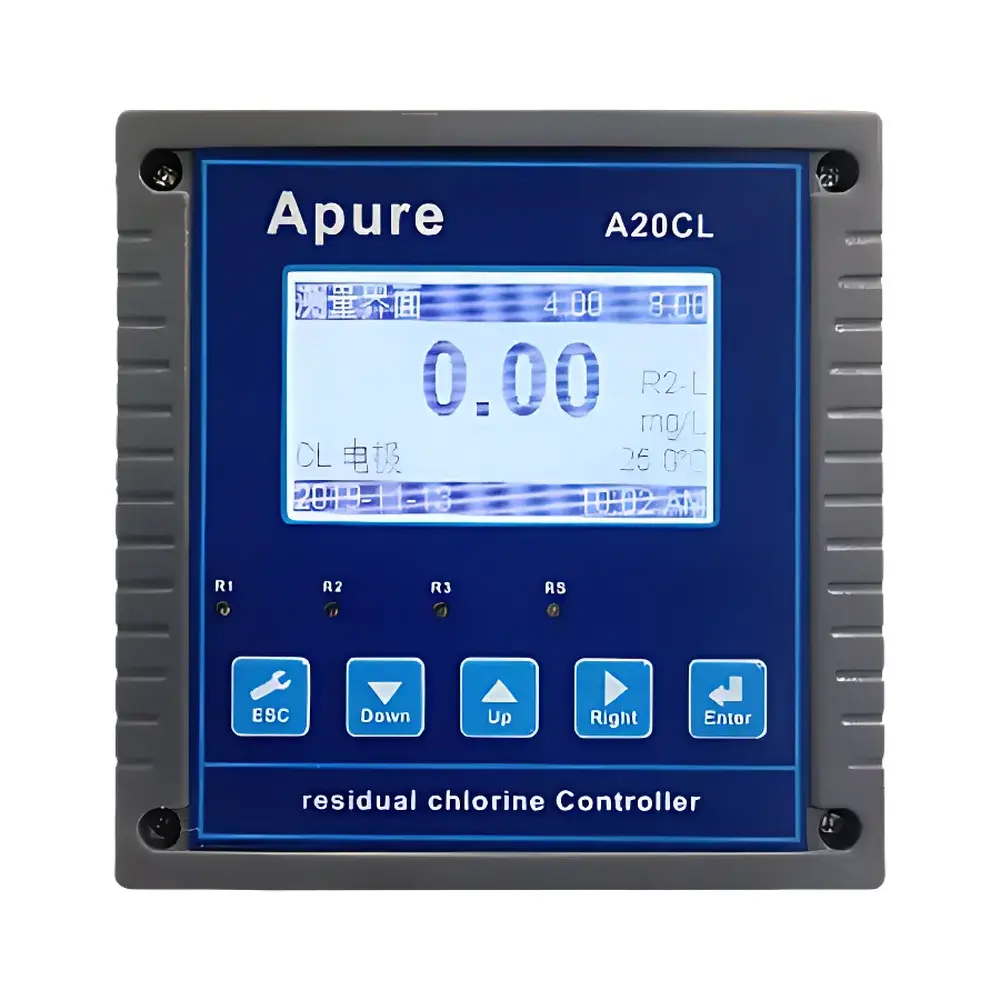
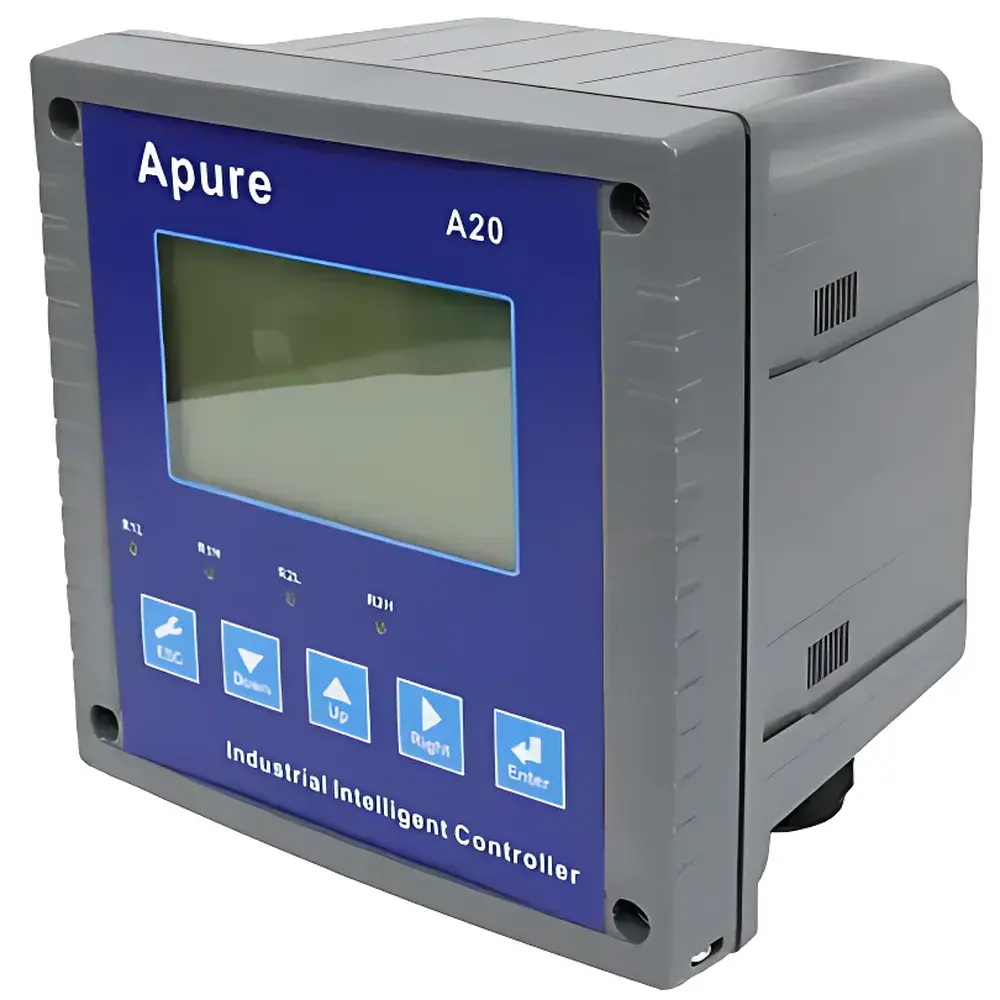
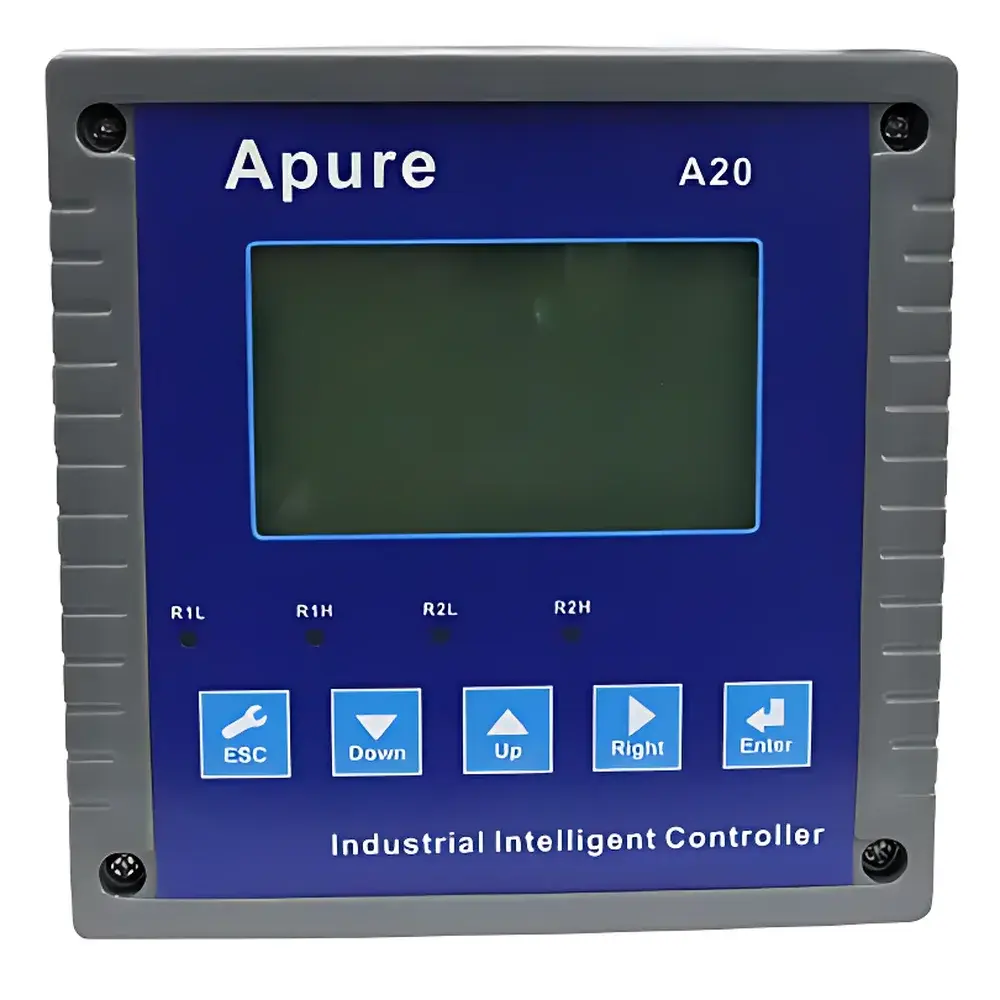
APURE A20CL-AA1 Residual Chlorine Analyzer
| Brand | APURE |
|---|---|
| Origin | Shanghai, China |
| Manufacturer Type | Direct Manufacturer |
| Product Category | Domestic (China-Made) |
| Model | A20CL-AA1 |
| Instrument Type | Online Analyzer |
| Measurement Principle | Electrochemical Amperometric Sensor |
| Measured Parameter | Free Residual Chlorine |
| Range Options | 0–20 ppm / 0.0–20.0 ppm / 0.00–20.00 ppm |
| Accuracy | ±0.01 ppm |
| Resolution | 0.01 ppm |
| Stability | ≤0.02 ppm/24 h |
| Temperature Compensation | 0–100 °C (PT1000, NTC10K, or Manual) |
| Output Signals | Dual Isolated 4–20 mA (Chlorine & Temperature, max. load 500 Ω) |
| Relay Outputs | 3 Programmable SPDT Relays (3 A / 250 V AC, NO contact, adjustable hysteresis) |
| Power Supply | AC 220 V ±10% or DC 24 V ±10% |
| Power Consumption | ≤7 W |
| Operating Environment | 0–50 °C, ≤85% RH |
| Enclosure Dimensions | 144 × 144 × 115 mm (H × W × D) |
| Panel Cutout | 138 × 138 mm |
| Ingress Protection | IP65 |
| User Interface | Bilingual (Chinese/English), Menu-Driven Navigation |
| Security | Password-Protected Configuration Access |
Overview
The APURE A20CL-AA1 Residual Chlorine Analyzer is an online electrochemical amperometric analyzer engineered for continuous, real-time monitoring of free residual chlorine concentration in potable water, treated effluent, and process streams. It operates on the principle of diffusion-controlled amperometry: chlorine molecules permeate a selective hydrophobic membrane and undergo reduction at a working electrode (typically platinum or gold), generating a current linearly proportional to the aqueous free chlorine concentration. This measurement architecture ensures high specificity for hypochlorous acid (HOCl) and hypochlorite ion (OCl⁻) — the dominant biocidal species in chlorinated water — while minimizing interference from oxidants such as ozone, chlorine dioxide, or hydrogen peroxide when properly calibrated and maintained. Designed for integration into distributed control systems (DCS) and supervisory control and data acquisition (SCADA) platforms, the A20CL-AA1 delivers stable, trace-level quantification across three selectable resolution modes (ppm, 0.1 ppm, and 0.01 ppm), supporting compliance with regulatory thresholds defined by WHO, EPA Method 334.0, ISO 7393-2, and national drinking water standards.
Key Features
- Triple-resolution measurement capability: configurable ranges of 0–20 ppm, 0.0–20.0 ppm, and 0.00–20.00 ppm enable precise adaptation to low-dose disinfection control (e.g., distribution networks) and high-concentration applications (e.g., chlorination contact tanks).
- Dual isolated 4–20 mA analog outputs — independently assignable to residual chlorine and temperature — provide galvanically separated signal transmission with immunity to ground loops and electromagnetic interference (EMI), meeting IEC 61000-4-4 surge immunity requirements.
- Flexible temperature compensation architecture supports PT1000 RTD, NTC10K thermistor, or manual offset input — ensuring accurate normalization of sensor response across operational temperatures from 0 to 100 °C.
- Three fully programmable SPDT relays support customizable high/low alarm logic with user-defined hysteresis, preventing rapid cycling during transient fluctuations near setpoints — critical for pump control, chemical dosing activation, or SCADA event triggering.
- Bilingual menu-driven interface (Chinese/English) with contextual on-screen prompts reduces operator training time and minimizes configuration errors; password protection restricts access to calibration, relay, and output parameters per GLP-aligned operational protocols.
- IP65-rated front panel enclosure enables wall- or panel-mount deployment in humid, chemically exposed environments typical of water treatment plants, pharmaceutical utilities, and food-grade process areas.
Sample Compatibility & Compliance
The A20CL-AA1 is validated for use with clarified, filtered, and deaerated aqueous matrices exhibiting pH 5.0–8.5 and conductivity 5 NTU), suspended solids, or strong reducing agents (e.g., sulfite residuals). The analyzer conforms to CE marking directives (EMC Directive 2014/30/EU, Low Voltage Directive 2014/35/EU), meets RoHS 2011/65/EU substance restrictions, and supports audit-ready operation under ISO/IEC 17025-accredited laboratories when paired with documented calibration procedures traceable to NIST SRM 2671a (chlorine standard solutions). Its relay logic and data logging behavior align with GMP Annex 11 and FDA 21 CFR Part 11 expectations for electronic records when integrated with compliant SCADA historians.
Software & Data Management
While the A20CL-AA1 operates as a standalone controller without embedded PC software, its analog and relay outputs are compatible with third-party data acquisition systems (e.g., Siemens Desigo, Honeywell Experion, Ignition SCADA) via standard 4–20 mA input modules and dry-contact interfaces. All configuration changes—including range selection, temperature compensation mode, relay thresholds, and hysteresis values—are stored in non-volatile memory with timestamped write cycles. Calibration events (zero/span) require manual entry of date, operator ID, and standard concentration; no automated electronic audit trail is generated internally, but external systems may log these inputs via modbus-compatible gateways (optional add-on). Firmware updates are performed locally via USB port using APURE-provided configuration utility (Windows only).
Applications
- Municipal drinking water distribution: continuous verification of disinfectant residual at entry points, storage reservoirs, and zone boundaries to ensure microbial safety per WHO Guidelines for Drinking-water Quality.
- Wastewater disinfection effluent monitoring: real-time feedback control of post-secondary chlorination or dechlorination (e.g., sodium bisulfite dosing) to meet NPDES discharge limits.
- Pharmaceutical purified water (PW) and water for injection (WFI) loop surveillance: compliance with USP and EU GMP Annex 1 requirements for oxidative residual control in non-sterile process water systems.
- Food and beverage process water: inline verification of sanitizer concentration in CIP rinse stages and final product contact water lines.
- Power plant cooling tower make-up water: prevention of biofilm formation through sustained residual maintenance within ASHRAE 188-2021 recommended ranges.
FAQ
What chlorine species does the A20CL-AA1 measure?
It measures total free residual chlorine — the sum of hypochlorous acid (HOCl) and hypochlorite ion (OCl⁻) — which constitutes the primary disinfecting agent in chlorinated water systems.
Is the sensor suitable for seawater or brackish water applications?
No. High chloride ion concentration (>5,000 mg/L) accelerates electrode passivation and membrane fouling; use is restricted to freshwater matrices with TDS < 1,000 mg/L.
How often should calibration be performed?
Daily zero calibration with dechlorinated water and weekly span calibration with certified chlorine standard (e.g., NIST-traceable DPD-based solution) are recommended for critical applications; less frequent calibration may be justified under stable process conditions with documented performance verification.
Can the unit operate on battery backup?
No. It requires continuous AC 220 V or DC 24 V supply; integration with UPS systems is advised for continuity in mission-critical installations.
Does it support Modbus RTU or other digital communication protocols?
Not natively. Digital communication requires optional external protocol converters; analog 4–20 mA remains the primary interface for system integration.
Related Products







