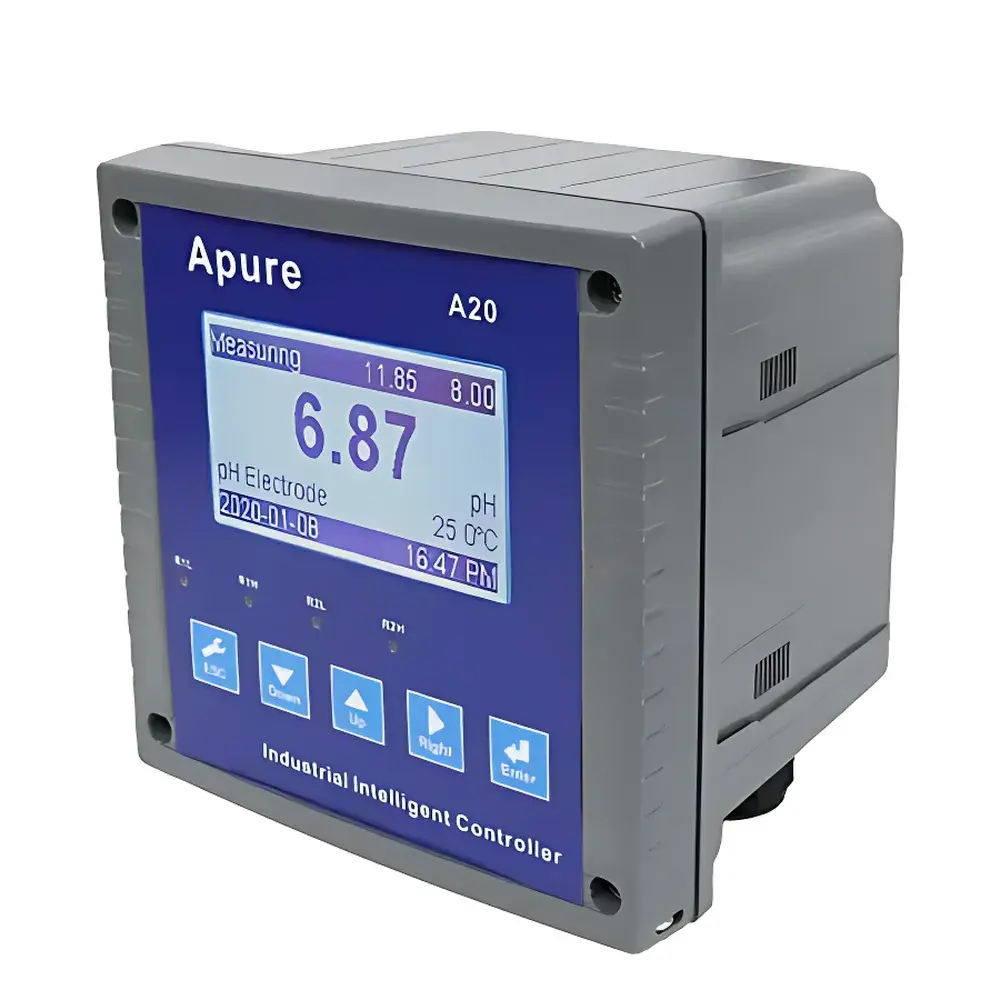
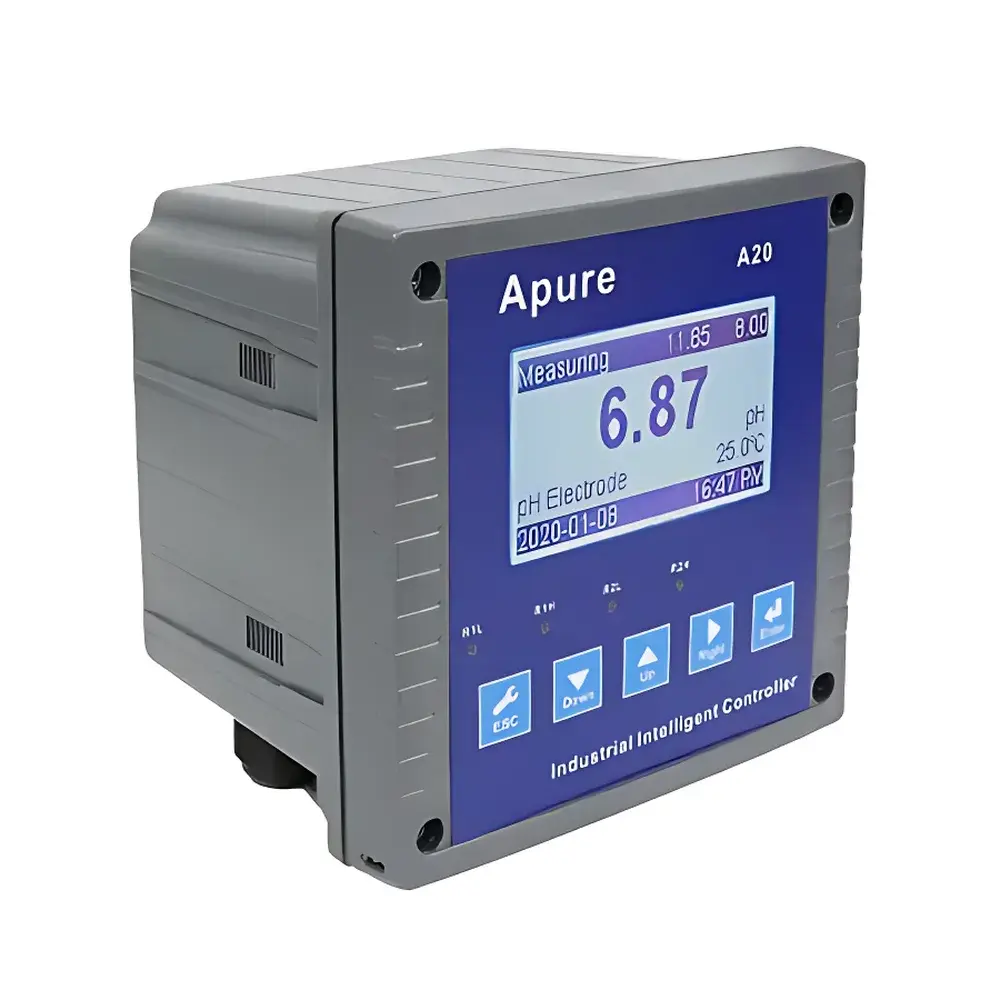
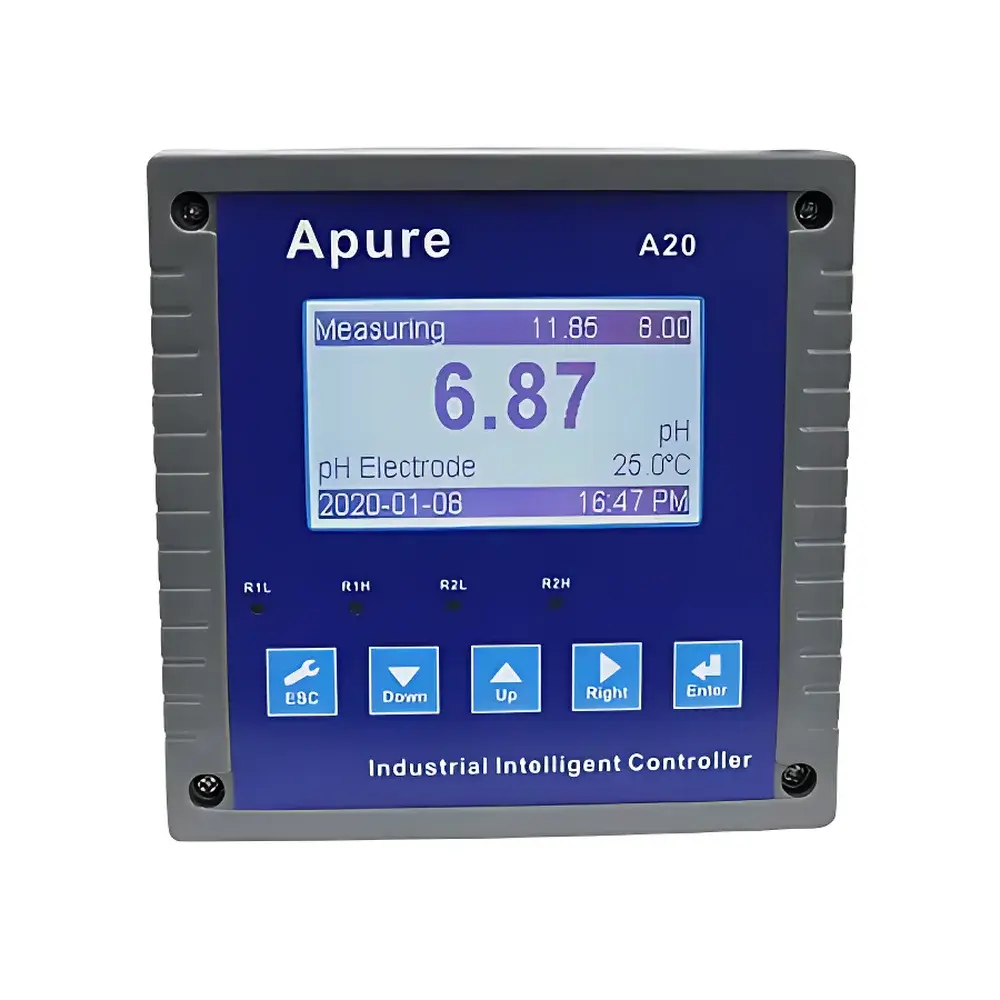
APURE A20PR-AA1 Online pH/ORP Controller
| Brand | APURE |
|---|---|
| Model | A20PR-AA1 |
| Measurement Range | pH 0.00–14.00 |
| Resolution | 0.01 pH |
| Accuracy | ±0.01 pH |
| Temperature Compensation | 0–100 °C (manual, PT1000, or NTC10K) |
| Output | Isolated 4–20 mA (dual optional), RS-485 Modbus RTU (optional) |
| Relay Outputs | 2 configurable SPDT relays (3 A/250 VAC), including self-cleaning function |
| Power Supply | AC 220 V or DC 24 V |
| Enclosure Dimensions | 144 × 144 × 115 mm (H × W × D) |
| Panel Cutout | 138 × 138 mm |
| Stability | ≤0.02 pH/24 h |
| Operating Environment | 0–60 °C |
| Power Consumption | ≤5 W |
Overview
The APURE A20PR-AA1 Online pH/ORP Controller is an industrial-grade process analyzer engineered for continuous, high-reliability monitoring and control of aqueous solution acidity (pH) and oxidation-reduction potential (ORP) in real time. Based on potentiometric measurement principles—utilizing a glass electrode for pH and a noble metal (typically platinum or gold) reference electrode for ORP—the controller delivers stable, traceable readings under dynamic process conditions. Its dual-parameter capability enables simultaneous acquisition of pH, ORP, and temperature, with integrated automatic temperature compensation (ATC) critical for maintaining electrochemical accuracy across thermal gradients. Designed for permanent panel-mount installation in harsh industrial environments, the A20PR-AA1 complies with IEC 61000-6-2 (immunity) and IEC 61000-6-4 (emission) standards, supporting uninterrupted operation in wastewater treatment plants, pharmaceutical water systems, boiler feedwater control loops, chemical dosing stations, and food & beverage CIP (Clean-in-Place) validation processes.
Key Features
- Triple temperature compensation modes: fully automatic via PT1000 or NTC10K sensor input, or manual setpoint entry—ensuring consistent calibration integrity across variable thermal regimes.
- Dual independent relay outputs (SPDT, 3 A/250 VAC) with user-definable hysteresis and alarm logic (high/low, latching/non-latching), plus dedicated self-cleaning relay output for automated electrode maintenance cycles.
- Flexible analog output architecture: standard single isolated 4–20 mA loop assignable to pH, ORP, or temperature; optional dual 4–20 mA configuration or RS-485 Modbus RTU interface for integration into DCS, SCADA, or PLC-based control networks.
- Multi-language operator interface (English/Chinese) with context-sensitive menu navigation, password-protected configuration access (three-tier privilege levels), and real-time status indicators for electrode impedance, calibration validity, and signal stability.
- Rugged IP65-rated front panel housing (144 × 144 × 115 mm DIN format), low-power design (≤5 W), and wide-input power options (AC 220 V ±10% or DC 24 V ±15%) for compatibility with global plant electrical infrastructure.
Sample Compatibility & Compliance
The A20PR-AA1 is optimized for aqueous solutions with conductivity ≥50 µS/cm and total dissolved solids (TDS) < 10,000 ppm. It supports standard combination pH/ORP electrodes with BNC or DIN connectors and accommodates both refillable and gel-filled reference systems. Electrode compatibility includes common industrial configurations (e.g., double-junction, armored, or high-temperature variants). The instrument meets CE marking requirements and adheres to electromagnetic compatibility (EMC) directives per EN 61326-1. While not certified for intrinsic safety (ATEX/IECEx), it is suitable for Zone 2/Class I Div 2 environments when installed with appropriate barrier systems. Calibration traceability aligns with ISO/IEC 17025 practices when used with NIST-traceable buffer standards (e.g., ASTM D1293, USP ).
Software & Data Management
No embedded PC software is required for basic operation; all configuration, calibration, and diagnostics are performed locally via the intuitive membrane keypad and LCD display. However, optional Modbus RTU communication enables remote parameter read/write, real-time data logging, and event-triggered alarms via supervisory systems. The controller records up to 1,000 calibration events with timestamps and electrode slope/mV offset values—supporting audit-ready documentation for GLP/GMP-regulated facilities. Data retention persists through power loss thanks to non-volatile EEPROM memory. Firmware updates are performed via USB-to-serial adapter (not included), following validated update procedures compliant with FDA 21 CFR Part 11 electronic record requirements when deployed in regulated pharmaceutical or biotech applications.
Applications
- Municipal and industrial wastewater treatment: monitoring neutralization basins, anaerobic digesters, and effluent discharge compliance (e.g., EPA NPDES permit thresholds).
- Power generation: boiler feedwater pH control (target: 9.2–9.6), condensate polishing, and corrosion mitigation in steam cycles.
- Pharmaceutical purified water (PW) and water-for-injection (WFI) distribution systems—validated per USP and EU Annex 1 guidelines.
- Chemical manufacturing: batch reaction pH endpoint detection, acid/base dosing control, and redox-mediated synthesis (e.g., chlorine dioxide generation).
- Food processing: sanitizing solution verification (e.g., peracetic acid ORP > 650 mV), brine concentration control, and enzymatic reaction monitoring.
FAQ
What temperature sensors are supported for automatic compensation?
The A20PR-AA1 accepts PT1000 (DIN EN 60751 Class B) and NTC10K (β = 3950 K) thermistors, in addition to manual temperature entry.
Can the 4–20 mA outputs be assigned independently to pH, ORP, and temperature simultaneously?
Yes—when equipped with the dual-output option, one channel can transmit pH (or ORP) while the second transmits temperature, each with user-defined scaling and fault signaling (e.g., 3.6 mA = sensor fault).
Is the relay output suitable for direct control of solenoid valves or dosing pumps?
Each relay is rated for 3 A resistive load at 250 VAC and may directly drive small AC solenoids or pilot relays; for higher-power loads, external solid-state relays or contactors are recommended.
Does the controller support two-point pH calibration with slope and offset verification?
Yes—it guides users through standard two-buffer (e.g., pH 4.01/7.00 or 7.00/10.01) calibration with real-time slope calculation (%), asymmetry potential, and accept/reject criteria based on ±5 mV deviation thresholds.
How is long-term drift managed during unattended operation?
The unit logs daily stability metrics (ΔpH/24 h and ΔmV/24 h); if drift exceeds 0.02 pH or 3 mV, a maintenance alert appears on-screen and can trigger a relay or Modbus register flag for predictive maintenance scheduling.