
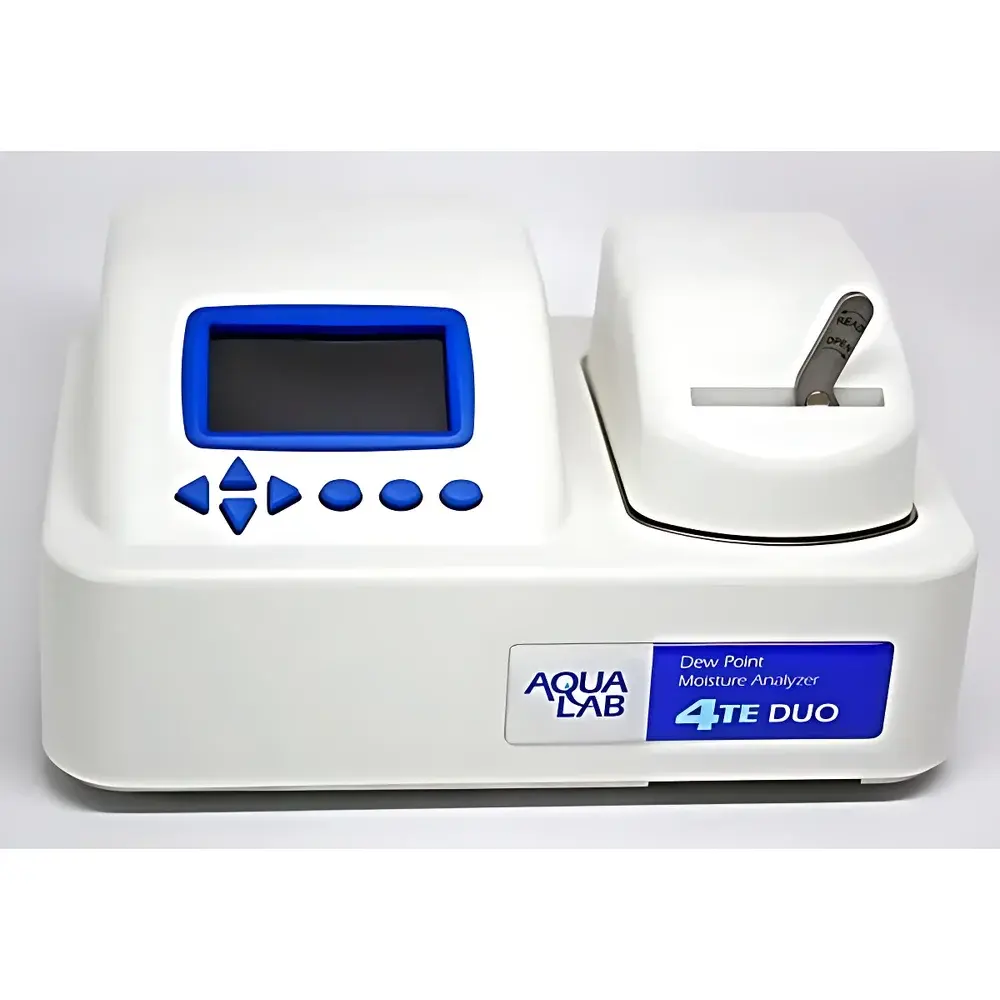
Aqualab 4TE DUO Water Activity Analyzer
| Brand | METER Group, Inc. |
|---|---|
| Origin | USA |
| Model | Aqualab 4TE DUO |
| Measurement Principle | Chilled-Mirror Dew Point |
| Temperature Control | Dual-Zone Peltier (±0.1 °C) |
| Water Activity Range | 0.01–0.98 aw |
| Resolution | 0.001 aw |
| Moisture Content Accuracy | Up to 10× higher than gravimetric methods for hygroscopic matrices |
| Calibration Traceability | NIST-traceable saturated salt standards |
| Data Security | User-access levels, audit trail, password-protected settings |
| Compliance | Supports FDA 21 CFR Part 11, GLP/GMP documentation requirements |
| Sample Equilibration Time | <5 min typical |
| Power | 100–240 VAC, 50/60 Hz |
Overview
The Aqualab 4TE DUO Water Activity Analyzer is a dual-function, temperature-controlled instrument engineered by METER Group, Inc. (formerly Decagon Devices) for simultaneous, high-fidelity measurement of water activity (aw) and moisture content in food, pharmaceutical, and agricultural materials. It employs the chilled-mirror dew point method—a physically based, thermodynamic technique recognized as the industry gold standard for water activity determination. Unlike indirect or loss-on-drying approaches, the dew point method directly measures the equilibrium vapor pressure above a sample by detecting the precise temperature at which condensation forms on a highly polished, temperature-regulated mirror surface. This physical endpoint eliminates reliance on chemical reagents, drying kinetics, or empirical correlations—ensuring traceable, reproducible, and matrix-independent results. The 4TE DUO integrates dual-zone Peltier temperature control to stabilize both sample chamber and mirror assembly within ±0.1 °C, enabling robust performance across ambient and sub-ambient conditions. Since its introduction in the early 1980s, this methodology has been adopted by over 80% of the Fortune 100 food manufacturers in the United States and is cited in ASTM F1718, ISO 21807, and USP <1112> as a validated reference method.
Key Features
- Dual-parameter output: Simultaneous reporting of water activity (aw) and moisture content (g H2O/100 g dry basis) from a single 5-minute measurement cycle
- Chilled-mirror dew point sensor with real-time infrared optical detection—no consumables, no drift, no calibration drift between verifications
- Integrated dual-zone Peltier thermal control for precise sample and mirror temperature regulation (range: 5–50 °C)
- NIST-traceable calibration using certified saturated salt standards; full calibration history stored with timestamp, operator ID, and instrument serial number
- Configurable user access levels (operator, supervisor, administrator) with password protection and encrypted audit trail compliant with FDA 21 CFR Part 11
- Low total cost of ownership: Annual operational cost estimated at $1,598 USD for 20 samples/day—less than one-third the cost of gravimetric drying methods ($4,560 USD/year under identical throughput)
Sample Compatibility & Compliance
The Aqualab 4TE DUO accommodates solid, semi-solid, paste, and powdered samples—including low-moisture snacks, dairy powders, spices, confectionery, pet food, and active pharmaceutical ingredients (APIs). Its sealed sample chamber minimizes ambient interference, while the non-destructive dew point principle preserves sample integrity for downstream testing. Method validation aligns with international regulatory frameworks: it satisfies the instrumental requirements of ISO 21807:2022 (Food — Determination of water activity), ASTM F1718-21 (Standard Test Method for Water Activity of Food Products), and USP Chapter <1112> (Water Activity and Microbial Growth). For GxP environments, the system supports electronic signatures, change control logs, and full data integrity per ALCOA+ principles. All firmware updates and calibration records are time-stamped and digitally signed to support internal audits and regulatory inspections.
Software & Data Management
The instrument operates via METER’s proprietary AquaLab Connect software (Windows-compatible), providing real-time graphing of dew point convergence, automated pass/fail thresholds, and batch report generation in PDF or CSV. Raw sensor data—including mirror temperature, signal intensity, and equilibrium time—are retained with metadata (user ID, date/time, sample ID, calibration status). Exported files include embedded digital signatures and checksums to prevent tampering. The software enforces role-based permissions: operators may run measurements but cannot modify calibration parameters; supervisors can initiate recalibrations; administrators manage user accounts and audit log exports. All actions—including measurement start/stop, calibration execution, and parameter changes—are recorded in an immutable audit trail with ISO 8601 timestamps and hash-verified entries.
Applications
- Shelf-life prediction modeling through correlation of aw with microbial growth limits (e.g., Aspergillus flavus inhibition at aw < 0.80)
- Formulation optimization for intermediate moisture foods (IMF), where precise aw control prevents caking, clumping, or texture degradation
- Raw material release testing in contract manufacturing organizations (CMOs) to verify supplier-provided moisture specifications against traceable physical standards
- Stability studies under accelerated storage conditions (e.g., 40 °C/75% RH) to quantify moisture migration in multilayer packaging systems
- Process validation for spray drying, freeze drying, and extrusion lines where real-time aw feedback informs endpoint determination
FAQ
How does the dew point method differ from Karl Fischer titration or loss-on-drying?
The dew point method measures the thermodynamic equilibrium vapor pressure of water above a sample—providing direct, absolute aw without assumptions about sample composition or volatiles. Karl Fischer requires reagent compatibility and is sensitive to interfering substances; gravimetric methods assume only water is lost during heating, which is invalid for many food matrices containing volatile organics.
Can the Aqualab 4TE DUO be used for regulatory submissions?
Yes—its NIST-traceable calibration, audit trail, electronic signature capability, and compliance with FDA 21 CFR Part 11 make it suitable for regulated environments including FDA, EMA, and Health Canada submissions.
What maintenance is required?
No routine maintenance beyond periodic verification with saturated salt standards (recommended every 30 days or per SOP); the chilled mirror is self-cleaning via controlled condensation cycles and requires no polishing or replacement.
Is moisture content calculation standardized across sample types?
Moisture content is derived from aw and temperature using the GAB (Guggenheim-Anderson-de Boer) or BET model selected by the user—both embedded in the firmware and configurable per material class per ISO 1871 guidelines.
Does the instrument support network integration?
Yes—via Ethernet or USB, it supports integration into LIMS and MES platforms using OPC UA or Modbus TCP protocols; raw data streams are accessible via RESTful API endpoints.





