
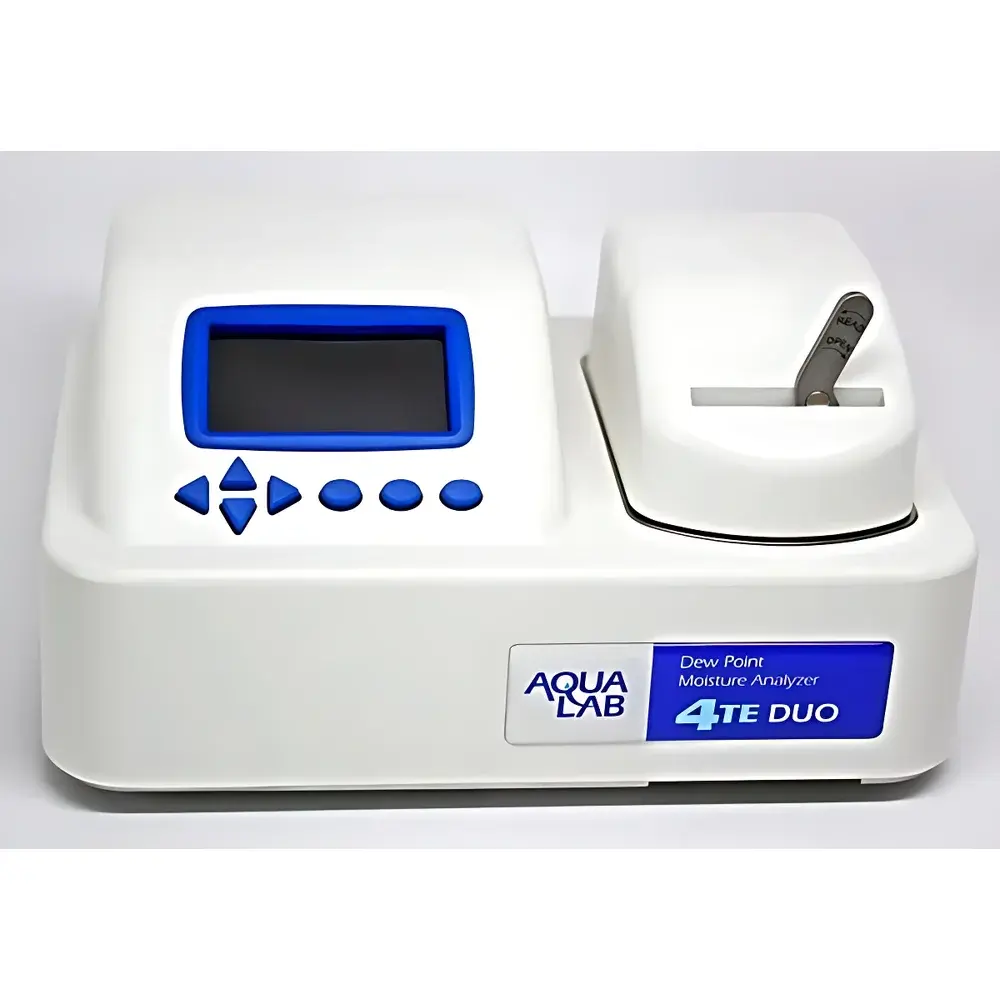
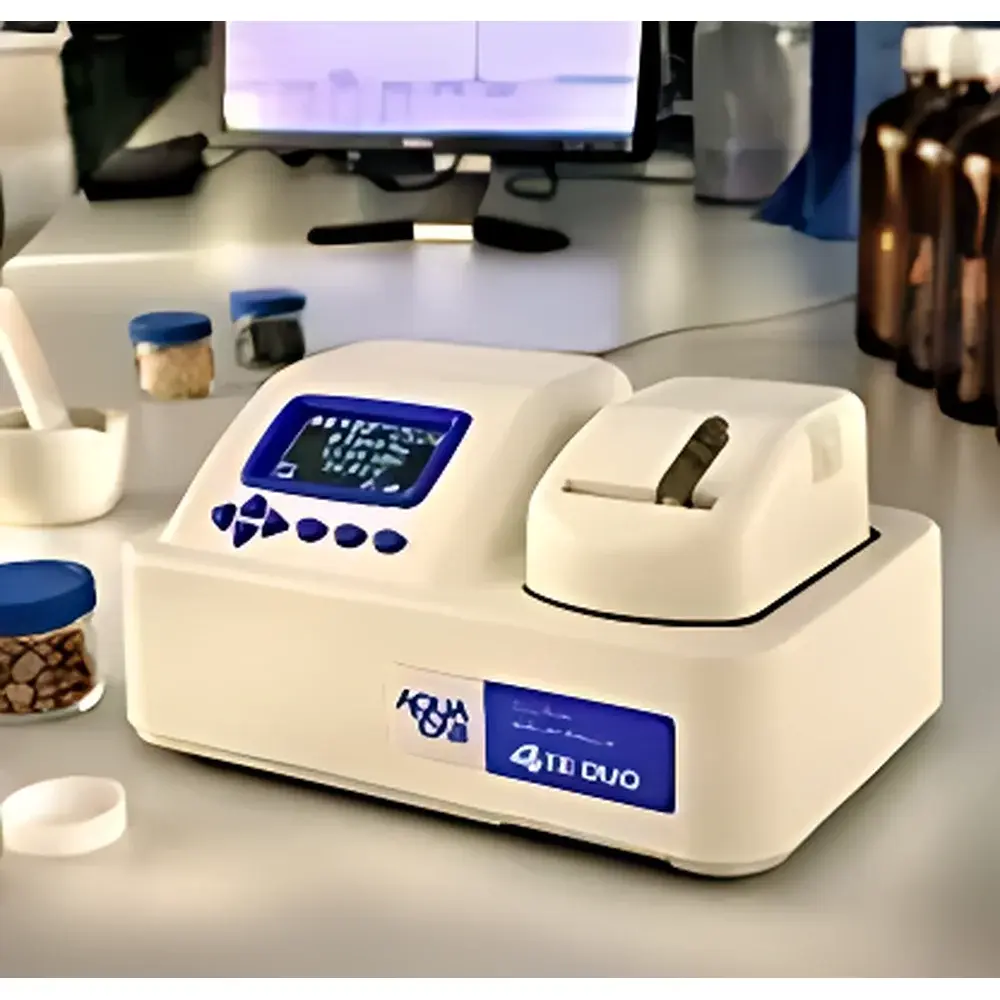
Aqualab 4TE DUO Water Activity Analyzer & Moisture Content Analyzer
| Brand | Aqualab |
|---|---|
| Origin | USA |
| Model | 4TE DUO |
| Sensor Type | Mirror Condensation Dew Point Sensor |
| Accuracy (aw) | ±0.003 aw |
| Resolution (aw) | ±0.0001 aw |
| Measurement Range (aw) | 0.1000–0.9500 aw |
| Repeatability (aw) | ±0.001 aw |
| Moisture Content Resolution | ±0.01% |
| Moisture Content Repeatability | ±0.02% |
| Temperature Control Range | 15–50 °C |
| Temperature Accuracy | ±0.2 °C |
| Temperature Resolution | 0.01 °C |
| Sample Volume | 7 mL (max 15 mL) |
| Measurement Time | <5 min (avg. 2.5 min) |
| Data Storage Capacity | 8,000 readings |
| Display | 128×64 pixel backlit LCD |
| Interface | RS-232, USB |
| Dimensions | 26.7 × 17.8 × 12.7 cm |
| Weight | 3.18 kg |
| Power | 110–220 VAC, 50/60 Hz, <0.4 A |
| Operating Environment | 4–60 °C, 0–90% RH (non-condensing) |
| Certifications | CE |
| Warranty | 1 year (parts & labor) |
Overview
The Aqualab 4TE DUO Water Activity Analyzer & Moisture Content Analyzer is an engineered dual-parameter instrument designed for precision measurement of water activity (aw) and moisture content in a single operational cycle. It employs the mirror condensation dew point method — a thermodynamic principle grounded in the equilibrium vapor pressure of water above a sample surface — to determine water activity with high reproducibility. Unlike gravimetric or Karl Fischer titration methods, the 4TE DUO requires no consumables, reagents, or elevated temperature exposure, minimizing analytical interference and operator variability. Once a representative sample (7 mL typical, up to 15 mL) is sealed in the sample chamber, the system establishes vapor-phase equilibrium between the sample and the headspace. An infrared beam focuses onto a chilled, polished mirror surface; condensation onset is detected optically, yielding the precise dew point temperature. This value is converted to water activity using the Magnus–Tetens equation, and subsequently mapped to moisture content via user-loaded or factory-calibrated sorption isotherms stored in non-volatile memory.
Key Features
- Dual-parameter output: Simultaneous aw and moisture content reporting within ≤5 minutes (typical 2.5 min), eliminating sequential testing workflows.
- Mirror condensation dew point sensor with ±0.003 aw accuracy and ±0.0001 aw resolution — compliant with ISO 21807:2004 and ASTM F1718–19 standards for water activity instrumentation.
- Programmable temperature control (15–50 °C, ±0.2 °C accuracy) enables standardized measurements across variable ambient conditions — critical for stability studies and shelf-life modeling.
- Integrated sorption isotherm database supports automatic moisture content derivation from aw, configurable per product class (e.g., dairy powders, cereal grains, pharmaceutical excipients).
- Robust data governance architecture: 8,000 internal storage slots with timestamp, operator ID, calibration history, and measurement metadata — aligned with FDA 21 CFR Part 11 requirements for audit-ready records.
- Modular access design: Hinged sample chamber lid facilitates rapid visual inspection and cleaning of the mirror sensor — reducing downtime and cross-contamination risk in high-throughput labs.
Sample Compatibility & Compliance
The 4TE DUO accommodates heterogeneous solid and semi-solid matrices common in food, nutraceutical, and pharmaceutical manufacturing — including freeze-dried proteins, roasted coffee beans, confectionery coatings, and hygroscopic excipients. Its sealed chamber design ensures reliable performance with volatile or low-aw samples (down to 0.1000 aw). The instrument meets CE marking requirements and adheres to IEC 61000-6-3 (EMC) and IEC 61010-1 (safety) directives. For regulated environments, its password-protected multi-user interface (25 configurable accounts), electronic signature support, and immutable data logging satisfy GLP and GMP documentation expectations. While not intrinsically calibrated to USP <1151> or ISO 18867, its dew point methodology is recognized as a primary reference technique under ISO 21807 Annex A.
Software & Data Management
Data export is supported via RS-232 serial or USB interface to third-party LIMS or ELN platforms. Instrument firmware permits alphanumeric sample identification (e.g., batch ID, lot number, formulation code) directly on the 128×64 pixel backlit display. All stored entries include date/time stamp, operator login, calibration verification status, and environmental chamber temperature at time of measurement. Audit trail functionality logs all configuration changes and user actions, supporting 21 CFR Part 11 compliance when deployed with validated software extensions. No proprietary cloud service is required; raw data files are exported in ASCII-delimited format for traceable post-processing in Excel or statistical analysis tools (e.g., JMP, Minitab).
Applications
- Food safety validation: Correlating aw with microbial growth limits (e.g., inhibition of Staphylococcus aureus at aw < 0.86) per FDA Food Code guidelines.
- Pharmaceutical stability testing: Monitoring moisture-driven degradation pathways in lyophilized biologics and amorphous small-molecule APIs.
- Quality control of intermediate powders: Verifying consistency of spray-dried milk, whey protein, or starch derivatives prior to blending or encapsulation.
- Research on sorption kinetics: Generating dynamic isotherms under controlled temperature ramping protocols.
- Regulatory submission support: Providing auditable, instrument-generated evidence for aw-based shelf-life claims in FDA IND/NDA or EMA marketing authorization dossiers.
FAQ
How does the dew point method differ from capacitance or resistive sensor-based water activity analyzers?
The mirror condensation dew point method is a primary thermodynamic technique that directly measures the physical condensation temperature of water vapor in equilibrium with the sample. Capacitance and resistive sensors are secondary methods requiring empirical calibration against dew point references and exhibit drift over time and humidity cycling.
Can the 4TE DUO validate moisture content against AOAC official methods?
It does not replace AOAC 950.46 (loss-on-drying) or AOAC 985.14 (Karl Fischer) for regulatory moisture quantification, but provides orthogonal, rapid screening data highly correlated with those methods — typically within ±0.01–0.5% absolute difference depending on matrix and isotherm fidelity.
Is temperature control mandatory during measurement?
Yes. Water activity is temperature-dependent; the 4TE DUO requires active thermal stabilization of the sample chamber to ensure thermodynamic equilibrium and measurement repeatability — consistent with ISO 21807 Section 6.2.
What maintenance is required for long-term sensor stability?
Annual verification against NIST-traceable saturated salt standards (e.g., LiCl, MgCl₂, NaCl) is recommended. The mirror surface may be cleaned with spectroscopic-grade methanol and lint-free wipes if contamination is observed — no recalibration is needed after routine cleaning.
Does the instrument support custom isotherm entry for proprietary formulations?
Yes. Users may import isotherm data in tab-delimited format (aw vs. % moisture) via USB, assign it to specific product IDs, and select it at runtime — enabling accurate moisture estimation across diverse R&D portfolios.





