
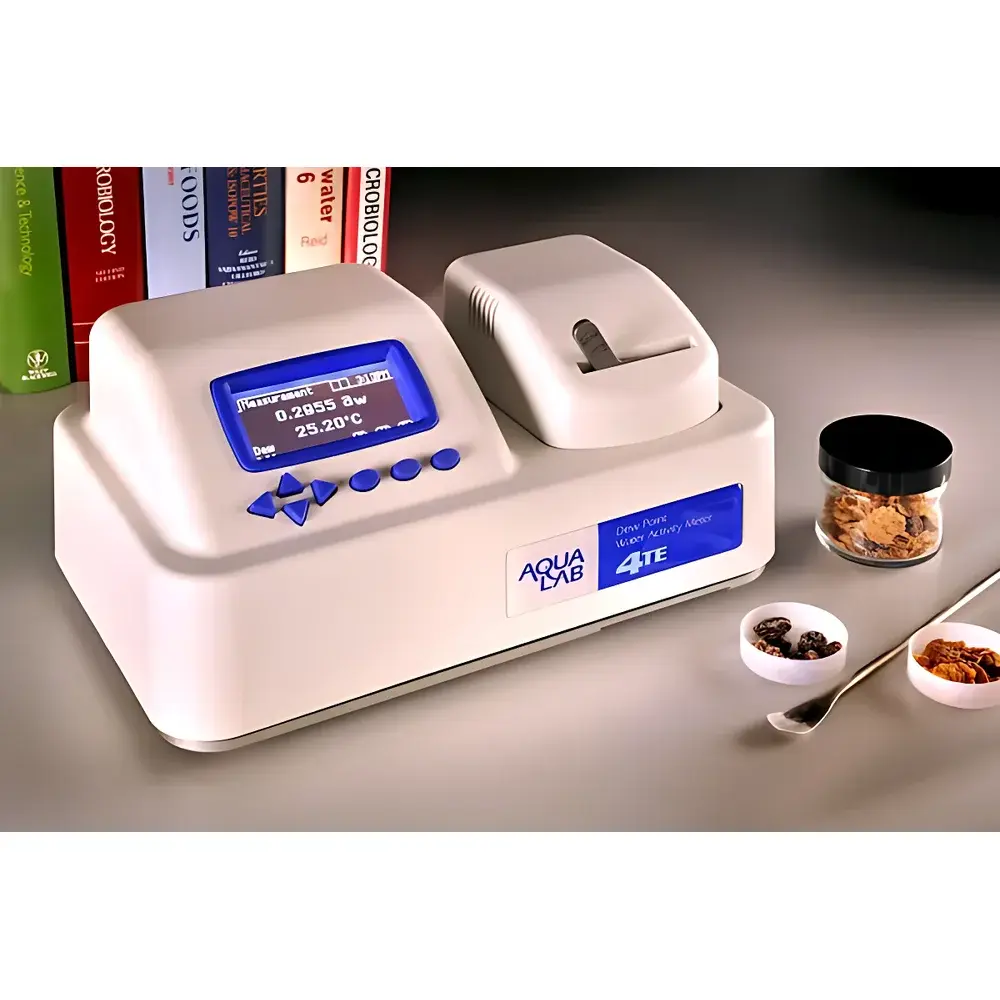
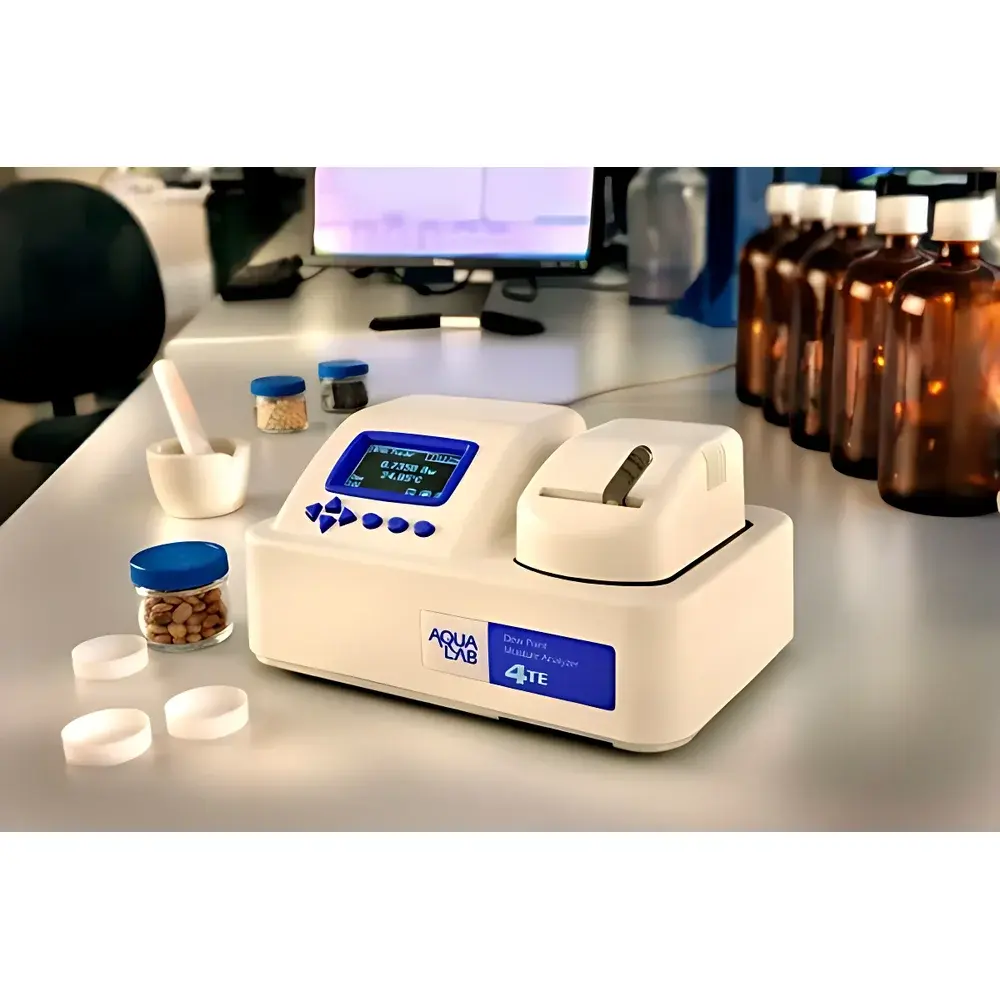
Aqualab 4TE High-Precision Temperature-Controlled Water Activity Analyzer
| Brand | Aqualab |
|---|---|
| Origin | USA |
| Model | Aqualab 4TE |
| Sensor Principle | Mirror Condensation Dew Point |
| Accuracy | ±0.003 aw |
| Resolution | 0.0001 aw |
| Measurement Range | 0.030–1.000 aw |
| Repeatability | ±0.001 aw |
| Temperature Control Range | 15–50 °C |
| Temperature Accuracy | ±0.2 °C |
| Temperature Resolution | 0.01 °C |
| Sample Volume | 7 mL (max 15 mL) |
| Measurement Time | <5 min (avg. 2.5 min) |
| Data Storage Capacity | 8,000 secure readings with timestamp, user ID, and calibration logs |
| User Accounts | Up to 25 configurable usernames/passwords |
| Interface | RS-232, USB |
| Display | 128×64-pixel backlit LCD |
| Dimensions | 26.7 × 17.8 × 12.7 cm |
| Weight | 3.18 kg |
| Power | 110–220 V AC, 50/60 Hz, <0.4 A |
| Operating Environment | 4–60 °C, 0–90% RH (non-condensing) |
| Certifications | CE, AOAC Official Method 975.13, FDA 21 CFR Part 11 compliant (audit trail, electronic signature support) |
Overview
The Aqualab 4TE High-Precision Temperature-Controlled Water Activity Analyzer is an industrial-grade dew point hygrometer engineered for rigorous quality control in food, pharmaceutical, cosmetic, and agricultural sectors. It employs the mirror condensation dew point method—a primary reference technique endorsed by AOAC International (Official Method 975.13)—to directly measure the equilibrium relative humidity (ERH) of a sample’s headspace at a precisely controlled temperature. This physical principle relies on optical detection of condensate formation on a chilled, polished mirror surface using infrared thermometry; the resulting dew point temperature is converted to water activity (aw) via thermodynamic equations (Magnus formula with empirical corrections). Unlike capacitance or resistive sensors, which require frequent recalibration and suffer from hysteresis or matrix interference, the dew point method delivers traceable, absolute measurements with minimal drift—making the Aqualab 4TE suitable for regulatory submissions, stability studies, and HACCP-critical process verification.
Key Features
- Temperature-controlled measurement chamber: Integrated Peltier-based thermal regulation enables stable, programmable setpoints from 15 °C to 50 °C in 0.01 °C increments—critical for evaluating temperature-dependent aw behavior per ISO 21807 and USP <1112>.
- High-fidelity dew point detection: Dual-wavelength infrared sensor monitors mirror surface temperature and condensation onset with ±0.2 °C thermal accuracy and 0.0001 aw resolution, ensuring compliance with ISO 20988:2007 validation requirements.
- Robust data integrity architecture: Onboard non-volatile memory stores up to 8,000 measurement records—including date/time stamps, operator ID, sample ID, calibration history, and environmental metadata—with full audit trail functionality aligned with FDA 21 CFR Part 11 Annex 11 expectations.
- Modular user access control: Supports up to 25 unique user accounts with role-specific password protection, enabling segregation of duties in GLP/GMP environments without external database dependencies.
- Field-deployable mechanical design: CNC-machined aluminum chassis with flame-retardant Lustran 433 ABS housing (UL94 V-0 rated), IP54-rated sealing, and wide ambient operating range (4–60 °C, 0–90% RH non-condensing) permit operation in production floors, cold storage docks, or mobile labs.
Sample Compatibility & Compliance
The Aqualab 4TE accommodates heterogeneous solid, semi-solid, and viscous liquid matrices—including powders, gels, pastes, fermented products, and dried botanicals—without requiring homogenization or solvent extraction. Its 7 mL standard cup (15 mL max) ensures sufficient headspace-to-mass ratio for rapid equilibration while minimizing wall adsorption artifacts. The instrument meets AOAC Official Method 975.13 for food safety validation and supports ISO 21807:2021 (food microbiological stability), ASTM F1718 (pharmaceutical packaging), and USP <1112> (microbial risk assessment). All firmware and calibration routines are validated per ICH Q2(R2) guidelines, and electronic records satisfy ALCOA+ principles (Attributable, Legible, Contemporaneous, Original, Accurate, Complete, Consistent, Enduring, Available).
Software & Data Management
Data export is supported via RS-232 serial interface or USB mass storage mode, generating CSV-formatted files compatible with LIMS, SAP QM, or statistical process control (SPC) platforms. The embedded firmware includes configurable pass/fail limits, automated report generation (PDF/CSV), and real-time trend visualization on the 128×64-pixel backlit display. For enterprise integration, optional Aqualab Connect software provides remote monitoring, multi-instrument fleet management, and electronic signature workflows compliant with 21 CFR Part 11 Subpart B—enabling full lifecycle traceability from measurement acquisition through QA review and archival.
Applications
- Food manufacturing: Predicting microbial growth thresholds (e.g., Staphylococcus aureus inhibition at aw ≤ 0.86), optimizing drying endpoints, validating shelf-life models, and verifying ingredient specifications per Codex Alimentarius standards.
- Pharmaceutical production: Assessing excipient compatibility, monitoring lyophilized product stability, qualifying desiccant packaging, and supporting ICH Q5C biologics storage condition justification.
- Agricultural commodities: Verifying safe storage conditions for grains, nuts, and spices to prevent mycotoxin formation (e.g., aflatoxin B1 above aw = 0.82).
- Research & development: Quantifying moisture sorption isotherms (BET modeling), studying glass transition temperatures (Tg), and validating predictive microbiology algorithms (e.g., ComBase).
FAQ
How does the mirror condensation dew point method differ from capacitance-based water activity meters?
The dew point method measures the thermodynamic equilibrium state directly via phase-change detection, yielding absolute, calibration-independent results. Capacitance sensors infer aw indirectly from dielectric changes and require matrix-specific calibration—introducing uncertainty in complex samples like chocolate or hydrocolloid gels.
Is temperature control essential for accurate water activity measurement?
Yes. Water activity is temperature-dependent; a 1 °C deviation can induce ±0.005–0.015 aw error in hygroscopic materials. The Aqualab 4TE’s active thermal regulation eliminates ambient drift and enables standardized testing per ISO 21807 Annex B.
Can the Aqualab 4TE be used for regulatory audits under GMP/GLP?
Yes. Its built-in audit trail, electronic signatures, user access controls, and AOAC/FDA-aligned validation documentation meet core requirements for inspection readiness per FDA Guidance for Industry (2022) and EU Annex 11.
What maintenance is required to sustain metrological performance?
Annual verification against NIST-traceable saturated salt standards (e.g., LiCl, MgCl₂, NaCl) is recommended. The mirror surface is cleaned with spectroscopic-grade methanol and lint-free wipes; no consumables or replacement sensors are needed over the instrument’s service life.
Does the instrument support automated calibration verification?
Yes. Built-in calibration check routines compare real-time dew point response against stored reference values for three internal humidity points (0.11, 0.75, 0.90 aw), flagging deviations exceeding ±0.002 aw before measurement execution.





