
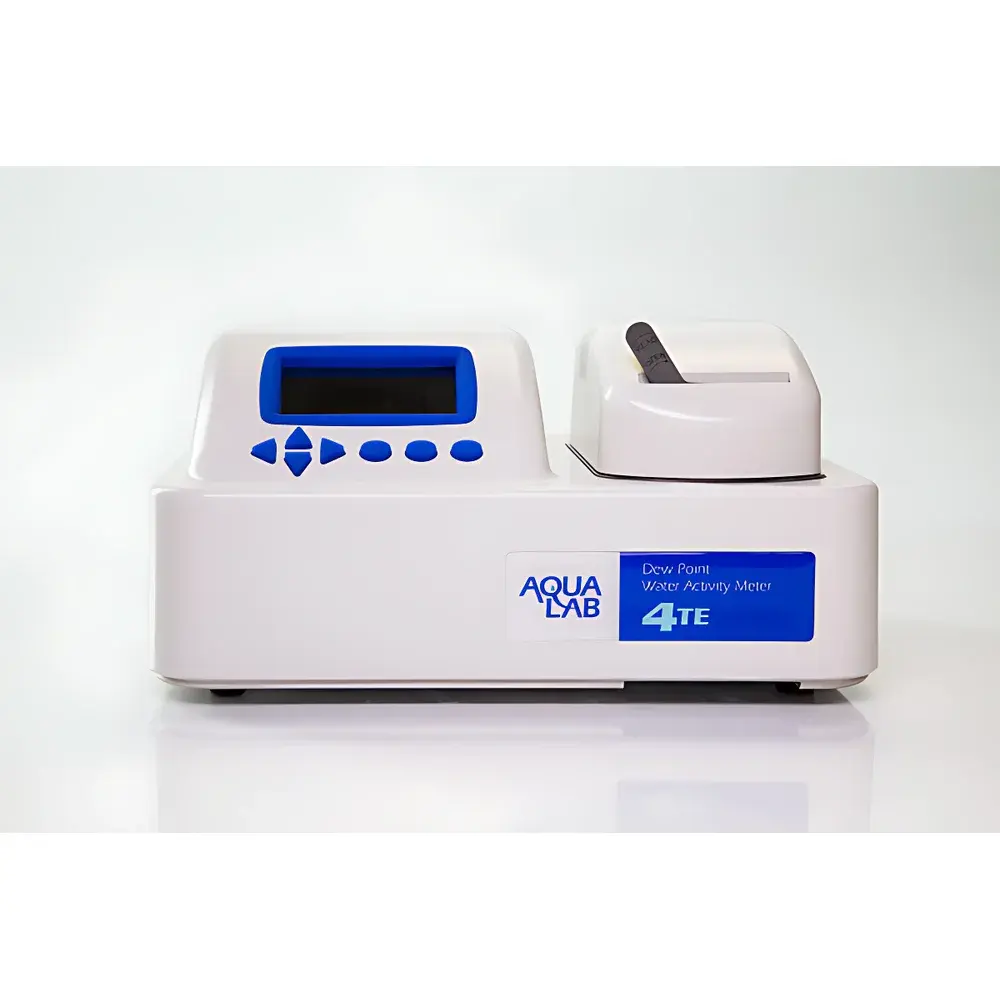
Aqualab 4TE Temperature-Controlled Dew Point Water Activity Analyzer
| Brand | Aqualab |
|---|---|
| Origin | USA |
| Model | 4TE |
| Measurement Principle | Chilled-Mirror Dew Point |
| Operating Temperature Range | 4–50 °C |
| Accuracy | ±0.003 aw |
| Repeatability | ±0.001 aw |
| Application | Laboratory-Grade Water Activity Analysis |
Overview
The Aqualab 4TE Temperature-Controlled Dew Point Water Activity Analyzer is a high-precision, laboratory-grade instrument engineered for traceable, metrologically sound measurement of water activity (aw) in solid and semi-solid matrices. It employs the fundamental physical principle of chilled-mirror dew point thermometry—where a polished mirror surface is cooled until condensation forms, and the corresponding equilibrium temperature is used to calculate vapor pressure and thus aw. This method is recognized as the primary reference technique by international standards bodies including AOAC International, ISO 21807, USP <1112>, and FDA guidance documents for food and pharmaceutical stability assessment. Unlike capacitance or tunable diode laser sensors, the chilled-mirror approach provides direct, absolute measurement without calibration drift or matrix-dependent bias—making it the benchmark for regulatory compliance and method validation.
Key Features
- Integrated Peltier temperature control: Maintains sample chamber temperature within ±0.1 °C across the full 4–50 °C operating range, eliminating ambient thermal interference and ensuring thermodynamic equilibrium during measurement.
- Traceable accuracy and reproducibility: Delivers ±0.003 aw accuracy and ±0.001 aw repeatability—validated against NIST-traceable saturated salt standards and certified reference materials per ISO/IEC 17025 requirements.
- Automated measurement cycle: Completes analysis in under 5 minutes with minimal user intervention—sample loading, lid closure, and auto-initiation ensure operator-independent results.
- Robust optical detection system: High-resolution photodiode array monitors mirror condensation onset with sub-micron sensitivity, enabling precise dew point identification even in low-aw (<0.2) or viscous samples.
- Compliance-ready architecture: Designed to support GLP/GMP workflows, including audit trail logging, electronic signatures, and data integrity features aligned with FDA 21 CFR Part 11 requirements.
Sample Compatibility & Compliance
The Aqualab 4TE accommodates a broad spectrum of sample types—including powders, gels, pastes, lyophilized solids, and intermediate moisture foods—without requiring grinding, dilution, or solvent extraction. Its sealed, inert sample chamber prevents cross-contamination and preserves volatile components. The instrument conforms to multiple regulatory and consensus standards: AOAC Official Method 978.18, ISO 21807:2022 “Plastics — Determination of water activity”, USP <1112> “Application of Water Activity Determination”, and ASTM F1980 for accelerated stability testing of medical device packaging. All measurements are directly traceable to the International Temperature Scale (ITS-90) and SI-based vapor pressure definitions.
Software & Data Management
Bundled Aqualab Connect software provides full instrument control, real-time dew point visualization, and automated report generation compliant with ISO 17025 documentation requirements. Data export supports CSV, PDF, and XML formats with embedded metadata (operator ID, timestamp, calibration status, environmental logs). Audit trail functionality records all user actions, parameter changes, and result modifications with time-stamped, non-erasable entries—essential for FDA 21 CFR Part 11 compliance and internal quality audits. Optional LIMS integration via HL7 or ASTM E1384 interfaces enables seamless data flow into enterprise laboratory systems.
Applications
- Microbial safety assessment: Quantifying aw thresholds for mold, yeast, and pathogenic bacteria (e.g., Staphylococcus aureus, Clostridium botulinum) per FDA Bad Bug Book and USDA FSIS guidelines.
- Shelf-life modeling: Supporting Arrhenius-based prediction of chemical degradation kinetics (Maillard reactions, lipid oxidation) and physical instability (caking, crystallization, glass transition).
- Formulation optimization: Guiding excipient selection and moisture barrier design in oral solid dosage forms and nutraceuticals.
- Process validation: Verifying drying endpoints in spray drying, freeze drying, and fluid bed granulation operations.
- Regulatory submission support: Generating data packages for ANDA, NDA, and FSMA Preventive Controls plans where aw is a Critical Control Point.
FAQ
Is the Aqualab 4TE suitable for use in regulated pharmaceutical environments?
Yes—it meets design and documentation requirements for GxP laboratories, including configurable user roles, electronic signature capability, and full 21 CFR Part 11 compliance when deployed with validated software configuration.
How does temperature control improve measurement reliability?
Precise thermal stabilization ensures sample equilibration at defined conditions, eliminating variability caused by lab ambient fluctuations and enabling valid comparison across batches, sites, and timepoints.
Does the instrument require routine recalibration with saturated salt standards?
While factory calibration is NIST-traceable, periodic verification using certified reference standards (e.g., LiCl, MgCl₂, NaCl) is recommended per ISO/IEC 17025 and internal SOPs—typically every 3–6 months depending on usage frequency.
Can the 4TE measure samples with high sugar or salt content?
Yes—the chilled-mirror method is unaffected by solute chemistry, making it ideal for syrups, jams, brines, and electrolyte formulations where capacitance sensors exhibit significant hysteresis and drift.
What maintenance is required for long-term performance?
Annual mirror cleaning with spectroscopic-grade methanol and inspection of Peltier module thermal interface paste are the only scheduled interventions—no consumables or proprietary reagents are needed.





