
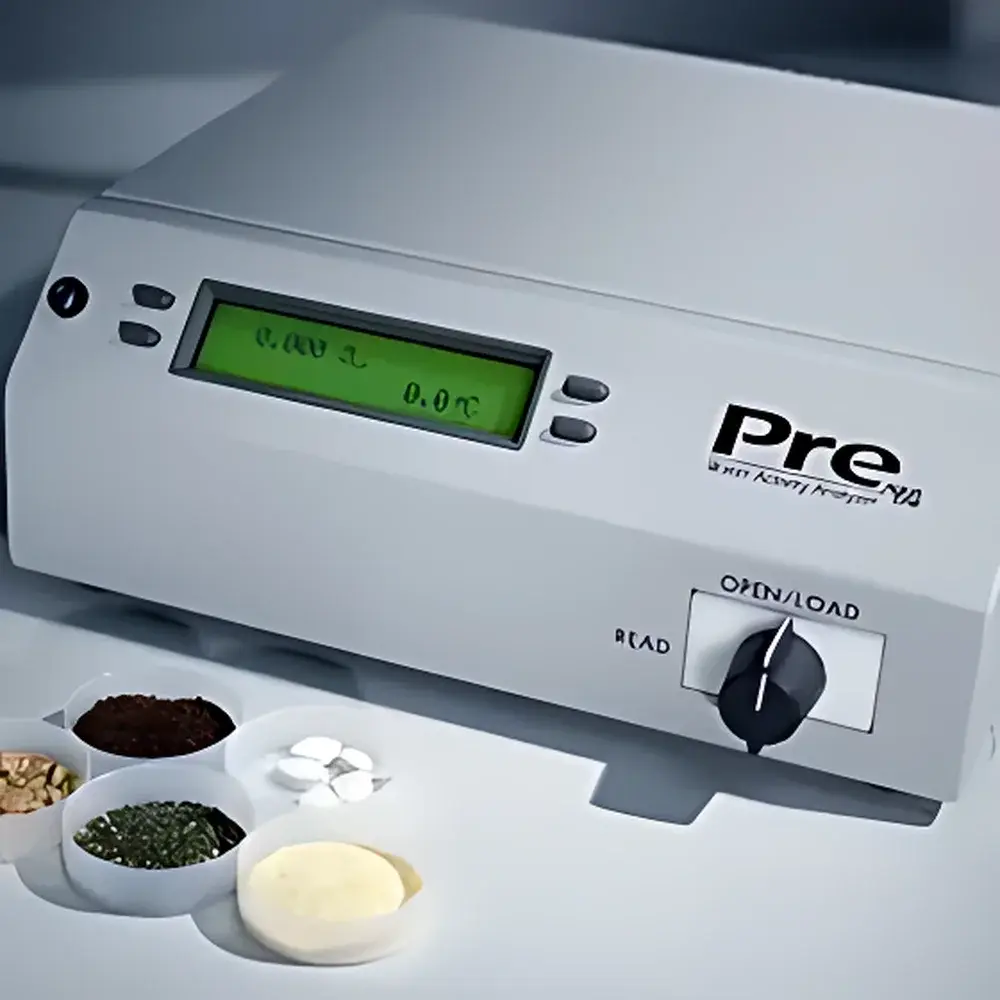
Aqualab Pre Water Activity Analyzer by METER Group (formerly Decagon Devices)
| Brand | Aqualab / METER Group |
|---|---|
| Origin | USA |
| Model | AquaLab Pre |
| Sensor Type | Mirror Condensation Dew Point (Standard), Capacitance (Optional) |
| Accuracy | ±0.01 aw (Dew Point), ±0.015 aw (Capacitance) |
| Resolution | 0.001 aw |
| Measurement Range | 0.05–1.000 aw |
| Repeatability | ≤ ±0.002 aw |
| Temperature Control | Fixed at 25.0 °C (±0.2 °C stability) |
| Temp. Resolution | 0.1 °C |
| Sample Volume | 7 mL recommended (max 15 mL) |
| Measurement Time | < 5 minutes |
| Display | 20-character alphanumeric backlit LCD |
| Interface | RS-232, USB |
| Dimensions | 24.1 × 22.9 × 8.9 cm |
| Weight | 3.2 kg |
| Power | 110–220 VAC, 50/60 Hz, < 0.4 A |
| Operating Environment | 4–60 °C, 0–90% RH (non-condensing) |
| Certifications | CE, AOAC Official Method 978.18 |
| Warranty | 1 year parts and labor |
Overview
The AquaLab Pre Water Activity Analyzer is a precision-engineered instrument developed by METER Group (formerly Decagon Devices) for rapid, reliable, and traceable water activity (aw) measurement in food, pharmaceutical, cosmetic, and agricultural materials. It employs the gold-standard mirror condensation dew point method—recognized by AOAC International as Official Method 978.18—to directly determine the equilibrium relative humidity (ERH) above a sample at a controlled temperature of 25.0 °C. Unlike indirect methods such as capacitance or resistive hygrometry, dew point measurement quantifies the thermodynamic state of unbound water molecules without calibration drift or matrix interference. The instrument’s integrated Peltier-controlled thermal chamber ensures stable sample temperature throughout analysis, eliminating environmental variability and enabling high reproducibility across laboratories and production shifts.
Key Features
- Dew Point Sensor Architecture: Uses a polished aluminum mirror and high-sensitivity thermopile to detect condensation onset with sub-millikelvin thermal resolution—enabling direct, first-principles aw determination without empirical correlation or sensor recalibration.
- Fixed-Temperature Measurement at 25.0 °C: Maintains thermal stability within ±0.2 °C via closed-loop feedback control; eliminates inter-laboratory variance caused by ambient fluctuations and satisfies ISO 21807 and ASTM F1718 requirements for standardized testing conditions.
- Sub-5-Minute Analysis Cycle: Achieves full-range measurement (0.05–1.000 aw) in under five minutes with no warm-up delay, supporting high-throughput QC workflows in manufacturing environments.
- Low-Maintenance Design: Requires only periodic verification using saturated salt standards (e.g., LiCl, NaCl, KCl); no routine sensor cleaning, coating, or replacement—reducing total cost of ownership and downtime.
- Robust Industrial Housing: Die-cast aluminum chassis with powder-coated finish provides EMI shielding, mechanical durability, and resistance to laboratory and plant-floor contaminants.
Sample Compatibility & Compliance
The AquaLab Pre accommodates heterogeneous solid, semi-solid, and powdered samples—including baked goods, dairy powders, spices, pet food, freeze-dried pharmaceuticals, and herbal extracts—in standard 7 mL sample cups (up to 15 mL capacity). Its sealed measurement chamber prevents cross-contamination and ensures vapor-phase equilibrium. The instrument complies with AOAC 978.18 for microbiological safety assessment, supports HACCP validation per FDA Food Code §3-201.11, and meets data integrity expectations under 21 CFR Part 11 when paired with compliant software (e.g., AquaLab Connect). It is routinely cited in USP <1112> and EU GMP Annex 19 for stability-indicating moisture characterization in excipient and final product release testing.
Software & Data Management
While the AquaLab Pre operates as a standalone analyzer with local display and manual data recording, it interfaces seamlessly with METER’s AquaLab Connect software via RS-232 or USB. This platform enables automated data logging, audit-trail generation (including operator ID, timestamp, sample ID, and environmental metadata), report export in CSV/PDF formats, and trend analysis across batches. All electronic records comply with ALCOA+ principles (Attributable, Legible, Contemporaneous, Original, Accurate) and support GLP/GMP audit readiness. Firmware updates are delivered through the same interface to ensure continued alignment with evolving regulatory guidance.
Applications
- Food safety risk assessment: Predicting microbial growth limits (e.g., Staphylococcus aureus at aw ≥ 0.86, Aspergillus flavus at aw ≥ 0.80) per ICMSF guidelines.
- Shelf-life modeling: Correlating aw with chemical degradation kinetics (Maillard browning, lipid oxidation) and physical instability (caking, crystallization).
- Process validation: Verifying drying endpoints in spray drying, fluidized bed processing, and vacuum dehydration.
- Raw material qualification: Screening incoming ingredients against supplier specifications and internal aw thresholds.
- Regulatory submissions: Generating defensible, method-validated data for FDA GRAS dossiers, EFSA scientific opinions, and Health Canada NHP ingredient assessments.
FAQ
Is the AquaLab Pre compliant with AOAC International Method 978.18?
Yes—the instrument implements the mirror condensation dew point principle as defined in AOAC 978.18 and is listed in the AOAC Performance Tested Methods℠ directory.
Can the AquaLab Pre measure samples with high fat or volatile content?
Yes, provided the sample is placed in a sealed cup and allowed to equilibrate; the dew point method is unaffected by non-aqueous volatiles, unlike capacitance sensors which may exhibit cross-sensitivity.
What is the recommended verification frequency?
METER Group recommends daily verification using two certified reference standards (e.g., 0.112 aw LiCl and 0.752 aw NaCl) prior to sample analysis—documented per internal SOPs and aligned with ISO/IEC 17025 clause 7.7.
Does the instrument require annual recalibration?
No—dew point sensors do not drift over time; only periodic verification is required. Full factory recalibration is optional and typically performed every 2–3 years or after physical damage.
Is temperature control adjustable beyond 25 °C?
No—the AquaLab Pre is fixed at 25.0 °C to ensure method consistency and regulatory compliance; for variable-temperature studies, the AquaLab 4TE or AquaLab TX models are recommended.





