
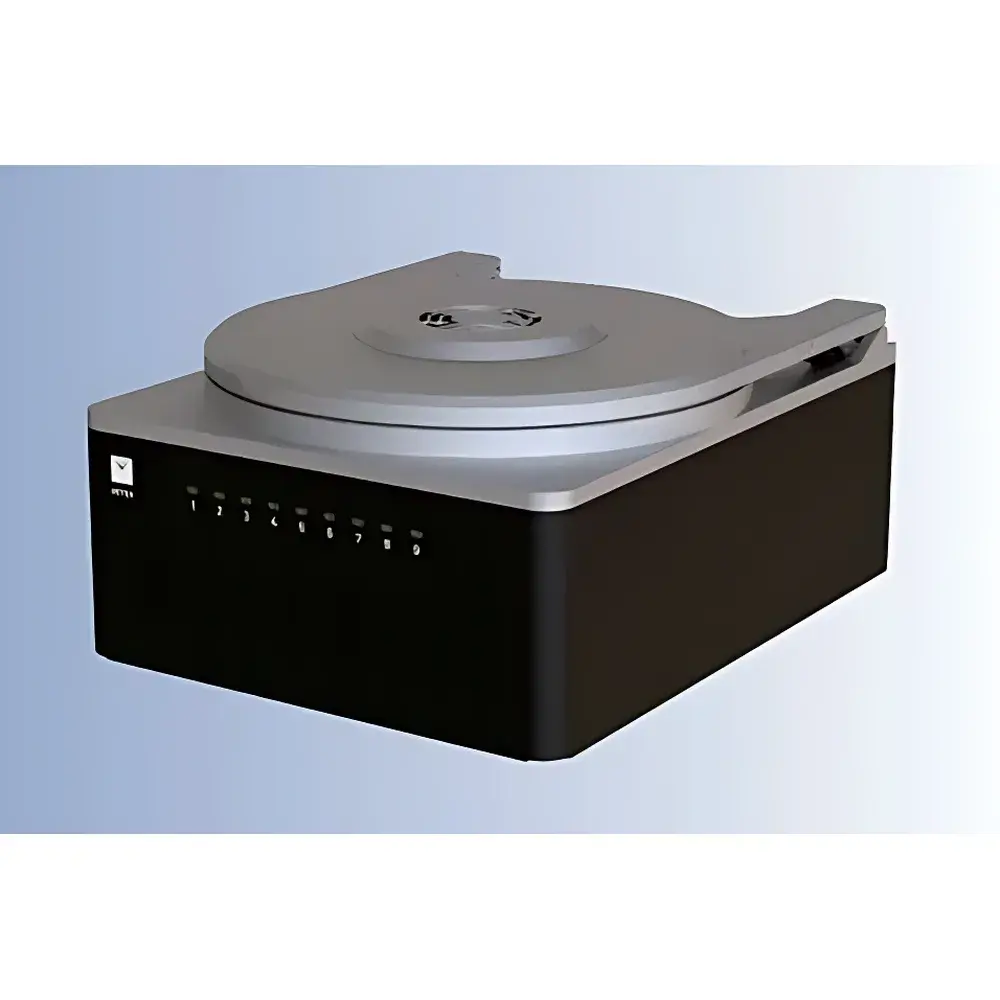
Aqualab ROS 1 Automated Multi-Sample Moisture Analyzer
| Brand | Aqualab |
|---|---|
| Origin | USA |
| Manufacturer Type | Authorized Distributor |
| Origin Category | Imported |
| Model | ROS 1 |
| Pricing | Available Upon Request |
| Measurement Principle | Standard Gravimetric Loss-on-Drying (LOD) with Real-Time Mass Monitoring |
| Heating Method | Resistive Coil Conduction (Not Halogen or Microwave) |
| Sample Capacity | 9 Independent Positions |
| Temperature Range | 50–150 °C (1 °C Increments) |
| Balance Readability | 0.0001 g |
| Max Load per Pan | 50 g |
| Sample Weight Range | 1–15 g |
| Moisture Range | 0.1–100 % w/w |
| Accuracy | ±0.15 % |
| Repeatability (4 g) | ±0.05 % |
| Repeatability (10 g) | ±0.01 % |
| Compliance | AOAC 937.02, ASTM D4442, ISO 4463, USP <921>, FDA 21 CFR Part 11 Ready (with optional software audit trail) |
Overview
The Aqualab ROS 1 Automated Multi-Sample Moisture Analyzer is an engineered gravimetric moisture determination system that delivers oven-dry accuracy with throughput and reproducibility unattainable by conventional drying ovens or rapid halogen-based instruments. Unlike infrared, near-infrared (NIR), or microwave methods—whose calibration drifts over time and depends on reference standards—the ROS 1 implements the primary standard method: loss-on-drying (LOD) under controlled thermal conditions. It uses resistive coil heating to provide uniform, conductive heat transfer—eliminating surface charring, sample melting, or case hardening commonly observed with high-intensity halogen lamps. Each of the nine independent sample positions features a dedicated, integrated analytical balance (0.0001 g readability) that continuously records mass loss at sub-second intervals. This enables real-time drying curve generation and algorithmic endpoint detection based on dynamic derivative analysis (dw/dt), not fixed time or temperature presets. The result is methodologically traceable, thermally stable, and fully compliant with internationally recognized regulatory frameworks.
Key Features
- Nine parallel, independently controlled sample stations with synchronized real-time mass monitoring
- Resistive coil heating system delivering precise, uniform conduction-based thermal energy—no radiant overshoot or localized degradation
- Dynamic endpoint detection via adaptive drying algorithm: user-defined dw/dt threshold (e.g., ≤0.1 mg/min for 60 s) ensures true constant-mass termination
- Full programmability per sample: individual temperature setpoints (50–150 °C, 1 °C resolution) and drying profiles—including ramp-hold sequences
- Integrated 0.0001 g analytical balance with auto-zero and internal calibration routine; no external weights required
- Comprehensive data logging: every mass reading, temperature point, and time stamp stored internally and exportable via USB
- Robust stainless-steel powder-coated enclosure (38.1 × 30.5 × 20.3 cm; 12.5 kg) rated for operation in ambient environments from 4 °C to 50 °C, up to 90% non-condensing RH
Sample Compatibility & Compliance
The ROS 1 accommodates solid, semi-solid, and granular matrices—including pharmaceutical powders, food ingredients, polymers, soil, ceramics, and botanicals—within the 1–15 g recommended sample mass range. Its adherence to fundamental LOD methodology ensures compatibility with validated quality control workflows across regulated industries. It satisfies method requirements outlined in AOAC Official Method 937.02 (moisture in feed), ASTM D4442 (wood moisture), ISO 4463 (soil), and USP <921> (moisture content). When paired with validated software enabling electronic signatures, audit trails, and user access controls, the system supports 21 CFR Part 11 compliance for GMP/GLP environments. All drying curves, raw mass data, and metadata are timestamped and immutable post-acquisition—facilitating full traceability during regulatory audits.
Software & Data Management
Data acquisition and reporting are managed through Aqualab’s proprietary Windows-based software suite, which supports both manual review and automated batch processing. Every run generates a complete dataset: time-stamped mass vs. time curves, derivative plots, endpoint confirmation logs, and summary statistics (mean, SD, RSD%). Export formats include CSV, PDF, and XML for LIMS integration. The software enforces role-based user permissions, session logging, and electronic signature capability—essential for laboratories operating under FDA, EMA, or Health Canada oversight. Optional add-ons enable instrument qualification documentation (IQ/OQ/PQ templates), calibration certificate management, and periodic verification reports aligned with ISO/IEC 17025 requirements.
Applications
- Pharmaceutical QC labs verifying moisture content in APIs and excipients per USP <921> and ICH Q5C stability guidelines
- Food & beverage manufacturers validating shelf-life models and complying with FDA nutrition labeling regulations
- Materials science research assessing hygroscopicity of polymers, composites, and battery electrode materials
- Agricultural testing labs performing routine grain and feed moisture analysis per AOAC protocols
- Environmental laboratories quantifying moisture in soil and sediment samples prior to contaminant extraction
- Quality assurance departments replacing multi-day oven methods with same-day, high-reproducibility results (RSD ≤0.01% at 10 g)
FAQ
How does the ROS 1 differ from halogen moisture analyzers?
It uses resistive coil conduction heating instead of intense radiant halogen energy—preventing thermal degradation, surface hardening, and non-uniform drying that compromise accuracy in volatile or thermolabile samples.
Can different samples be dried simultaneously at different temperatures?
Yes. Each of the nine sample positions supports independent temperature programming and drying profile definition—enabling heterogeneous batch processing without cross-method interference.
Is the ROS 1 suitable for GLP/GMP-regulated environments?
When operated with the validated software package—including audit trail, electronic signatures, and user access controls—it meets core requirements of 21 CFR Part 11 and ISO/IEC 17025 for documented traceability and data integrity.
What is the smallest detectable moisture change?
With 0.0001 g balance resolution and algorithmic endpoint detection, the system reliably resolves moisture differences as low as 0.01% w/w (at 10 g sample mass), verified per ASTM D4442 repeatability criteria.
Does the instrument require daily calibration?
No. Internal calibration routines and factory-traceable weight verification ensure long-term stability. However, routine performance checks using certified reference standards (e.g., sodium tartrate dihydrate) are recommended per ISO/IEC 17025 quality management systems.





