
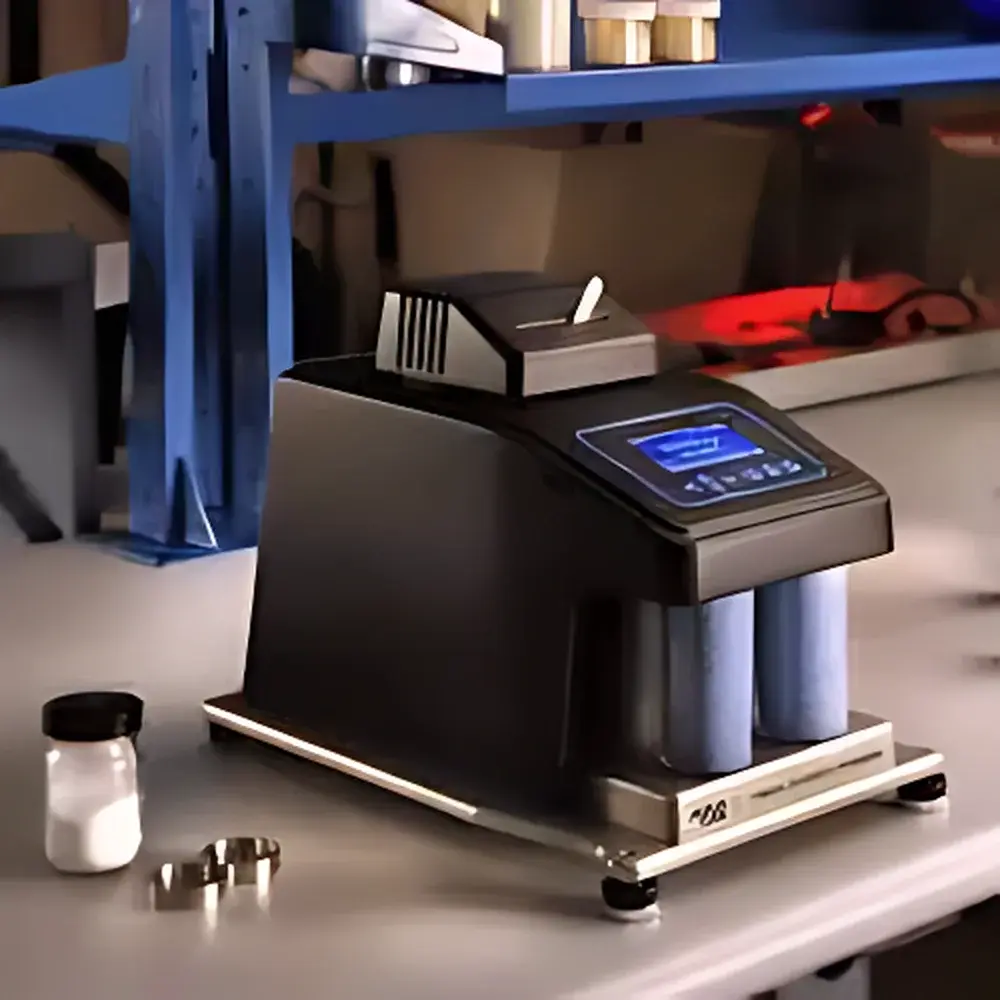
Aqualab VSA Dynamic Vapor Sorption Analyzer
| Brand | Aqualab |
|---|---|
| Origin | USA |
| Manufacturer Type | Authorized Distributor |
| Product Category | Imported Instrument |
| Model | AquaLab VSA |
| Price Range | USD 25,000 – 62,500 (converted at ~¥200,000–¥500,000) |
| Measurement Principle | Mirror Condensation Dew Point |
| Isotherm Methods | Dynamic Dew-point Isotherm (DDI) & Dynamic Vapor Sorption (DVS) |
| Accuracy | ±0.005 aw |
| Resolution | ±0.001 aw |
| aw Range | 0.030–0.950 |
| Repeatability | ±0.003 aw |
| Temperature Control | 10–60 °C (STP adjustable) |
| Temp Stability | ±0.1 °C |
| Max Operating Pressure | ≤7 psi |
| Sample Mass Range | 500–5000 mg |
| Mass Resolution | ±0.1 mg |
| Sample Cup Volume | 7.5 mL (recommended), up to 15 mL |
| Water Reservoir Volume | 7 mL (max 15 mL) |
| Display | 128×64-pixel backlit LCD |
| Dimensions | 25.4×38.1×30.5 cm |
| Enclosure | Machined aluminum frame with flame-retardant silicone resin |
| Weight | 14.97 kg |
| Power | 110–220 V AC, 50/60 Hz |
| Operating Environment | 4–60 °C, 10–90% RH (non-condensing) |
| Certifications | CE |
| Warranty | 1 year (parts & labor) |
Overview
The Aqualab VSA Dynamic Vapor Sorption Analyzer is a precision laboratory instrument engineered for high-resolution characterization of moisture sorption behavior in food, pharmaceutical, and material science applications. It operates on the fundamental principle of mirror condensation dew point measurement—a thermodynamically rigorous method that directly determines water activity (aw) by detecting the temperature at which vapor condenses on a chilled, polished mirror surface. Coupled with a high-stability microbalance (±0.1 mg resolution), the VSA simultaneously tracks real-time mass change under controlled humidity and temperature conditions. This dual-signal acquisition enables generation of full dynamic vapor sorption isotherms—capturing both adsorption and desorption pathways—with over 100 data points per isotherm within 48 hours. Unlike static equilibrium methods requiring prolonged dwell times at discrete humidity steps, the VSA’s continuous DDI (Dynamic Dew-point Isotherm) mode provides kinetic insight into moisture uptake/release mechanisms, while its DVS (Dynamic Vapor Sorption) mode delivers conventional stepwise isotherms fully compatible with ASTM E104-22 and ISO 187:2017 reference protocols.
Key Features
- Two complementary isotherm acquisition modes: DDI (continuous dew-point tracking during dynamic humidity ramping) and DVS (stepwise equilibration at defined relative humidity levels)
- Mirror condensation dew point sensor with ±0.001 aw resolution and ±0.005 aw accuracy—traceable to NIST-standard humidity references
- Integrated high-precision microbalance (±0.1 mg) synchronized with dew point detection for simultaneous mass and aw recording
- Programmable temperature control from 10 °C to 60 °C with stability maintained within ±0.1 °C—critical for studying temperature-dependent sorption hysteresis
- Automated sample identification via alphanumeric labeling (batch ID, product code, operator tag) supporting audit-ready data traceability
- Compact benchtop architecture (25.4 × 38.1 × 30.5 cm) with flame-retardant silicone resin housing and machined aluminum structural frame for long-term mechanical stability
- USB interface compliant with Windows-based Aqualab software for instrument control, real-time visualization, and export of raw time-series datasets (CSV, TXT)
Sample Compatibility & Compliance
The VSA accommodates solid and semi-solid samples ranging from 500 mg to 5000 mg in standard 7.5 mL sample cups (up to 15 mL optional). Its design supports powders, granules, freeze-dried matrices, confectionery systems, dairy powders, cereal-based formulations, and hydrocolloid gels—materials where moisture-mediated physical instability (caking, crystallization, texture collapse) dictates shelf life. The instrument meets CE marking requirements for electromagnetic compatibility (EMC Directive 2014/30/EU) and low-voltage safety (LVD Directive 2014/35/EU). While not inherently 21 CFR Part 11-compliant, its data export architecture allows integration into validated LIMS or ELN platforms supporting GLP/GMP workflows. All isotherm outputs are fully compatible with predictive modeling frameworks referenced in USP , FDA Guidance for Industry on Moisture Sorption in Solid Dosage Forms, and Codex Alimentarius CAC/RCP 3-1969 (General Principles of Food Hygiene).
Software & Data Management
Aqualab software provides a deterministic, non-proprietary workflow for method definition, run execution, and post-acquisition analysis. Users define DDI or DVS protocols—including ramp rates, dwell durations, temperature setpoints, and humidity endpoints—via intuitive parameter tables. Real-time plots display concurrent mass drift (%) and aw vs. time, enabling immediate assessment of equilibration kinetics. Exported datasets retain full timestamped metadata (sensor readings, environmental logs, calibration history), facilitating reproducible reprocessing. The software supports calculation of monolayer moisture content (BET theory), hysteresis area quantification, and diffusion coefficient estimation using Fickian models. No cloud dependency or subscription licensing is required; all processing occurs locally, ensuring data sovereignty and alignment with institutional IT security policies.
Applications
- Predicting critical water activity thresholds for microbial inhibition, lipid oxidation onset, and Maillard reaction acceleration in intermediate-moisture foods
- Optimizing spray-drying and fluid-bed granulation endpoints by mapping aw–moisture relationships across process-relevant humidity ranges
- Evaluating packaging barrier performance through accelerated moisture ingress studies under controlled T/RH stress conditions
- Quantifying hygroscopicity-driven caking propensity in powdered dairy, infant formula, and dietary supplements
- Characterizing amorphous phase stability in lyophilized biologics and excipient blends—correlating sorption hysteresis with glass transition temperature (Tg) depression
- Validating moisture migration pathways in multilayer snacks or coated confections using asymmetric DDI cycling
FAQ
What distinguishes DDI mode from conventional DVS operation?
DDI employs continuous, unidirectional humidity scanning with real-time dew point and mass monitoring—ideal for capturing transient sorption kinetics without user-defined equilibration criteria. DVS follows traditional stepwise equilibration, pausing at each RH level until mass change falls below a preset threshold (e.g., 0.01 mg/min), yielding thermodynamically stable isotherm points.
Can the VSA be used for regulatory submission data packages?
Yes—when operated within documented SOPs, with calibrated sensors (annual dew point verification recommended), and with full raw data retention, VSA-generated isotherms meet evidentiary requirements for FDA IND/NDA filings, EFSA scientific opinions, and Health Canada Natural Health Product license applications.
Is temperature programming supported during isotherm acquisition?
The VSA maintains isothermal conditions throughout each run; however, sequential isotherms can be acquired at different temperatures (e.g., 25 °C, 40 °C, 60 °C) to construct Arrhenius-type moisture diffusion models.
How is sensor calibration performed?
The dew point sensor is factory-calibrated against saturated salt solutions (LiCl, MgCl₂, NaCl, KCl) per ISO 4887. Field verification uses traceable humidity standards; no user-serviceable recalibration is required within the 1-year warranty period.
Does the system support automated sample changers?
No—the VSA is a single-position analyzer optimized for method development and small-batch screening. High-throughput labs typically deploy multiple units in parallel rather than integrate robotic handling, preserving measurement integrity across heterogeneous sample sets.





