
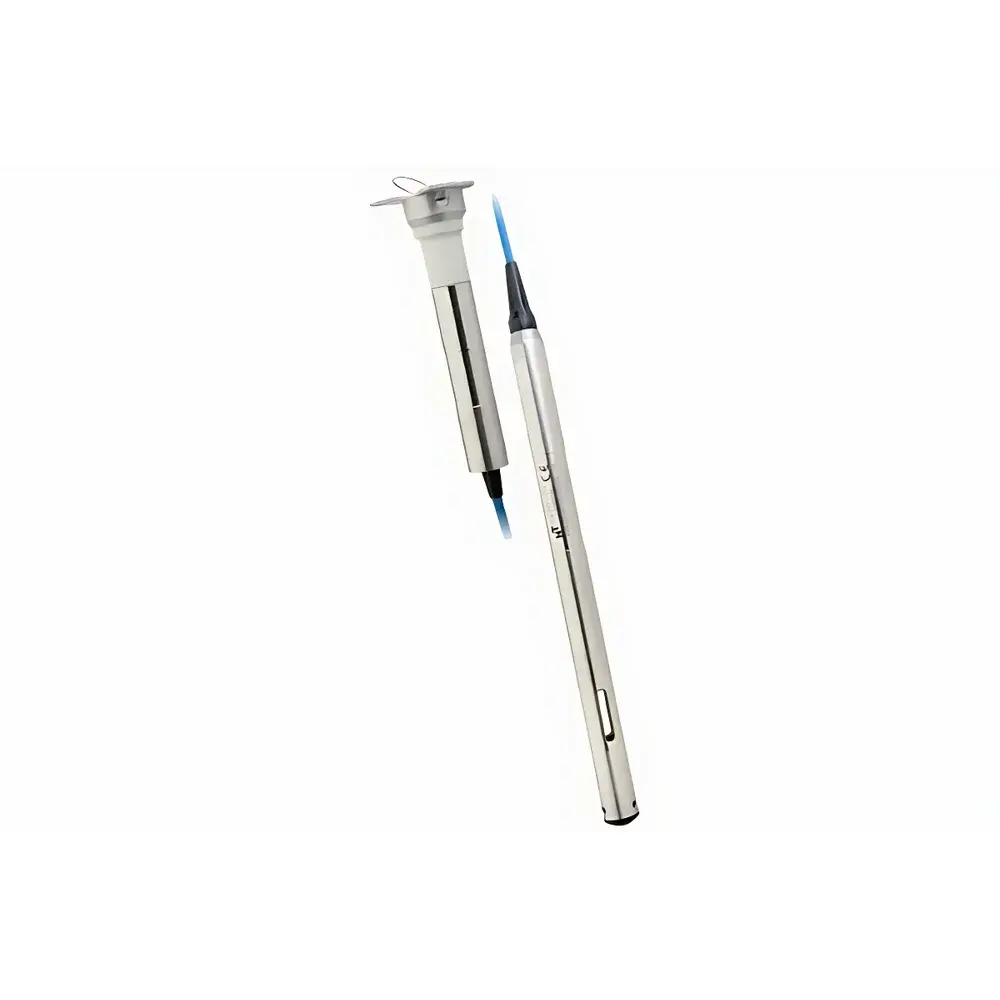
AQUALABO 575-LTC Submersible Water Level and Conductivity Logger
| Brand | AQUALABO |
|---|---|
| Origin | France |
| Model | 575-LTC |
| Instrument Type | Portable |
| Temperature Range | –5 to +50 °C (optional –5 to +70 °C) |
| Conductivity Range | 0–200,000 µS/cm |
| Water Level Range | 0–300 m |
| Accuracy (Water Level) | <0.05% FS |
| Accuracy (Temperature) | <0.1 °C |
| Accuracy (Conductivity) | <0.5% of reading (min. 2 µS/cm) |
| Resolution (Water Level) | 1 cm (optional 1 mm) |
| Resolution (Temperature) | 0.1 °C (optional 0.01 °C) |
| Resolution (Conductivity) | 0.0005% FS |
| Long-term Stability (Water Level) | <0.05%/year |
| Long-term Stability (Temperature) | <0.02 °C/year |
| Battery Life | ~3 million measurements (~10 years at 2-min interval) |
| Memory | 4 MB Flash |
| Cable Length | up to 500 m (optional) |
| Probe Depth Rating | 300 m |
| Housing Material | 316 stainless steel & titanium alloy |
| Ingress Protection | IP68 |
| Interface | RS-232, USB |
| Data Formats | HT-Standard, Excel (.xlsx), *.zrxp, Labdüs (*.lgd), *.uvf |
Overview
The AQUALABO 575-LTC is a submersible, battery-powered water level and multi-parameter logger engineered for long-term, unattended deployment in groundwater, surface water, and coastal aquifer monitoring applications. It operates on the principle of piezoresistive pressure sensing for hydrostatic water level measurement, combined with high-stability platinum resistance temperature detection (Pt1000 or Pt10000) and four-electrode conductivity measurement—ensuring minimal polarization error and superior accuracy across wide salinity ranges. Unlike conventional two-electrode sensors, the 575-LTC’s quad-electrode cell eliminates electrode fouling artifacts and enables stable calibration traceability over extended field deployments. Its integrated atmospheric pressure compensation tube allows for absolute (vented) or gauge (non-vented) water level configurations, supporting both static and dynamic head analysis per ISO 4064-1 and ASTM D4044 standards.
Key Features
- Self-contained, maintenance-free design: No desiccant replacement, no sensor cleaning intervals, and no field recalibration required for ≥3 years under typical conditions
- Ultra-long-life lithium battery system: Rated for ~3 million measurements; estimated operational lifetime of >10 years at 2-minute sampling intervals
- High-precision quad-electrode conductivity cell: Optimized for stability in brackish to hypersaline environments (0–200,000 µS/cm), with automatic temperature compensation (ATC) compliant with DIN EN 27888
- Three ATC modes: Standard 25 °C reference (DIN EN 27888), user-defined linear coefficient (%/°C), or raw uncorrected output for post-processing validation
- Robust mechanical architecture: 316 stainless steel and titanium alloy housing rated IP68 and pressure-tested to 300 m H₂O (3 MPa)
- Flexible cabling: UV-resistant, Kevlar-reinforced PUR-jacketed cable (Ø6 mm), available up to 500 m length with integrated vent tube
- Onboard 4 MB flash memory: Stores timestamped, calibrated data with full metadata (sensor ID, firmware version, calibration dates)
Sample Compatibility & Compliance
The 575-LTC is validated for continuous immersion in freshwater, estuarine, and seawater matrices—including high-turbidity, organic-rich, and sulfide-laden groundwater. Its titanium alloy wetted parts resist chloride-induced pitting and microbial-influenced corrosion (MIC), satisfying material requirements of ISO 15190 and ASTM G46. The instrument supports GLP-compliant data integrity via immutable timestamping and firmware-locked calibration coefficients. All conductivity calibrations are traceable to NIST SRM 3199 (KCl solutions), and pressure transducer calibration adheres to ISO/IEC 17025-accredited procedures. Software-generated reports include audit trails meeting FDA 21 CFR Part 11 requirements when used with HT-Operator software configured for electronic signatures and role-based access control.
Software & Data Management
The HT-Operator software suite (Windows XP through Windows 11 compatible) provides full configuration, real-time telemetry, and post-deployment data export. Users configure sampling schedules (1 s to 24 h intervals), define alarm thresholds, and select ATC algorithms directly from an intuitive graphical interface. Data exports support multiple formats: native HT-Standard binary (for AQUALABO analytics), Excel-compatible CSV, legacy Labdüs (*.lgd), UVF spectral format (*.uvf), and proprietary *.zrxp archives for time-series interpolation. All exported files retain embedded calibration metadata and sensor health diagnostics—including drift logs, battery voltage history, and thermal hysteresis flags. The software includes built-in tools for TDS derivation using EPA Method 120.1 algorithms and supports batch processing of multi-node deployments via project-based folder structures.
Applications
- Salinity intrusion mapping in coastal aquifers and barrier island systems
- Long-term trend analysis of groundwater response to precipitation events, irrigation recharge, or wastewater infiltration
- Real-time monitoring of tidal influence on shallow wells and piezometers
- Regulatory compliance reporting for EU Water Framework Directive (WFD) Article 7 groundwater status assessments
- Calibration reference for distributed sensor networks and remote telemetry units (RTUs)
- Baseline characterization of small water bodies (ponds, springs, seeps) prior to land-use change or remediation activities
FAQ
What is the recommended calibration frequency for the 575-LTC in long-term deployments?
AQUALABO recommends factory recalibration every 36 months for pressure and temperature channels, and every 24 months for conductivity—based on accelerated aging tests per IEC 60751 and IEC 60746-3. Field verification using certified KCl standards is advised annually.
Can the 575-LTC be deployed in artesian wells with pressures exceeding ambient?
Yes—the 300 m depth rating corresponds to absolute pressure tolerance of 3 MPa. For artesian conditions, ensure proper vent tube routing to prevent back-pressure on the compensation diaphragm.
Is the device compatible with third-party SCADA or IoT gateways?
The RS-232 and USB interfaces support Modbus RTU and ASCII protocols. Custom protocol drivers are available upon request for integration with Campbell Scientific CR-series loggers, Siemens Desigo, or AWS IoT Core via serial-to-MQTT bridges.
How does the instrument handle biofouling in eutrophic environments?
The quad-electrode conductivity cell minimizes current density per electrode surface area, reducing electrolytic deposition. Titanium housing further inhibits macrofouling; optional copper-nickel alloy sleeves are available for enhanced antifouling performance in warm, nutrient-rich waters.
Does the software support automated report generation for regulatory submissions?
Yes—HT-Operator includes configurable templates aligned with USGS NWIS, EU WISE-GWD, and national groundwater monitoring program reporting formats, including QA/QC flagging per ISO 5725-2 precision criteria.
Related Products







