
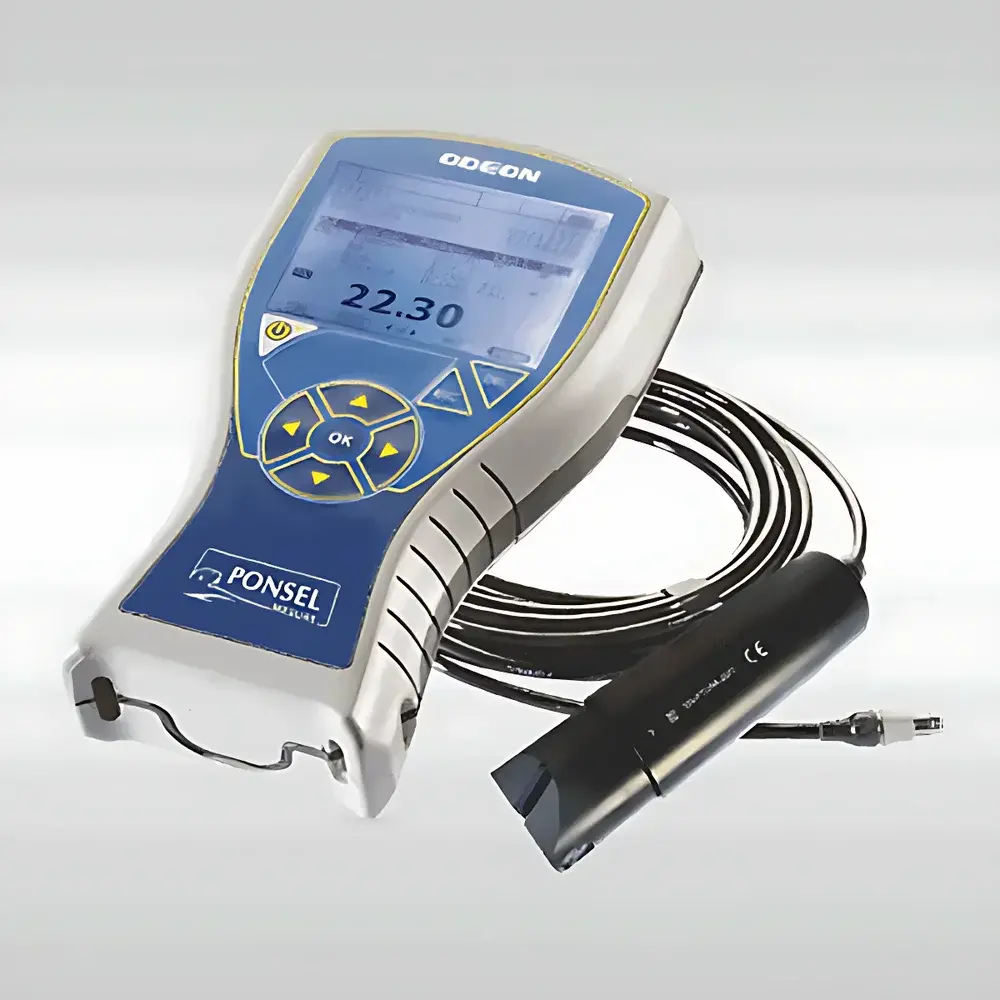
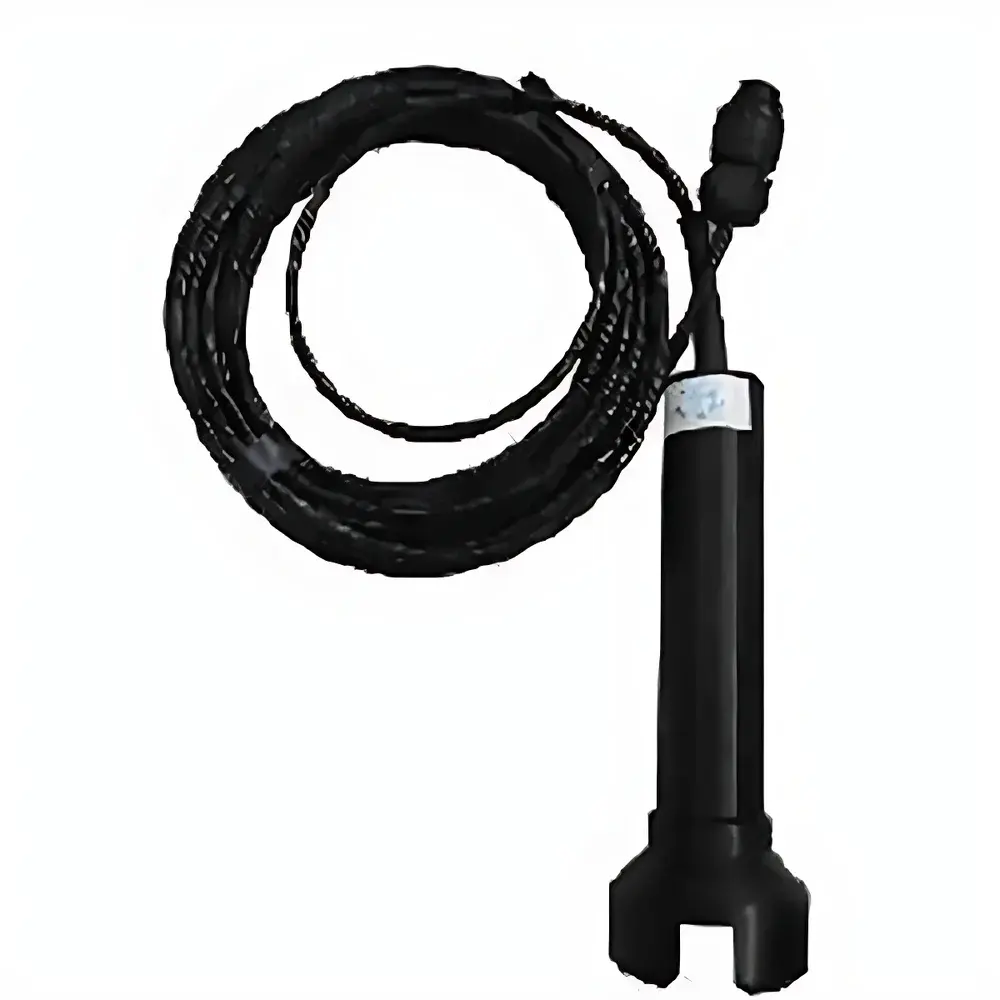
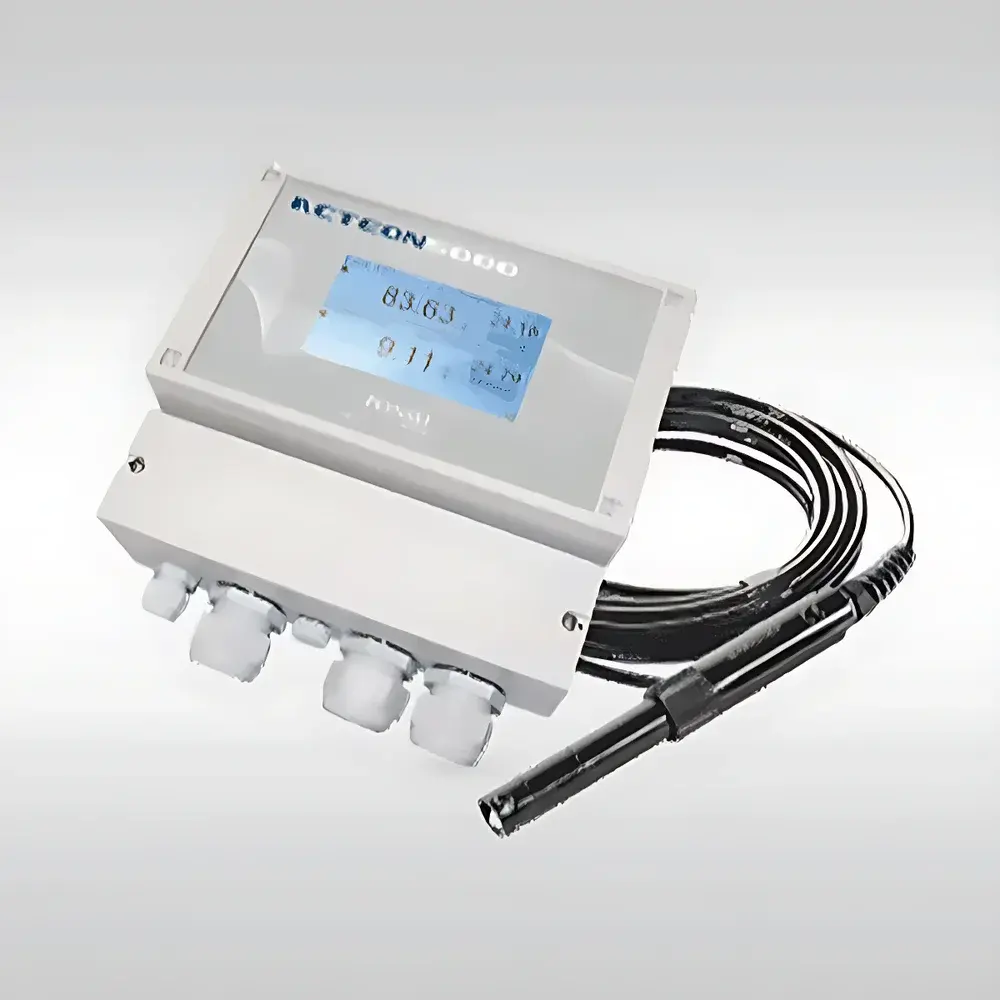
AQUALABO APW Sludge Interface Gauge
| Brand | AQUALABO |
|---|---|
| Origin | France |
| Model | APW |
| Measurement Principle | 950 nm Infrared Absorption |
| Wavelength | 950 nm (primary), 880 nm (for VB calibration) |
| Output Range | 0–100% VB (sludge interface visibility index) |
| Solids Concentration Ranges | VB5: 0–100 g/L, VB20: 0–7 g/L |
| Accuracy | ±2% of reading |
| Temperature Compensation | Automatic, Pt100 sensor integrated |
| Operating Temperature | –10.0 to +60.0 °C |
| Sensor Dimensions | Ø43 mm (bottom), Ø25 mm (top), H210 mm |
| Sensor Weight | 400 g |
| Cable | 4-conductor shielded PU cable, standard 10 m (up to 100 m optional), 40 g/m |
| Sensor Housing Material | Delrin®, polyurethane, and specialized optical glass |
| Sensor IP Rating | IP68 |
| Controller Power | 1 × 9 V alkaline battery (~2000 h typical life) |
| Controller Enclosure | Reinforced polyethylene with transparent IP67-rated cover |
| Controller Dimensions | 161 × 81 × 55 mm |
| Display | 3-digit LCD, 18 × 46 mm active area |
| Controller IP Rating | IP65 (with IP67 cover installed) |
Overview
The AQUALABO APW Sludge Interface Gauge is a dedicated optical instrument engineered for continuous, non-invasive detection and monitoring of the sludge/water interface in clarifiers, thickeners, and settling basins. It operates on the principle of near-infrared (NIR) absorption photometry at 950 nm — a wavelength selected for its high sensitivity to suspended solids while minimizing interference from dissolved organics and coloration commonly present in wastewater matrices. The device defines a normalized visibility index (0–100% VB), where 100% corresponds to optically clear water (zero suspended solids) and 0% represents fully opaque, highly concentrated sludge. This linearized optical response enables precise localization of the sludge blanket boundary without mechanical contact or moving parts, ensuring long-term stability in aggressive aqueous environments.
Key Features
- Optical measurement based on standardized 950 nm NIR absorption — compliant with empirical correlations used in municipal and industrial wastewater process control.
- Integrated Pt100 temperature sensor enabling real-time automatic temperature compensation, critical for maintaining accuracy across seasonal and diurnal thermal fluctuations.
- Robust, submersible sensor housing rated IP68, constructed from chemically resistant Delrin®, polyurethane elastomer, and hardened optical glass — suitable for permanent immersion in raw sewage, activated sludge, and anaerobic digestate.
- Low-power, battery-operated controller (IP65 with IP67 protective cover) featuring a high-contrast 3-digit LCD display (18 × 46 mm active area) optimized for field readability under variable lighting conditions.
- Modular cabling system: 4-conductor shielded polyurethane (PU) cable with standard 10 m length; custom lengths up to 100 m available to accommodate deep-tank installations or remote mounting configurations.
- No calibration drift due to optical path fouling — the dual-wavelength referencing (950 nm primary, 880 nm auxiliary) supports built-in baseline correction and long-term signal stability.
Sample Compatibility & Compliance
The APW is validated for use in heterogeneous, high-turbidity aqueous suspensions exhibiting vertical density gradients — including activated sludge, primary sludge, waste-activated sludge (WAS), and thickened sludge streams. It meets functional requirements aligned with ISO 7027 (water quality — determination of turbidity) for optical measurement principles, and its materials comply with EN 61326-1 (EMC for laboratory and industrial measurement equipment). While not a certified metrological standard instrument, its output correlates directly with gravimetrically determined total suspended solids (TSS) per ASTM D5907 and ISO 11923, supporting routine QC/QA protocols in drinking water treatment plants, wastewater resource recovery facilities (WRRFs), and environmental laboratories operating under GLP frameworks.
Software & Data Management
The APW operates as a standalone analog/digital indicator with no embedded firmware or network connectivity. Its 0–100% VB output is provided as a stable analog voltage or digital pulse signal (configurable), facilitating direct integration into existing SCADA, PLC, or DCS architectures via standard 4–20 mA or 0–10 V I/O modules. For data logging, external acquisition systems may record timestamped VB values alongside concurrent temperature readings (Pt100 output). No proprietary software is required; all configuration and interpretation rely on documented empirical relationships between %VB and sludge blanket depth or concentration — consistent with industry practice for interface-level control loops in secondary clarifier optimization per EPA Guidance Document EPA/600/R-17/231.
Applications
- Real-time sludge blanket level monitoring in secondary clarifiers and final settlement tanks to prevent effluent turbidity excursions and optimize sludge return pump scheduling.
- Process validation during startup, shutdown, or upset conditions in biological nutrient removal (BNR) systems where interface dynamics indicate biomass health and settling performance.
- Quality assurance in potable water treatment plants performing coagulation-flocculation-sedimentation, particularly when assessing floc blanket integrity in lamella or inclined plate settlers.
- Research and development studies involving sludge rheology, compression testing, and sedimentation column analysis in academic and regulatory laboratories.
- Regulatory compliance support for wastewater discharge permits requiring documented interface control, including those governed by EU Urban Waste Water Treatment Directive (91/271/EEC) Annex I.B.
FAQ
What does “%VB” represent, and how is it calibrated?
%VB (Visibility Base) is a dimensionless optical index defined by AQUALABO, ranging from 0% (fully opaque sludge) to 100% (optically clear water). Calibration is performed using two reference points: deionized water (100% VB) and a standardized sludge suspension (e.g., kaolin or site-specific sludge at known TSS), following manufacturer-provided procedures.
Can the APW be used in saline or seawater applications?
Yes — the optical principle is unaffected by ionic strength, and the IP68-rated sensor housing resists chloride-induced corrosion. However, biofouling mitigation (e.g., periodic cleaning or ultrasonic antifouling integration) is recommended in marine or brackish environments.
Is the controller compatible with 24 V DC industrial power supplies?
The standard unit uses a 9 V alkaline battery for portability and intrinsic safety; however, an optional 24 V DC-powered controller variant (APW-DC) is available for permanent installation in control rooms or panel-mounted applications.
Does the APW meet FDA 21 CFR Part 11 requirements?
No — the APW is a field-indicating instrument without electronic audit trail, user authentication, or electronic signature capabilities. It is intended for operational monitoring, not regulated GMP data capture.
How often does the sensor require maintenance or cleaning?
Under typical municipal wastewater conditions, visual inspection and manual wipe-down are recommended every 3–6 months; frequency increases in high-fouling environments (e.g., grease-laden influent or anaerobic digester supernatant). No recalibration is needed unless physical damage occurs to the optical window.







