
AQUALABO C4E Four-Electrode Conductivity Sensor
| Brand | AQUALABO |
|---|---|
| Origin | France |
| Model | C4E |
| Conductivity Range | 0–200.0 mS/cm |
| Resolution | 0.01–1 (scale-dependent) |
| Accuracy | ±1% of full scale |
| Salinity Range | 5–60 g/kg |
| TDS (KCl) | 0–133,000 ppm |
| Response Time | <5 s |
| Operating Temperature | 0–50 °C |
| Temperature Compensation | NTC |
| Output Interface | Modbus RS-485 (SDI-12 optional) |
| Update Interval | <1 s |
| Supply Voltage | 5–12 V DC |
| Standby Current | 25 µA |
| Measurement Current (RS-485) | 6.3 mA @ 1 Hz |
| Pulse Current | 500 mA |
| Dimensions | Ø27 mm × 219 mm (total length) |
| Weight | 300 g (sensor + 3 m cable) |
| Housing Materials | PVC, Delrin®, stainless steel |
| Max Pressure Rating | 5 bar |
| Protection Rating | IP68 |
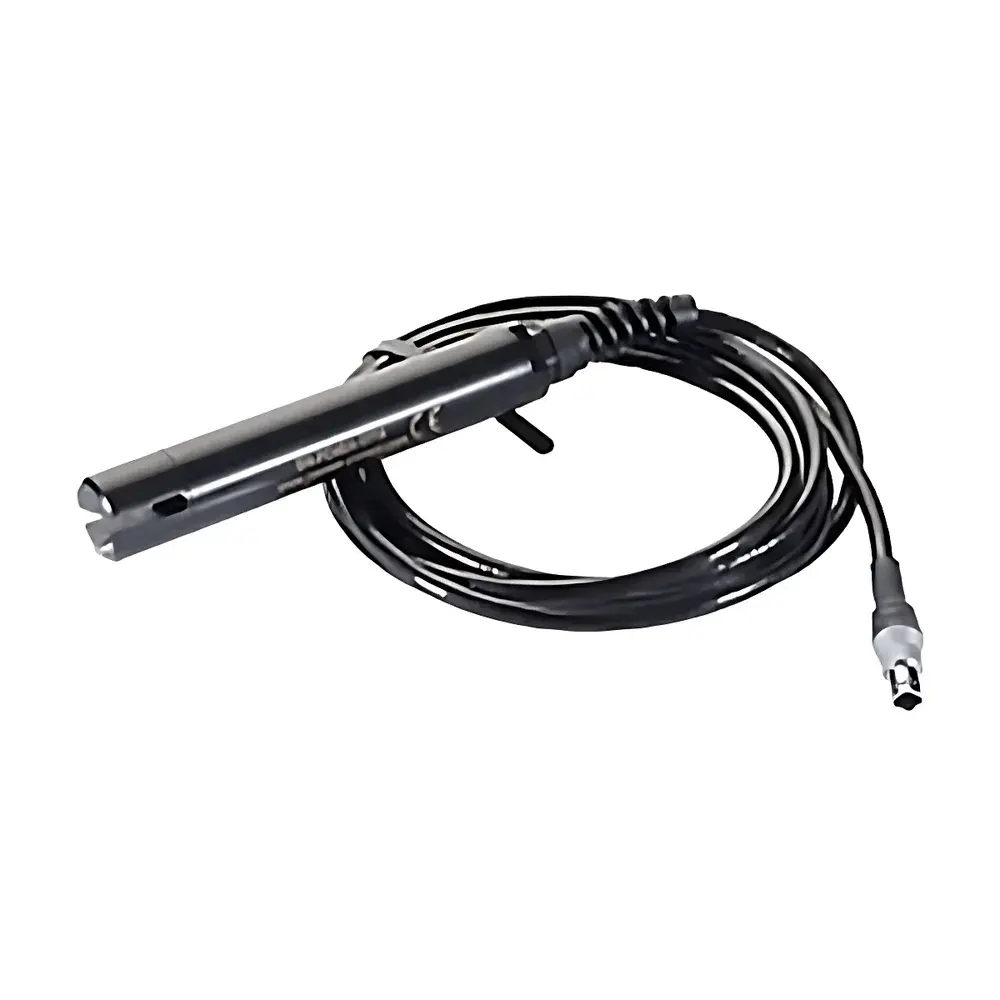
| Connector | 9-pin armored connector with polyurethane jacket or waterproof Fisher-type |
Overview
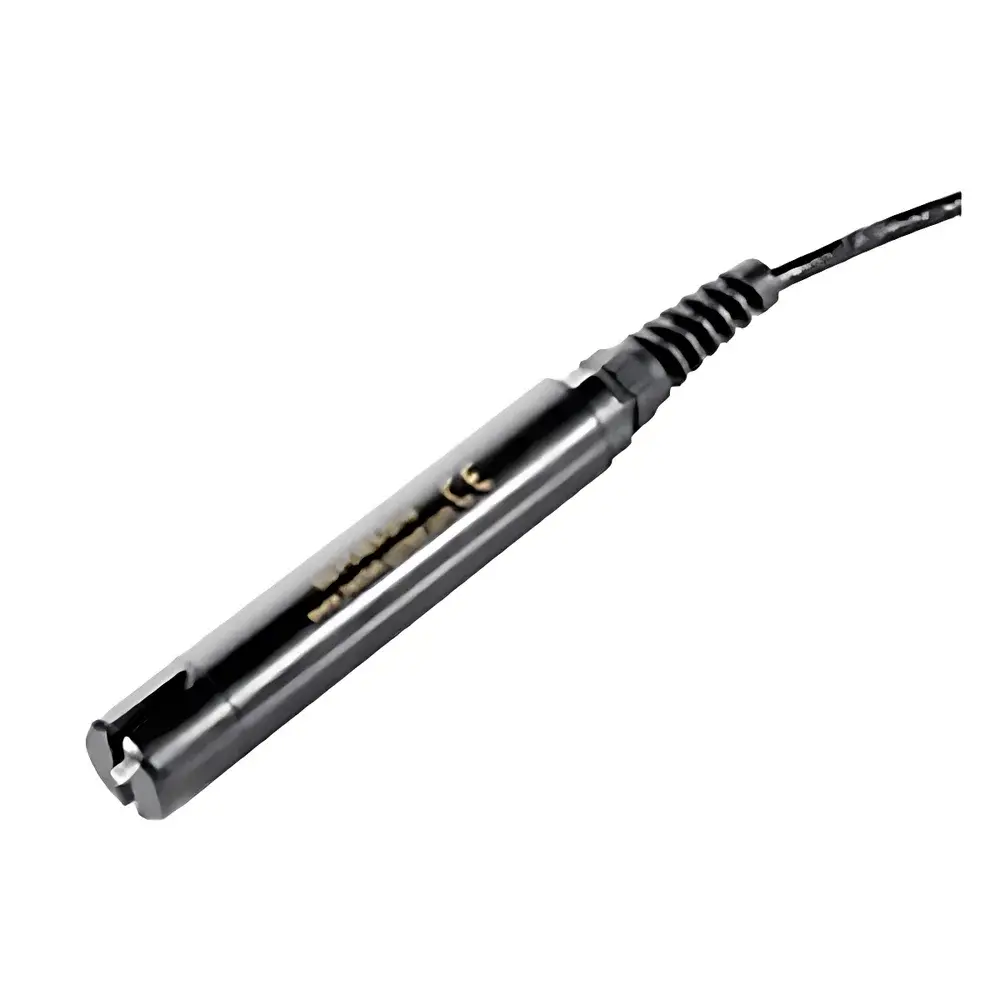
The AQUALABO C4E Four-Electrode Conductivity Sensor is an industrial-grade, submersible digital sensor engineered for long-term, high-stability conductivity measurement in demanding aqueous environments. It operates on the four-electrode (tetrapolar) AC conductance principle—distinct from traditional two-electrode designs—to eliminate polarization effects and electrode fouling artifacts. Two graphite electrodes serve as the current source, applying a precisely controlled alternating voltage across the medium; two separate platinum wire electrodes function as high-impedance potential sensors, measuring the resulting voltage drop without drawing significant current. This decoupling ensures stable, drift-free readings even in turbid, biofouling-prone, or high-solids wastewater streams. The sensor embeds non-volatile memory for factory calibration coefficients and operational history, enabling true plug-and-play deployment without field recalibration under normal operating conditions.
Key Features
- Four-electrode architecture with dual graphite current electrodes and dual platinum sensing electrodes for immunity to surface contamination and polarization errors
- Digital output via standard Modbus RTU over RS-485 (SDI-12 available as optional interface), ensuring seamless integration into SCADA, PLC, data loggers, and remote telemetry systems
- Wide dynamic conductivity range spanning 0–200.0 mS/cm across four auto-ranging sub-scales (0–200.0 µS/cm, 0–2000 µS/cm, 0.00–20.00 mS/cm, 0.0–200.0 mS/cm), supporting freshwater to hypersaline applications
- Integrated NTC thermistor for automatic temperature compensation per ASTM D1125 and ISO 7888 standards
- IP68-rated housing constructed from chemically resistant PVC, Delrin® polymer, and 316 stainless steel components, rated for continuous submersion at up to 5 bar pressure
- Ultra-low power consumption: 25 µA standby, 6.3 mA during RS-485 measurement cycles (1 Hz), compatible with solar-powered or battery-operated monitoring stations
- Onboard non-volatile memory stores calibration parameters, firmware version, serial number, and timestamped measurement logs for auditability and traceability
Sample Compatibility & Compliance
The C4E sensor is validated for use in natural waters (rivers, lakes, estuaries), municipal and industrial effluents, desalination plant intakes and brines, potable water distribution networks, and aquaculture systems. Its fouling-resistant electrode configuration meets performance expectations under GLP-compliant environmental monitoring protocols. While not intrinsically certified for hazardous locations, its construction complies with RoHS and REACH directives. Data integrity aligns with principles outlined in EPA Method 120.1 and ISO/IEC 17025 for conductivity measurement uncertainty management. The embedded Modbus implementation supports register-level access to raw ADC counts, compensated conductivity, temperature, and diagnostic flags—facilitating validation against third-party reference standards.
Software & Data Management
The sensor communicates using open Modbus RTU protocol (function codes 03h and 04h), allowing direct polling of calibrated conductivity (µS/cm or mS/cm), temperature (°C), salinity (g/kg), and TDS (ppm, KCl-based) values. All registers are mapped to standard Modbus address space, enabling compatibility with industry-standard platforms including Ignition SCADA, Campbell Scientific LoggerNet, Siemens Desigo CC, and custom Python/Node-RED implementations. Firmware updates are performed via serial bootloader mode. Internal memory retains ≥10,000 timestamped records (conductivity + temp), accessible via Modbus for offline diagnostics. No proprietary software or drivers are required—configuration and interrogation rely solely on standard serial communication tools.
Applications
- Real-time monitoring of influent and effluent conductivity in municipal and industrial wastewater treatment plants
- Continuous salinity tracking in coastal estuaries, tidal rivers, and desalination pre-treatment zones
- Process control in electroplating baths, cooling tower blowdown, and boiler feedwater systems
- Drinking water quality assurance in distribution networks and reservoir outfalls
- Autonomous buoy-based water quality networks for environmental research and regulatory compliance reporting
- Integration into multi-parameter sondes for comprehensive aquatic ecosystem assessment
FAQ
Does the C4E require periodic recalibration in the field?
No—factory calibration is stored in non-volatile memory and remains valid for typical deployment conditions. Field verification against a traceable standard is recommended annually or after mechanical impact or exposure to extreme chemical stress.
Can the sensor operate in seawater or saturated brine?
Yes—the 0–200.0 mS/cm upper range accommodates seawater (~50 mS/cm) and concentrated brines up to 200 mS/cm. The platinum sensing electrodes resist chloride-induced passivation better than stainless-steel alternatives.
Is temperature compensation configurable?
The built-in NTC thermistor applies linearized compensation per IEC 60751; no user configuration is needed. Compensation algorithm follows the CaCl₂-based model specified in ISO 7888 for broad salinity coverage.
What is the maximum cable length supported for RS-485 communication?
With proper twisted-pair shielding and termination, reliable operation is achieved up to 1,200 meters at 9,600 bps. For longer runs or noisy industrial environments, isolated RS-485 repeaters are advised.
How is sensor health monitored?
Modbus register 0x001F returns a diagnostic code indicating electrode impedance status, memory integrity, and internal voltage rail health—enabling predictive maintenance alerts within supervisory systems.







