
AQUALABO CTZN Inductive Conductivity Sensor
| Brand | AQUALABO |
|---|---|
| Origin | France |
| Model | CTZN |
| Measurement Principle | Inductive (Toroidal) Conductivity |
| Temperature Compensation | Integrated NTC |
| Conductivity Range | 0.0–100.0 mS/cm |
| Resolution | 0.1 mS/cm |
| Salinity Range | 0–60 g/kg |
| Temperature Range | 0–50 °C |
| Temp. Accuracy | ±0.5 °C (0–40 °C) |
| Response Time (90%) | <30 s |
| Output Interface | Modbus RTU over RS-485 (standard), SDI-12 optional |
| Supply Voltage | 5–28 VDC (max 30 V) |
| Power Consumption | <50 µA (sleep), 11.5–31 mA (active, depending on supply) |
| Max Pulse Current | 700 mA (150 ms), 350 mA (2 ms) |
| Dimensions | Ø62.4 × 196 mm |
| Weight | 700 g |
| Housing Materials | EPDM, PVC, stainless steel (316L) |
| Pressure Rating | 5 bar |
| Ingress Protection | IP68 |
| Cable Termination | 9-pin armored connector with polyurethane jacket or waterproof Fisher connector |
Overview
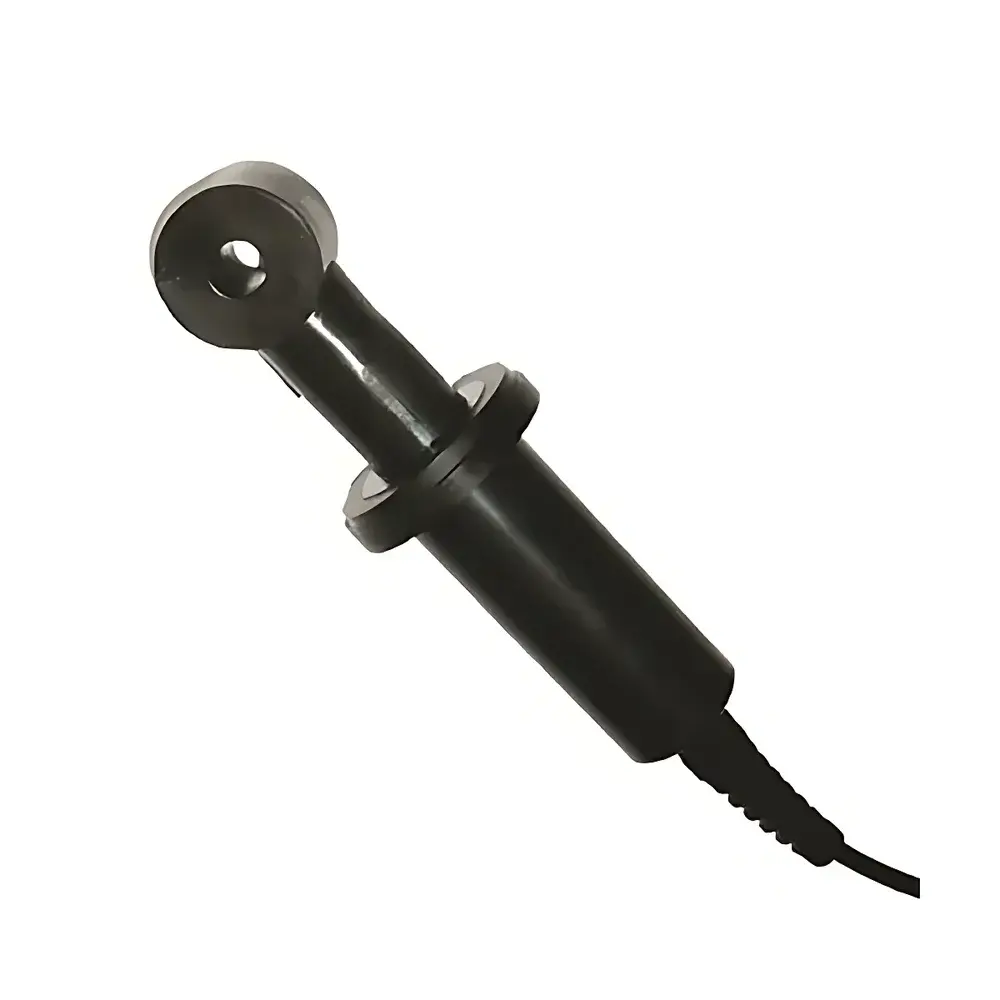
The AQUALABO CTZN Inductive Conductivity Sensor is a high-reliability, maintenance-free instrument engineered for continuous, long-term deployment in demanding aqueous environments. Unlike contact-type electrodes—prone to fouling, polarization, and drift—the CTZN employs a toroidal (inductive) measurement principle: two isolated coils are embedded within a chemically inert polymer body. A primary coil generates an alternating magnetic field; conductive media passing through the sensor’s flow path induce eddy currents, which in turn generate a secondary magnetic field detected by the receiving coil. The magnitude of this induced signal is directly proportional to the solution’s electrical conductivity—free from electrode-surface interactions. This architecture ensures stable performance across wide salinity ranges (0–60 g/kg), including seawater, brackish estuaries, industrial effluents, and aquaculture recirculation systems. Integrated NTC-based temperature compensation enables accurate, real-time correction per ISO 7888 and ASTM D1125 standards. Designed for unattended operation, the CTZN operates continuously at temperatures from 0 to 50 °C and withstands static pressures up to 5 bar—making it suitable for submersible, pipe-mounted, and open-channel installations.
Key Features
- Toroidal induction technology eliminates electrode corrosion, coating, and calibration drift—ideal for high-fouling wastewater and saline matrices.
- Embedded non-volatile memory stores factory calibration coefficients, serial history, and operational logs—enabling true plug-and-play integration without field recalibration.
- Dual communication protocols: standard Modbus RTU over RS-485 (addressable, multi-drop capable) and optional SDI-12 for compatibility with legacy environmental data loggers (e.g., Campbell Scientific CR series).
- Ultra-low power design: deep-sleep mode consumes <50 µA, extending battery life in solar-powered remote stations; wake-on-measure functionality supports scheduled sampling intervals.
- Robust mechanical construction: 316L stainless steel core, EPDM sealing elements, and PVC housing provide resistance to UV, hydrolysis, and common oxidants (e.g., chlorine residuals up to 5 mg/L).
- IP68-rated housing with armored 9-pin polyurethane-jacketed cable or sealed Fisher connector ensures integrity in submerged, tidal, or high-vibration applications.
Sample Compatibility & Compliance
The CTZN is validated for use across diverse water matrices without preconditioning or chemical cleaning cycles. It maintains metrological stability in municipal wastewater (with suspended solids >100 mg/L), cooling tower blowdown (pH 6.5–9.5), coastal surface waters (conductivity >50 mS/cm), and recirculating aquaculture systems (RAS) where organic loading and biofilm formation challenge conventional sensors. Its measurement traceability aligns with ISO/IEC 17025-accredited calibration practices. While not intrinsically certified for hazardous locations, its low-voltage operation (≤28 VDC) and absence of spark-prone components permit safe deployment in Zone 2/Class I, Division 2 environments when installed per IEC 60079-14. Data integrity meets GLP audit requirements via timestamped internal logging and Modbus register access to raw and compensated values—including simultaneous output of conductivity, temperature, and salinity (calculated per PSS-78 algorithm).
Software & Data Management
The CTZN requires no proprietary software: all configuration (baud rate, slave ID, polling interval, temperature compensation enable/disable) is performed via standard Modbus function codes (0x03, 0x06, 0x10). Field technicians may use open-source tools (e.g., QModMaster, Simply Modbus) or SCADA HMI platforms (Ignition, Siemens Desigo, Schneider EcoStruxure) for commissioning and diagnostics. Internal memory retains ≥10,000 timestamped records (conductivity + temp + salinity + status flags), accessible via Modbus address range 40001–49999. For regulatory reporting, the sensor supports time-synchronized data export compliant with EPA Method 120.1 and EU WFD Annex V requirements. When integrated into cloud-connected gateways (e.g., Teltonika RUT955, Advantech ECU-1251), encrypted MQTT payloads include CRC-16 checksums and device-specific UUIDs—ensuring data provenance under GDPR and FDA 21 CFR Part 11 electronic record provisions.
Applications
- Municipal wastewater treatment: real-time monitoring of influent conductivity for load balancing, effluent compliance verification against discharge permits (e.g., EU Urban Wastewater Directive limits), and digester feed control.
- Industrial process water: closed-loop monitoring in metal finishing, food & beverage CIP rinse validation, and pharmaceutical purified water (PW) distribution loops—where chloride ingress detection is critical.
- Surface and groundwater surveillance: long-term deployment in river gauging stations, reservoir intakes, and coastal buoys—resistant to biofouling and sediment abrasion.
- Marine and aquaculture systems: salinity-driven feeding automation in shrimp hatcheries, osmotic stress assessment in salmonid RAS, and ballast water treatment efficacy verification per IMO G8 guidelines.
- Environmental research networks: interoperable node in distributed sensor arrays (e.g., COSMOS, NEON) due to standardized Modbus register mapping and minimal thermal mass (<30 s 90% response).
FAQ
Does the CTZN require periodic recalibration?
No. Factory calibration is stored in non-volatile memory and remains valid for the sensor’s service life under normal operating conditions. Verification against traceable KCl standards is recommended annually per ISO/IEC 17025 quality management protocols.
Can the CTZN be used in seawater without drift?
Yes. The toroidal design is inherently immune to chloride-induced electrode passivation. Field studies across Atlantic and Mediterranean sites confirm 50 mS/cm.
Is SDI-12 interface firmware-upgradable?
The SDI-12 variant is hardware-configured at manufacture; protocol selection is fixed per unit order code (CTZN-MB for Modbus-only, CTZN-S12 for SDI-12-enabled). No field firmware updates are supported.
What is the minimum cable length for underwater installation?
Standard delivery includes 10 m of polyurethane-armored cable. Custom lengths up to 100 m are available with impedance-matched termination to maintain Modbus signal integrity at 19.2 kbps.
How is temperature measured—and can external probes be substituted?
An integrated NTC thermistor (10 kΩ @ 25 °C, β = 3988 K) provides direct bulk-fluid temperature. External temperature inputs are not supported; however, dual-sensor configurations (e.g., co-located CTZN + separate PT100) are commonly deployed for cross-validation in QA/QC workflows.
Related Products







