
AQUALABO EHAN ORP Sensor
| Brand | AQUALABO |
|---|---|
| Origin | France |
| Model | EHAN |
| Measurement Principle | Composite Electrode (Pt Working Electrode / Ag/AgCl Reference Electrode with Colloidal KCl Electrolyte) |
| ORP Range | −1000.0 to +1000.0 mV |
| ORP Resolution | ±0.1 mV |
| ORP Accuracy | ±10 mV |
| Temperature Sensing | NTC Thermistor |
| Temp. Range | 0.00–50.00 °C |
| Temp. Resolution | 0.01 °C |
| Temp. Accuracy | ±0.5 °C |
| Response Time (t₉₀) | <5 s |
| Output Interface | Modbus RTU over RS-485 (standard), SDI-12 (optional) |
| Supply Voltage | 5–12 V DC |
| Quiescent Current | 25 µA |
| Active Current (1 measurement/s) | 20 mA (RS-485 or SDI-12) |
| Pulse Current (Heating Activation) | 500 mA |
| Heating Pulse Duration | 100 ms |
| Operating Pressure | ≤5 bar |
| Housing Materials | PVC, POM-C, Platinum, Polyurethane |
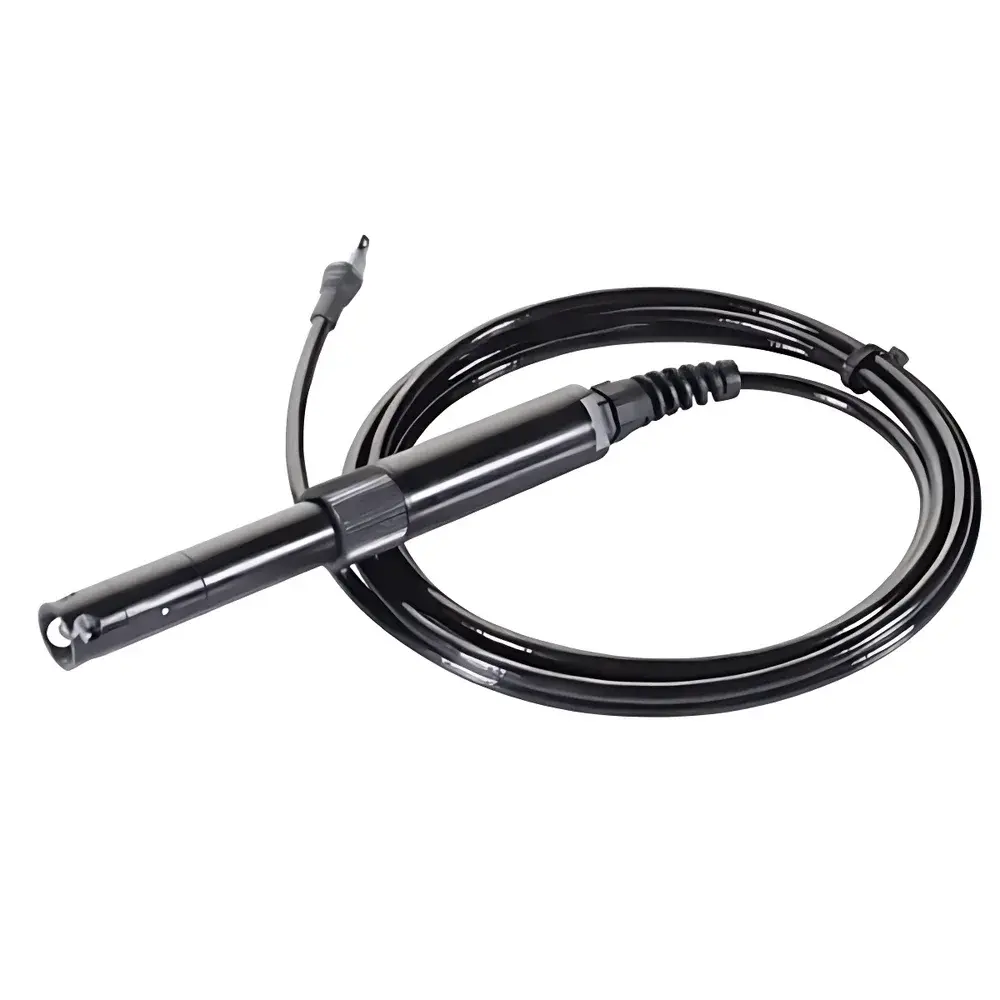
| Cable | 3 m armored polyurethane-sheathed cable with 9-pin connector (bare leads or waterproof Fischer-type) |
| Dimensions (installed, without gland) | 262 mm |
| (with compression gland) | 324 mm |
| Weight | 350 g (sensor + cable) |
Overview
The AQUALABO EHAN ORP Sensor is a robust, field-deployable electrochemical sensor engineered for continuous, high-stability oxidation-reduction potential (ORP) and temperature monitoring in demanding aqueous environments. Based on the fundamental principle of potentiometric measurement using a composite electrode system—comprising a platinum working electrode and an integrated Ag/AgCl reference electrode with colloidal KCl electrolyte—the EHAN delivers stable, drift-resistant mV output proportional to the electron activity of redox couples in solution. Unlike conventional ORP sensors prone to reference junction clogging or electrolyte depletion, the EHAN leverages PONSEL’s proprietary Plastogel® technology: a thixotropic gel electrolyte that minimizes ion leaching, resists fouling in high-suspended-solid or low-flow conditions, and extends service life between maintenance cycles. Its dual-parameter design (ORP + temperature) enables real-time thermal compensation per Nernst equation, ensuring metrological traceability across variable thermal regimes encountered in wastewater treatment, industrial effluent streams, and odor control systems.
Key Features
- Composite Pt/Ag-AgCl electrode architecture with Plastogel® colloidal KCl reference system for enhanced long-term stability and reduced calibration frequency
- Integrated NTC thermistor with 0.01 °C resolution for automatic temperature compensation and compliance with ISO 5814 and ASTM D1129 redox measurement standards
- Sub-5-second response time (t90) under dynamic flow conditions, validated per DIN EN 27888 protocols
- Low-flow insensitivity: minimal dependence on water velocity due to optimized hydrodynamic probe geometry and gel-based reference junction
- Ultra-low power consumption: 25 µA standby current supports battery-operated remote deployments; pulsed heating capability (500 mA, 100 ms) prevents ice formation in cold-climate installations
- Industrial-grade mechanical construction: pressure-rated to 5 bar, IP68 ingress protection, and chemical resistance to H2S, Cl2, nitrate-rich, and moderately acidic/alkaline matrices
Sample Compatibility & Compliance
The EHAN sensor is validated for use in municipal and industrial wastewater matrices—including influent channels, aerobic/anoxic basins, secondary clarifiers, and final effluent discharge points—as well as in odor abatement scrubber solutions and biogas desulfurization circuits. Its PVC/POM-C housing and platinum sensing surface resist biofouling, sulfide precipitation, and chloride-induced corrosion. The sensor meets CE marking requirements under the EU Electromagnetic Compatibility Directive 2014/30/EU and Low Voltage Directive 2014/35/EU. Data integrity aligns with GLP and GMP principles: onboard non-volatile memory stores up to 10,000 timestamped calibration events and measurement records, supporting audit-ready traceability. While not FDA 21 CFR Part 11-certified out-of-the-box, its Modbus RTU register structure supports integration into validated SCADA architectures compliant with 21 CFR Part 11 when paired with qualified data acquisition firmware.
Software & Data Management
Communicating exclusively via Modbus RTU over RS-485 (standard) or SDI-12 (optional), the EHAN integrates natively with industry-standard PLCs (e.g., Siemens S7, Allen-Bradley CompactLogix), data loggers (Onset HOBO, Campbell Scientific CR1000X), and cloud-connected telemetry gateways (Sierra Wireless AirLink, Teltonika RUT955). All configuration parameters—including measurement interval, temperature compensation mode, and alarm thresholds—are programmable via standard Modbus function codes (0x03, 0x06, 0x10). No proprietary software or drivers are required. Calibration coefficients and historical diagnostics (e.g., electrode impedance, reference potential drift) are stored in dedicated holding registers accessible for remote validation and predictive maintenance scheduling. Firmware updates are performed via serial command sequence—no physical disassembly needed.
Applications
- Municipal wastewater treatment: Real-time ORP profiling for process control of nitrification (target: +100 to +250 mV) and denitrification (target: −50 to −150 mV) in activated sludge systems
- Industrial pretreatment monitoring: Detection of oxidant residuals (e.g., chlorine, ozone) and reductant surges (e.g., sulfides, ferrous iron) upstream of membrane filtration or ion exchange units
- Odor control optimization: Closed-loop feedback control of chemical dosing (e.g., FeCl3, H2O2) in bioscrubbers based on redox setpoints linked to H2S oxidation pathways
- Environmental compliance reporting: Continuous ORP logging for regulatory submissions under EPA Method 9038 and ISO 15839, supporting NPDES permit requirements for disinfection efficacy verification
- Research and pilot-scale studies: High-temporal-resolution redox mapping in constructed wetlands, anaerobic digesters, and sediment-water interface investigations
FAQ
Does the EHAN require regular recalibration?
No—its Plastogel® reference system provides inherent stability; factory calibration remains valid for ≥6 months in typical wastewater applications. Field verification against a certified Zobell solution (e.g., +228 mV at 25 °C) is recommended quarterly.
Can the EHAN operate in seawater or brackish water?
Yes, but prolonged exposure (>72 h) to salinity >35 g/L may accelerate reference electrode drift; optional Ag/AgCl reference with saturated KCl fill is available for marine deployments.
Is temperature compensation automatic?
Yes—NTC-derived temperature is measured simultaneously and applied in real time using the Nernst equation (−59.16 mV/pH unit at 25 °C, adjusted for actual temperature).
What is the maximum cable length for RS-485 communication?
Up to 1,200 meters with proper twisted-pair shielding and termination; signal integrity verified per EIA/TIA-485-A.
How is sensor cleaning performed in-situ?
The Pt tip can be wiped with lint-free cloth moistened with dilute HNO3 (1% v/v); gel reference surface is cleaned using soft brush and deionized water—no abrasive agents or ultrasonic baths permitted.







