
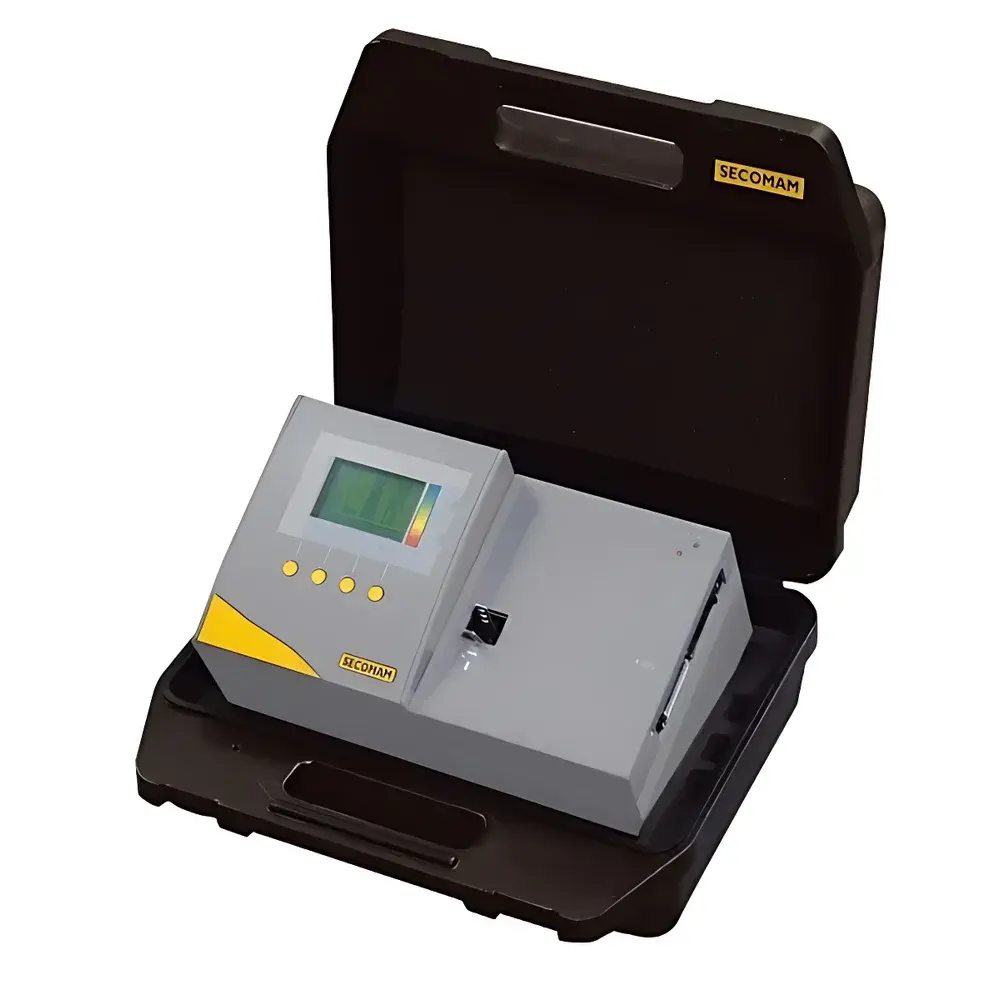
AQUALABO PASTEL UV Portable Organic Matter Analyzer
| Brand | AQUALABO |
|---|---|
| Origin | France |
| Model | PASTEL UV |
| Instrument Type | Portable/HANDHELD Water Quality Analyzer |
| Measured Parameters | Organic Matter (COD, BOD, TOC, TSS), Specific Compounds (NO₃⁻, Detergents) |
| Spectral Range | 200–350 nm |
| Optical Path Lengths | 5 mm and 10 mm |
| Detection Limits (10 mm path) | COD: 1–350 mg/L, BOD: 0.2–350 mg/L, TOC: 0.5–300 mg/L, TSS: 2.5–100 mg/L, Detergent: 0.5–60 mg/L, NO₃⁻: 0.5–40 mg/L, NO₃⁻-N: 0.11–9.03 mg/L |
| Display | 64 × 128 pixel monochrome LCD |
| Interface | RS232C bidirectional |
| Power | Internal rechargeable battery (≥100 measurements per charge) |
| Dimensions (L×W×H) | 35 × 17 × 20 cm |
| Weight | 9 kg |
| Max. Power Consumption | 35 W |
Overview
The AQUALABO PASTEL UV Portable Organic Matter Analyzer is a field-deployable, UV absorbance-based spectrophotometric instrument engineered for rapid, reagent-free quantification of organic load and selected inorganic species in diverse aqueous matrices. It operates on the principle of ultraviolet absorption spectroscopy in the 200–350 nm range, where organic chromophores—including aromatic compounds, conjugated double bonds, and nitrate ions—exhibit characteristic absorbance signatures. Unlike conventional wet-chemistry methods, PASTEL UV applies Advanced Spectral Deconvolution (ASD) algorithms to resolve overlapping spectral contributions from multiple analytes simultaneously. This enables concurrent estimation of chemical oxygen demand (COD), biochemical oxygen demand (BOD), total organic carbon (TOC), total suspended solids (TSS), nitrate (NO₃⁻), and anionic surfactants—without sample digestion, reagent addition, or laboratory infrastructure. Its core design targets operational simplicity, analytical robustness, and traceability under field conditions, making it suitable for routine surveillance, incident response, and compliance verification across environmental and industrial water management workflows.
Key Features
- Reagent-free operation: Eliminates consumables, hazardous waste generation, and calibration drift associated with colorimetric kits or titration-based methods.
- Automatic spectral background correction: Compares real-time sample spectra against pre-characterized reference spectra for water type (e.g., raw wastewater, treated effluent, surface water), enhancing accuracy and enabling anomaly detection.
- Integrated dilution factor calculation: When absorbance exceeds linear dynamic range, the instrument computes optimal dilution ratio and applies correction automatically—no manual intervention required.
- Onboard data management: Stores up to 200 measurement records with timestamp, user ID, site code, and sample ID; supports traceable audit trails compliant with GLP principles.
- Dual-pathlength cuvette system: Switches between 5 mm and 10 mm optical paths to maintain sensitivity across low- and high-concentration ranges without hardware change.
- Battery-powered autonomy: Delivers ≥100 consecutive measurements per full charge; optional AC adapter enables continuous operation during extended field campaigns or lab bench use.
Sample Compatibility & Compliance
PASTEL UV is validated for direct analysis of untreated samples from natural waters (rivers, lakes, groundwater), raw and secondary-treated wastewater, industrial process streams, and potable water distribution systems. No filtration, centrifugation, or pH adjustment is required prior to measurement. The instrument’s spectral methodology aligns with established UV-based surrogate metrics referenced in ISO 7888 (water quality — determination of conductivity), ASTM D5540 (standard test method for turbidity of water), and EPA Method 415.3 (total organic carbon in water). While not a direct replacement for certified reference methods (e.g., ISO 6060 for COD), its results demonstrate strong correlation (r² > 0.92) with standard techniques when calibrated against site-specific matrices—enabling rapid screening and trend monitoring in accordance with EU Urban Wastewater Treatment Directive (91/271/EEC) and US Clean Water Act reporting frameworks.
Software & Data Management
UV PRO software—developed by SECOMAM—is the dedicated platform for advanced spectral processing, calibration refinement, and long-term data governance. It supports both offline batch analysis of exported PASTEL UV datasets and real-time ingestion from networked installations. Key capabilities include: spectral library creation and maintenance for local water types; ASD model optimization using partial least squares (PLS) regression; automated report generation (PDF/CSV) with embedded metadata; firmware update management; and diagnostic logging for preventive maintenance scheduling. UV PRO complies with FDA 21 CFR Part 11 requirements for electronic records and signatures when deployed in regulated environments, including audit trail configuration, user role-based access control, and immutable data archiving.
Applications
- Routine organic load monitoring at wastewater influent/effluent points to support process control and regulatory discharge reporting.
- Early warning detection of accidental spills or illegal discharges via spectral deviation alerts—particularly effective for hydrocarbon, phenol, or detergent contamination.
- Assessment of treatment efficiency across biological, membrane, and advanced oxidation processes by tracking changes in UV254 absorbance and spectral slope ratios (e.g., SUVA₂₅₄).
- Field validation of online UV sensors and cross-calibration of distributed sensor networks in river basin management programs.
- Supporting ISO 14001 environmental management systems through standardized, auditable water quality documentation.
FAQ
Does PASTEL UV require daily calibration?
No—factory-calibrated spectral response remains stable over time. Field verification using certified reference standards (e.g., potassium hydrogen phthalate for COD equivalence) is recommended every 30 days or after 50 measurements, per ISO/IEC 17025 guidelines.
Can it measure chlorinated organics or heavy metals?
No—PASTEL UV does not detect non-chromophoric species such as heavy metals, chloride, or fully halogenated compounds. Its sensitivity is limited to UV-absorbing moieties present in natural and anthropogenic organic matter.
Is the device compatible with LIMS integration?
Yes—via RS232C serial output and UV PRO’s export modules, measurement data can be formatted for ingestion into laboratory information management systems supporting ASTM E1384 or HL7 standards.
What maintenance is required?
Routine cleaning of quartz cuvettes and optical windows with lint-free wipes and deionized water; annual verification of battery health and spectral lamp intensity by authorized service centers.
How is method validation performed for regulatory submissions?
Users must establish matrix-specific correlation models using parallel analysis with accredited reference methods (e.g., ISO 6060, ISO 15705), document uncertainty budgets per ISO/IEC 17025, and retain raw spectral files for audit purposes.







