
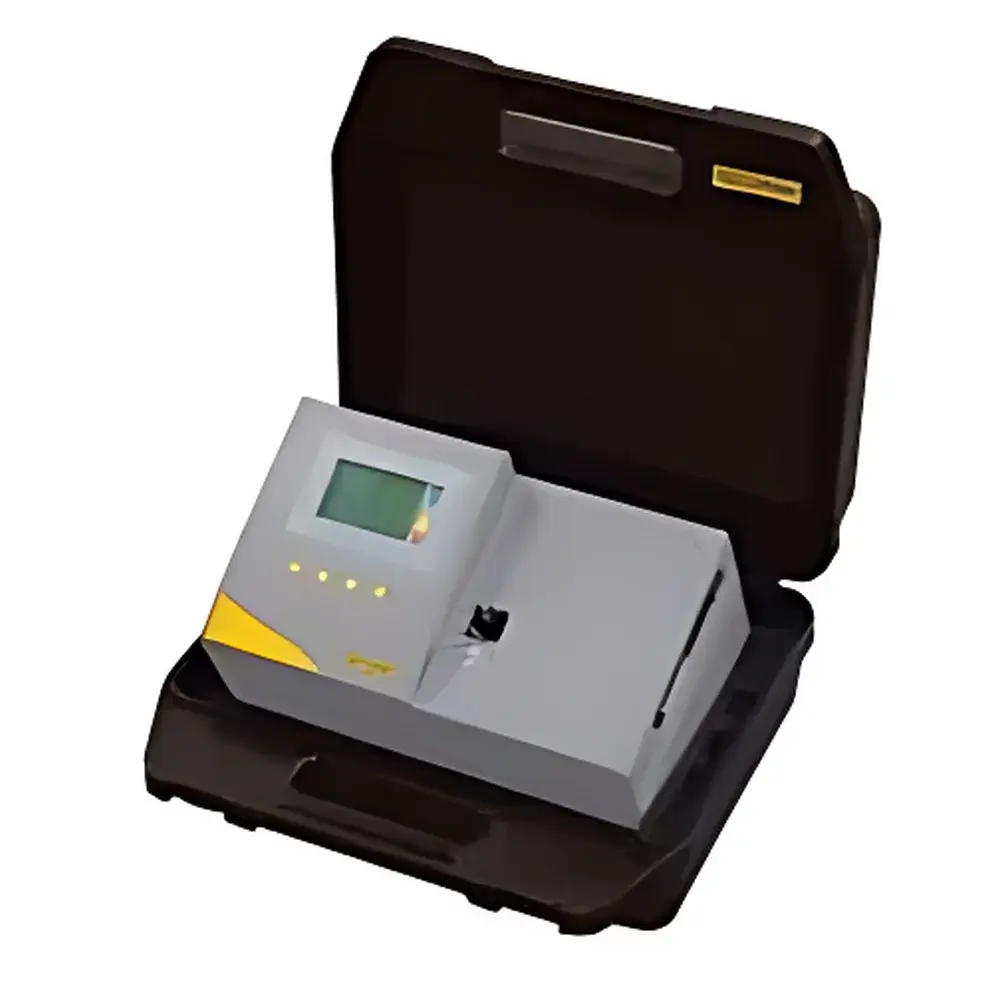
AQUALABO PASTEL-UV Portable UV Spectral Scanning Water Quality Analyzer
| Brand | AQUALABO |
|---|---|
| Origin | France |
| Model | PASTEL-UV |
| Instrument Type | Portable/Handheld Water Quality Analyzer |
| Detection Parameters | COD, BOD, TSS, TOC, NO₃⁻, Anionic Surfactant Concentration |
| Optical Range | 200–350 nm |
| Light Source | Pulsed Deuterium Lamp |
| Detector | UV Photodiode Array |
| Cuvette | 5 × 10 mm Quartz |
| Measurement Time | <60 s per sample |
| Data Storage | 200 samples with timestamp, operator ID, sample ID, and location ID |
| Power | Rechargeable battery (≥100 measurements per charge) |
| Dimensions | 320 × 170 × 350 mm |
| Weight | ~5 kg |
| Dilution Range | Auto-dilution from 1:1 to 1:250 |
| Linear Calibration Factor Range | 0.2–2.0 (software-adjustable via UV-PRO) |
| Display | 64 × 128 dot-matrix graphical LCD |
| Interface | RS232C bidirectional |
Overview
The AQUALABO PASTEL-UV is a portable, reagent-free UV spectral scanning water quality analyzer engineered for rapid, multi-parameter quantification of key organic and inorganic contaminants in aqueous matrices. It operates on the principle of ultraviolet absorbance spectroscopy across a continuous wavelength range of 200–350 nm, leveraging spectral fingerprinting and multivariate calibration models to simultaneously resolve six critical parameters—Chemical Oxygen Demand (COD), Biochemical Oxygen Demand (BOD), Total Suspended Solids (TSS), Total Organic Carbon (TOC), Nitrate (NO₃⁻), and Anionic Surfactant concentration—without chemical reagents or sample digestion. Unlike conventional wet-chemistry or enzymatic methods, the PASTEL-UV relies on pulsed deuterium lamp illumination and a solid-state photodiode array detector, eliminating moving optical components and ensuring long-term photometric stability and measurement reproducibility. Its design adheres to field-deployable instrumentation standards, supporting real-time decision-making in environmental monitoring, wastewater treatment operations, and industrial process water management.
Key Features
- Reagent-free operation: Eliminates consumables, hazardous waste generation, and associated handling compliance burdens (e.g., CLP/GHS labeling, storage, disposal).
- Single-sample, sub-minute analysis: Full-spectrum acquisition and multi-parameter regression completed in under 60 seconds per measurement.
- Auto-dilution capability: Integrated dilution algorithm extends dynamic range up to 250×, enabling accurate quantification of highly concentrated samples without manual intervention.
- Robust optical architecture: Pulsed deuterium light source delivers stable UV irradiance; quartz flow cell (5 × 10 mm) ensures high transmission efficiency and resistance to chemical degradation.
- Traceable data governance: Each stored record includes sample ID, operator ID, geographic location tag, date/time stamp, and instrument serial number—supporting GLP-compliant documentation workflows.
- Battery-powered portability: Integrated rechargeable battery supports ≥100 consecutive measurements; full system—including cuvettes, calibration standards, and charging kit—fits within a lightweight, impact-resistant carry case (320 × 170 × 350 mm; ~5 kg).
Sample Compatibility & Compliance
The PASTEL-UV is validated for use across diverse aqueous matrices, including natural surface waters, raw and treated municipal wastewater, industrial effluents, cooling tower water, and process rinse streams. It meets functional equivalence requirements for screening-level assessment under ISO 7888 (conductivity), ISO 8467 (COD spectrophotometric method), and ASTM D1253 (residual chlorine—where applicable via spectral deconvolution). While not a replacement for reference-grade laboratory methods (e.g., USP <643> for TOC, ISO 6060 for COD), its performance aligns with EPA Method 410.4 (UV-Vis screening for organics) and supports trend analysis, early-warning detection, and operational control per ISO 5667-3 and EN 15299. The absence of reagents and mechanical actuators reduces failure modes, enhancing reliability during unattended field deployment or routine plant-floor checks.
Software & Data Management
Data acquisition, calibration, and reporting are managed through UV-PRO software—a Windows-based application compliant with FDA 21 CFR Part 11 for electronic records and signatures. UV-PRO enables user-defined spectral curve optimization via adjustable linear calibration factors (0.2–2.0), allowing method adaptation to site-specific interferents (e.g., humic acid matrix effects, chloride interference in NO₃⁻ quantification). Raw absorbance spectra (200–350 nm, 1 nm resolution) are exportable in CSV format for third-party chemometric modeling (e.g., PLS regression in MATLAB or Python). Audit trails log all calibration events, parameter modifications, and data exports. Instrument firmware updates and spectral library expansion are performed via RS232C interface, ensuring long-term method adaptability without hardware modification.
Applications
- Wastewater treatment plants: Real-time monitoring of influent/effluent COD, BOD, and surfactants to optimize biological treatment efficiency and detect shock loads.
- Industrial pretreatment verification: Rapid screening of rinse waters from electroplating, textile dyeing, or pharmaceutical manufacturing for TOC and anionic surfactant compliance prior to discharge.
- Environmental field surveys: On-site assessment of river, lake, or groundwater contamination following spill incidents or seasonal runoff events.
- Drinking water distribution systems: Detection of nitrate anomalies and organic loading shifts indicating biofilm activity or source water intrusion.
- Research & education: Teaching spectral deconvolution principles, multivariate calibration, and UV-Vis applications in environmental analytical chemistry laboratories.
FAQ
Does the PASTEL-UV require daily calibration?
No—factory-calibrated spectral models remain stable for ≥6 months under normal field use. A single-point verification using certified reference standard (e.g., potassium hydrogen phthalate for COD) is recommended before each sampling campaign.
Can it measure samples with turbidity or particulate matter?
Yes—the 5 mm pathlength quartz cuvette and 200–350 nm spectral window minimize scattering artifacts; TSS quantification is derived from baseline-corrected absorbance at 254 nm, validated per ISO 7027 principles.
Is UV-PRO software validated for regulated environments?
UV-PRO includes configurable audit trail, electronic signature, and role-based access controls—fully aligned with ALCOA+ data integrity principles and suitable for GMP/GLP-regulated facilities conducting non-release testing.
What maintenance is required?
Only periodic cleaning of the quartz cuvette with deionized water and lint-free wipes; no optical alignment, lamp replacement, or fluidic servicing is needed over the instrument’s service life.
Related Products







