
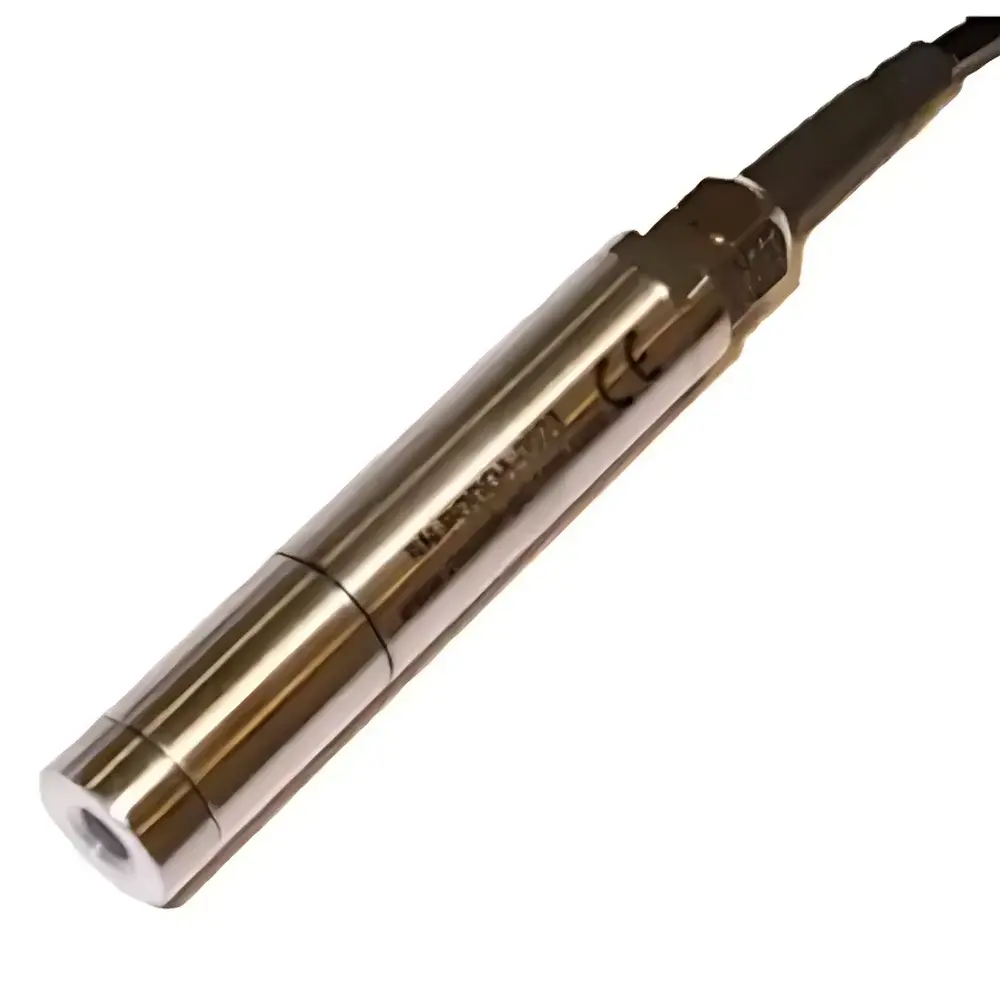
AQUALABO Ponsel OPTOD Optical Dissolved Oxygen Sensor
| Brand | AQUALABO |
|---|---|
| Origin | France |
| Model | Ponsel |
| Measurement Principle | Luminescence-based Optical (OPTOD) |
| DO Range | 0.00–20.00 mg/L (ppm), 0–200% saturation |
| Resolution | 0.01 mg/L |
| Accuracy | ±0.1 mg/L (±0.1 ppm, ±1% saturation) |
| Response Time (t₉₀) | <60 s |
| Temperature Compensation | CTN thermistor |
| Storage Temperature | −10°C to +60°C |
| Output Interface | Modbus RTU over RS-485 (standard), SDI-12 (optional) |
| Power Supply | 5–12 V DC |
| Current Consumption | Standby: 25 µA |
| RS-485 mode (1 reading/s) | avg. 4.4 mA |
| SDI-12 mode (1 reading/s) | avg. 7.3 mA |
| Dimensions | Ø25 mm × 146 mm (sensor body only) |
| Weight | 450 g (sensor + 3 m polyurethane cable) |
| Housing Material | 316L stainless steel |
| Max. Operating Pressure | 5 bar |
| Connector | 9-pin waterproof subminiature connector with polyurethane overmold |
Overview
The AQUALABO Ponsel OPTOD Optical Dissolved Oxygen Sensor is a field-deployable, maintenance-free probe engineered for high-stability, long-term dissolved oxygen (DO) monitoring in natural waters, wastewater streams, aquaculture systems, and laboratory benchtop applications. Unlike electrochemical Clark-type sensors, the Ponsel employs luminescence quenching technology—where molecular oxygen modulates the lifetime and intensity of a ruthenium-based luminophore immobilized on an optical sensing spot. This non-consumptive, solid-state measurement principle eliminates membrane fouling, electrolyte depletion, and zero drift associated with amperometric sensors. The sensor complies with ASTM D888-05 for dissolved oxygen determination in water, ensuring traceable metrological validity for regulatory reporting and research-grade data acquisition.
Key Features
- Luminescence-based optical detection (OPTOD) with no oxygen consumption—ideal for low-oxygen environments (e.g., hypolimnion, anaerobic bioreactors, sediment porewater)
- Integrated CTN thermistor for automatic temperature compensation across the full operational range (0–40°C typical)
- Embedded non-volatile memory storing factory calibration coefficients, serial number, and up to 10,000 timestamped readings—enabling true plug-and-play operation without recalibration after redeployment
- Low-power architecture optimized for battery-operated loggers: standby current as low as 25 µA supports multi-year deployments when paired with duty-cycled data loggers
- Dual communication options: standard Modbus RTU over RS-485 (multi-drop capable, up to 32 nodes per bus) and optional SDI-12 interface for compatibility with legacy environmental data loggers (e.g., Campbell Scientific, Onset HOBO)
- Robust 316L stainless steel housing rated to 5 bar (≈50 m water column), IP68-rated connector, and polyurethane-jacketed 3 m cable suitable for submerged or conduit-mounted installation
Sample Compatibility & Compliance
The Ponsel sensor is validated for use in freshwater, seawater (with salinity compensation applied in host system firmware), treated effluent, and process water. It exhibits minimal interference from hydrogen sulfide, chlorine, or heavy metals—common limitations of electrochemical DO probes. Its optical design ensures immunity to flow velocity variations and does not require minimum flow rates for accuracy. The device conforms to ASTM D888-05 and supports compliance with ISO 5815-2:2019 (Water quality — Determination of biochemical oxygen demand after n days — Part 2: Method using diluted sample and inoculum) when integrated into BOD incubation systems. For regulated environments, raw Modbus register access enables integration into SCADA platforms compliant with IEC 62443 and FDA 21 CFR Part 11 audit-trail requirements when paired with appropriate data acquisition software.
Software & Data Management
Data output follows standard Modbus RTU register mapping (holding registers 40001–40010), providing simultaneous access to DO concentration (mg/L and % saturation), temperature (°C), sensor status flags, and internal diagnostics. No proprietary drivers are required—compatibility extends to open-source platforms (e.g., Node-RED, Python pymodbus), commercial SCADA systems (Ignition, Siemens Desigo), and OEM telemetry modules. Calibration history and sensor metadata persist in onboard EEPROM, enabling traceability across instrument swaps and facilitating GLP/GMP-aligned maintenance logs. Optional firmware updates via RS-485 allow future protocol enhancements without hardware replacement.
Applications
- Real-time DO profiling in lakes, rivers, and estuaries for eutrophication studies and TMDL compliance monitoring
- Continuous aeration control in activated sludge and MBR wastewater treatment plants
- Process monitoring in pharmaceutical water-for-injection (WFI) loops and bioreactor sparging systems
- Long-term deployment in autonomous buoys, moored profilers, and riverbank telemetry stations
- Calibration reference for portable DO meters in field QA/QC programs
- Research applications requiring stable, drift-free DO data over weeks or months (e.g., sediment oxygen demand, benthic chamber experiments)
FAQ
Does the Ponsel sensor require membrane replacement or electrolyte refilling?
No. As an optical sensor, it contains no membranes, electrolytes, or cathodes—eliminating routine consumables and associated calibration drift.
Can this sensor be used in seawater?
Yes, provided the connected data logger or controller applies salinity compensation using conductivity or user-input salinity values per Winkler-derived correction algorithms.
Is temperature compensation automatic?
Yes—the integrated CTN thermistor provides real-time temperature measurement, and all DO calculations are automatically compensated within the sensor’s firmware.
What is the maximum cable length supported for RS-485 communication?
With proper termination and twisted-pair cabling, RS-485 operation is stable up to 1,200 meters at 9,600 bps; shorter distances are recommended for higher baud rates or noisy electrical environments.
How is sensor validation performed in the field?
Users may perform a two-point air-saturated water check (100% saturation) and a sodium sulfite zero-oxygen solution test (0 mg/L)—both referenced to temperature- and salinity-corrected theoretical values per APHA Standard Methods 4500-O G.







