
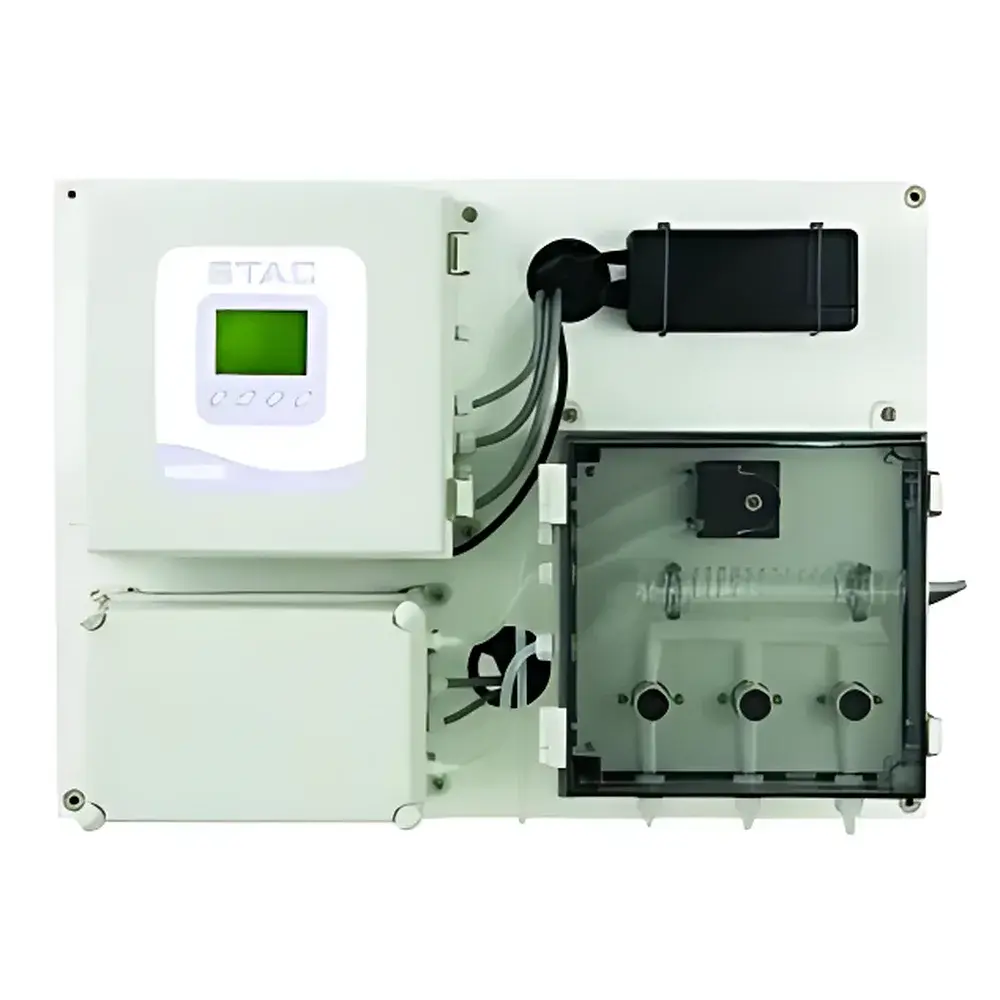
AQUALABO STAC CL High-Chlorine Analyzer
| Brand | AQUALABO |
|---|---|
| Origin | France |
| Model | STAC CL |
| Instrument Type | Online Analyzer |
| Measurement Principle | UV Absorption Spectrophotometry (204–321 nm) |
| Measured Parameters | Free Chlorine (Cl₂), Total Chlorine, Chlorine Dioxide (ClO₂), Hydrogen Sulfide (H₂S) |
| Range | Cl₂ 4–3000 mg/L |
| Optical Path Length Options | 2 mm (Cl₂: 100–3000 ppm, H₂S LOD: 10 ppm), 5 mm (Cl₂: 40–1200 ppm, H₂S LOD: 4 ppm) |
| Spectrometer | UV Multichannel Spectrophotometer |
| Sample Flow | Gravity-fed, max. pressure 1 bar |
| Channels | 1 standard, up to 4 programmable sample channels + blank channel |
| Valves | 2–5 solenoid valves |
| Detection Method | Deconvolution-based spectral analysis using reference spectra libraries |
| Data Output | Four 4–20 mA analog outputs + RS232C interface |
| Operating Temperature | 15–40 °C |
| Sample Temp. | ≤40 °C |
| Sample Matrix | Natural or treated water, suspended solids <2 mm |
| Power Supply | 230 V AC, 50/60 Hz, 300 VA |
| Dimensions | 800 × 600 × 360 mm |
| Weight | 15 kg |
| Light Source | Deuterium lamp (rated for ≥100,000 measurements) |
| Memory Capacity | 4 spectral models + 255 measurement records |
| Software | UV PRO for model calibration, spectrum visualization, maintenance diagnostics |
Overview
The AQUALABO STAC CL High-Chlorine Analyzer is an online UV absorption spectrophotometer engineered for precise, interference-resistant quantification of chlorine species and hydrogen sulfide in challenging high-chlorine water matrices. Unlike conventional DPD-based colorimetric analyzers — which suffer from reagent instability, narrow dynamic range (typically <1.5 mg/L Cl₂), and susceptibility to oxidant interferences — the STAC CL employs direct ultraviolet absorption spectroscopy across a calibrated 204–321 nm spectral window. This physical measurement principle eliminates reliance on chemical reagents, enabling stable, drift-free operation over extended unattended periods. The analyzer applies deconvolution algorithms to resolve overlapping absorption signatures of free chlorine (Cl₂), combined chlorine (e.g., chloramines), chlorine dioxide (ClO₂), and hydrogen sulfide (H₂S) within a single scan. Its design targets applications where rapid, accurate, and simultaneous multi-analyte monitoring is critical — particularly in wastewater odor control systems, chlorination optimization loops, and industrial effluent compliance monitoring.
Key Features
- Multi-parameter UV absorption analysis: Simultaneous quantification of Cl₂, total chlorine, ClO₂, and H₂S without reagent addition
- Extended measurement range: 4–3000 mg/L for chlorine species; 5–50 mg/L for H₂S — eliminating need for automatic dilution
- Deconvolution-based spectral processing: Uses pre-characterized reference spectra (“models”) to decompose complex absorption profiles and report both concentration and model-fit confidence metrics
- Modular flow architecture: Configurable with 1–4 sample channels plus dedicated blank channel; controlled via 2–5 integrated solenoid valves
- Optical path flexibility: Interchangeable 2 mm and 5 mm flow cells optimized for high- and mid-range chlorine detection, respectively
- Robust optical system: Stable deuterium lamp source (≥100,000 measurement cycles) coupled with multichannel UV spectrometer for high signal-to-noise ratio
- Onboard LCD interface with membrane keyboard: Enables local configuration, real-time spectrum viewing, and diagnostic access without external PC
- Comprehensive analog and digital I/O: Four isolated 4–20 mA outputs assignable per parameter; RS232C interface for data logging and remote firmware updates
Sample Compatibility & Compliance
The STAC CL is validated for use with natural surface waters, secondary-treated wastewater, and chlorinated process streams containing suspended solids <2 mm. It requires no filtration beyond standard 100 µm straining and operates under gravity-fed conditions (max. inlet pressure 1 bar). The instrument complies with key international standards governing environmental instrumentation, including ISO 7027 (turbidity-independent photometric measurement), EN ISO 15922 (chlorine determination in water), and ASTM D1253 (residual chlorine testing). Its software architecture supports audit-trail functionality compatible with GLP and GMP environments when used with UV PRO software and external SCADA integration. While not FDA 21 CFR Part 11 certified out-of-the-box, its data export structure (CSV, ASCII spectra) enables traceable recordkeeping aligned with regulatory data integrity requirements.
Software & Data Management
UV PRO software serves as the primary configuration, calibration, and diagnostic platform for the STAC CL. It enables users to import, edit, and validate spectral reference models — essential for adapting to site-specific matrix effects (e.g., variable humic content or nitrate interference). Users may download raw absorbance spectra for offline validation, overlay multiple measurements for trend analysis, and generate calibration reports compliant with internal QA protocols. The software logs all configuration changes, model updates, and maintenance events with timestamps, supporting root-cause analysis during method validation or regulatory audits. Measurement results are stored onboard (255 records) and can be exported via RS232C to centralized SCADA or LIMS systems. No cloud connectivity or proprietary drivers are required — communication follows standard Modbus RTU or ASCII command sets.
Applications
- Wastewater odor control: Real-time monitoring of chlorine dosing in chemical scrubbers to optimize H₂S oxidation while minimizing excess oxidant carryover
- Drinking water disinfection: Closed-loop control of chlorine generator output in membrane filtration or distribution system booster stations
- Industrial cooling tower management: Continuous tracking of residual biocide levels amid fluctuating organic loading and temperature
- Effluent compliance verification: Automated reporting of chlorine residuals prior to discharge, meeting EPA NPDES or EU Urban Wastewater Treatment Directive thresholds
- Process optimization in pulp & paper or food processing: Monitoring chlorine dioxide bleaching stages or sanitization rinse efficacy
FAQ
Does the STAC CL require daily reagent preparation or calibration?
No. As a physical UV absorption instrument, it operates without consumable reagents. Initial model calibration is performed during commissioning; periodic verification (e.g., monthly) using NIST-traceable standard solutions is recommended.
Can the STAC CL distinguish between free chlorine and monochloramine?
Yes. Its deconvolution algorithm resolves characteristic absorption features of Cl₂ (~240 nm), NH₂Cl (~270 nm), and NO₂⁻ (~300 nm), enabling speciation when appropriate reference models are loaded.
What maintenance intervals are specified for the deuterium lamp and flow cell?
The deuterium lamp is rated for ≥100,000 measurements (~2 years at 4-min cycle); replacement is user-serviceable. The quartz flow cell requires cleaning every 2–4 weeks depending on fouling potential; no consumable gaskets are needed.
Is remote firmware update supported?
Yes, via RS232C using UV PRO software. Updates preserve all stored models and historical data.
How does the analyzer handle turbid or colored samples?
The deconvolution approach inherently corrects for baseline offset and broad-band absorbance contributions. For highly colored matrices (e.g., peat-rich influent), inclusion of a “humic acid” reference spectrum in the model library improves accuracy.







