
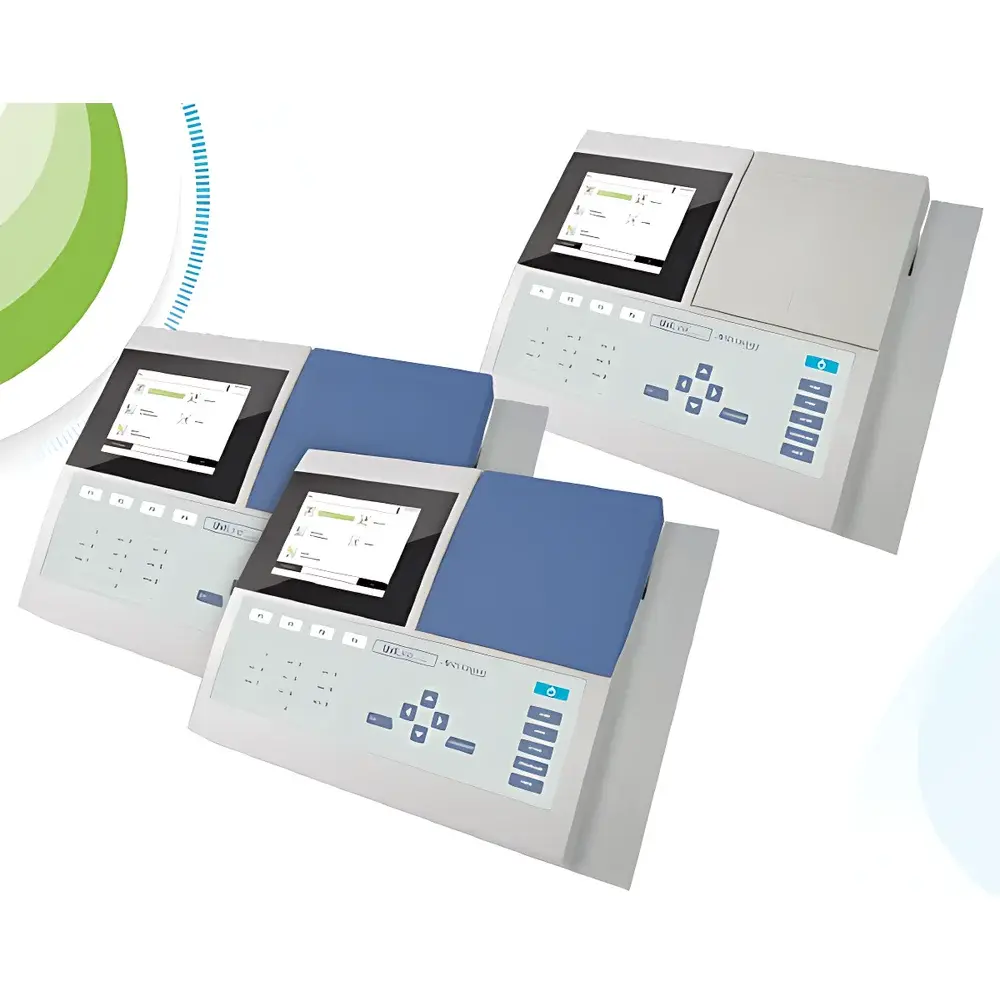
AQUALABO UVILINE 8100C / 9100C / 9400C UV-Vis Spectrophotometer
| Brand | AQUALABO |
|---|---|
| Origin | France |
| Model | UVILINE 8100C / 9100C / 9400C |
| Wavelength Range | 320–1100 nm (8100C/9100C), 190–1100 nm (9400C) |
| Light Source | Tungsten-Halogen (8100C/9100C), Xenon Flash Lamp (9400C) |
| Spectral Bandwidth | 6 nm (8100C), 4 nm (9100C/9400C) |
| Wavelength Accuracy | ±2 nm (8100C), ±1 nm (9100C/9400C) |
| Wavelength Repeatability | ±0.5 nm |
| Absorbance Range | ±3300 Abs |
| Absorbance Resolution | 0.001 Abs or 0.1% T |
| Photometric Accuracy | ±0.005–0.016 Abs (dependent on range) |
| Stray Light | <0.1% at 340 nm (NaNO₂), <1% at 220–400 nm (GG375/GG408/NaI) |
| Baseline Stability | ±0.01 Abs |
| Scan Speed | Low/Medium/Fast |
| Interface | 1× USB-A, 1× USB-B |
| Power Supply | 110–220 V, 50/60 Hz |
| Operating Temperature | 10–35 °C |
| Dimensions (L×W×H) | 404 × 314 × 197 mm |
| Weight | 4.7 kg (8100C), 4.0 kg (9100C/9400C) |
| IP Rating | IP30 |
| Software | Spectralab v5.x (GLP-compliant) |
Overview
The AQUALABO UVILINE 8100C, 9100C, and 9400C are benchtop double-beam UV-Vis spectrophotometers engineered for high-precision water quality analysis in environmental laboratories, municipal water treatment facilities, and regulatory testing centers. Based on classical Beer-Lambert absorption spectroscopy, these instruments deliver quantitative and qualitative spectral analysis across the ultraviolet and visible spectrum—enabling trace-level detection of key water quality parameters including nitrate, phosphate, ammonia, COD, TOC surrogates, heavy metals (e.g., Cr⁶⁺, Fe²⁺), and organic contaminants. The 9400C variant extends measurement capability into the deep UV (190 nm) using a pulsed xenon lamp and optimized optical path, critical for direct quantification of low-concentration analytes without derivatization. All models employ a R1200 L/mm holographic grating to minimize stray light (<0.1% at 340 nm), ensuring high photometric fidelity and robust baseline stability (±0.01 Abs) over extended operation. Designed for routine compliance workflows, the UVILINE platform integrates hardware-level GLP enforcement—including user authentication, audit-trail–enabled method storage, and timestamped result logging—aligning with ISO/IEC 17025, EPA Method 365.2, ASTM D515, and USP requirements.
Key Features
- High-resolution color touchscreen interface (≥7″) with ergonomic layout and intuitive icon-driven navigation—optimized for glove-compatible operation in wet-lab environments.
- Automated wavelength calibration via internal reference standards; no manual adjustment required during daily startup or recalibration cycles.
- Real-time absorbance/transmittance monitoring with continuous data streaming at user-defined intervals (10–500 ms resolution).
- Multi-wavelength analysis mode supporting up to 10 independent wavelengths per measurement cycle, with fully customizable mathematical expressions (e.g., Aλ₁ − k·Aλ₂ + c) incorporating temperature, pH, or dilution factors as variables.
- Full-spectrum scanning (190–1100 nm) with dynamic graph rendering: zoom, derivative calculation, peak/valley detection, and overlay comparison of up to 5 spectra.
- Kinetic measurement mode with time-resolved absorbance tracking, single-curve regression, and slope-based rate calculation (e.g., for enzymatic or oxidation-reduction assays).
- Integrated environmental light compensation algorithm—maintains photometric accuracy under variable ambient illumination without enclosure.
- Quick-Lock accessory mounting system enabling tool-free, repeatable installation of cuvette holders, flow cells, and Peltier-controlled sample stages.
Sample Compatibility & Compliance
The UVILINE series accommodates diverse sample formats through a modular accessory ecosystem certified to IEC 61000-4 electromagnetic compatibility standards. Standard 10 mm pathlength quartz or optical-grade glass cuvettes (up to 100 mm) are supported via the universal holder (70VI0609). For microvolume applications, 50 µL capillary cells and 16 mm round tube adapters (70VI0607) ensure reproducible positioning. The 5+1 automated sample changer (70VI0600) enables unattended sequential analysis with integrated blank correction—validated per ISO 7027 for turbidity and EPA 180.1 for colorimetric methods. Optional Peltier-controlled thermostatted cells (70VI0603, 70VI0610) maintain temperature within ±0.5 °C from 10–60 °C, satisfying thermal stability requirements for enzyme-linked assays (e.g., APHA 4500-P) and kinetic studies. All accessories comply with GLP documentation standards: each is serialized, calibrated against NIST-traceable references, and registered in Spectralab’s instrument log.
Software & Data Management
Spectralab v5.x (85LOG0001) is a standalone Windows-based application compliant with FDA 21 CFR Part 11 Annex 11 and EU GMP Annex 11. It provides role-based access control (administrator, analyst, reviewer), electronic signatures, and immutable audit trails covering method creation, parameter modification, calibration events, and result export. Internal memory stores up to 100 user-defined methods, 30 graphical templates, and 1000 raw results—with unlimited expansion via encrypted USB drives (FAT32 formatted). Preloaded methods cover >40 water quality parameters aligned with APHA Standard Methods, ISO 6060, and EN ISO 15301, including nitrate (220/275 nm dual-wavelength), orthophosphate (880 nm molybdenum blue), and chlorine residual (515 nm DPD). Export options include CSV, PDF reports with embedded spectra, and XML for LIMS integration (ASTM E1384, HL7). All spectral data retain full metadata: instrument ID, operator, date/time, ambient conditions, and accessory configuration.
Applications
The UVILINE platform supports statutory and research-driven water analysis workflows across multiple domains: municipal drinking water compliance (EPA 100-series, WHO Guidelines), wastewater effluent monitoring (ISO 15681-1 for phosphorus), industrial process water control (pharmaceutical cooling loops, semiconductor rinse water), and environmental field lab deployment (river, lake, groundwater screening). Specific validated use cases include COD determination by dichromate digestion (ISO 6060), total nitrogen quantification via alkaline persulfate oxidation, and humic substance characterization using SUVA254 indices. The 9400C’s deep-UV capability enables direct measurement of dissolved organic carbon (DOC) proxies and nitrite at 214 nm without interference from chloride—a critical advantage in saline or brackish matrices. Kinetic modules support BOD5 surrogate development and disinfectant decay modeling (e.g., free chlorine half-life under UV exposure).
FAQ
What regulatory standards does the UVILINE series support?
The instrument and Spectralab software meet ISO/IEC 17025:2017 clause 7.7 (data control), USP , and EU GMP Annex 11 requirements for analytical instrument qualification, including IQ/OQ/PQ documentation templates and electronic record integrity controls.
Can the UVILINE perform multi-point calibration curves with polynomial fitting?
Yes—Spectralab supports linear, quadratic, cubic, and 4th-order polynomial calibration models with automatic goodness-of-fit (R², %RSD) reporting and outlier rejection per ISO 8466-1.
Is external PC connectivity required for routine operation?
No—the spectrophotometer operates autonomously with onboard method execution and result display; PC connection is optional for advanced data export, remote diagnostics, or software updates.
How is lamp alignment verified during maintenance?
The xenon (9400C) and halogen (8100C/9100C) lamps are factory-aligned and pre-centered; spectral verification is performed automatically during boot-up using built-in holmium oxide and didymium filters—no user intervention needed.
Are NIST-traceable calibration certificates available for accessories?
Yes—SECOMAM-certified cuvettes (glass/quartz) and flow cells ship with individual calibration reports traceable to NIST SRM 2036 (absorbance) and SRM 2035 (wavelength), valid for 12 months from issue date.







