
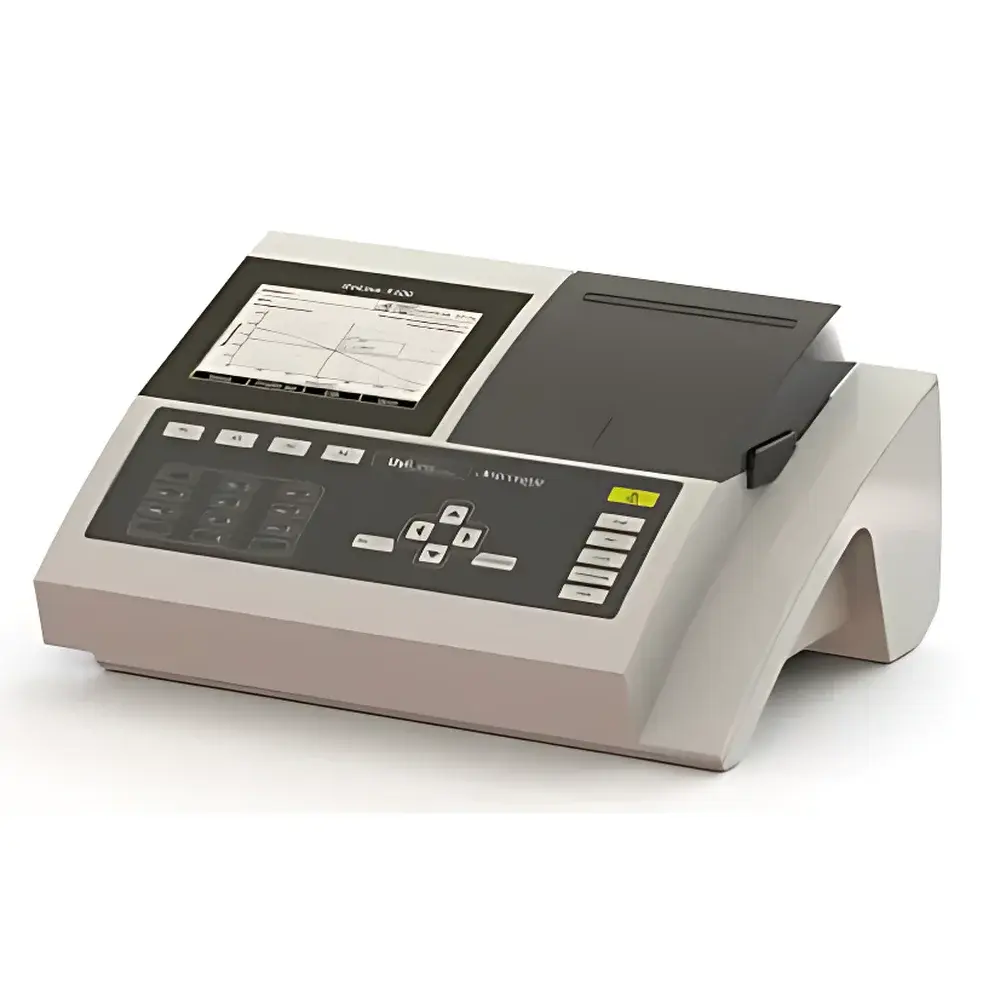
AQUALABO UVILINE 9300/9600 UV-Vis Spectrophotometer
| Brand | AQUALABO |
|---|---|
| Origin | France |
| Model | UVILINE 9300 / UVILINE 9600 |
| Wavelength Range | 320–1100 nm (9300) / 190–1100 nm (9600) |
| Light Source | Tungsten-Halogen Lamp (9300) / Xenon Flash Lamp (9600) |
| Spectral Bandwidth | 4 nm |
| Wavelength Accuracy | ±1 nm |
| Wavelength Repeatability | ±0.5 nm |
| Absorbance Range | ±3500 Abs |
| Absorbance Resolution | 0.001 Abs or 0.1% T |
| Photometric Accuracy | ±0.003 Abs (0.5 Abs), ±0.005 Abs (1.0 Abs), ±0.010 Abs (2.0 Abs) |
| Stray Light | <0.1% T at 340 nm (GG375), <0.05% T at 340 nm (GG375) for 9600 |
| Baseline Stability | ±0.002 Abs |
| Scan Speed | >600 nm/min (9300), >800 nm/min (9600) |
| Interface | USB-A, USB-B, RJ45 |
| IP Rating | IP30 |
| Power Supply | 110–220 V, 50/60 Hz |
| Operating Temperature | 10–35 °C |
| Dimensions | 404 × 197 × 314 mm |
| Weight | 4 kg |
Overview
The AQUALABO UVILINE 9300 and UVILINE 9600 are benchtop double-beam UV-Vis spectrophotometers engineered for high-precision quantitative and qualitative analysis in environmental, industrial, and research laboratories. Based on the principle of Beer-Lambert law absorption spectroscopy, these instruments measure sample absorbance across defined wavelength ranges—320–1100 nm for the UVILINE 9300 (visible-only configuration) and 190–1100 nm for the UVILINE 9600 (full UV-Vis capability). The dual-beam optical architecture ensures real-time reference beam compensation, minimizing drift from lamp instability or environmental fluctuations. Both models employ a fixed-slit monochromator with precision diffraction grating and optimized detector geometry to deliver consistent photometric performance, validated against ISO 9001-certified manufacturing protocols and traceable to NIST-traceable standards. Designed specifically for water quality analysis, the UVILINE platform supports compliance with EPA Methods 365.2, 365.3, ISO 7027 (turbidity), ISO 8467 (COD), and ASTM D1253 (residual chlorine), making it suitable for routine regulatory testing in municipal water utilities, wastewater treatment plants, and accredited environmental labs.
Key Features
- Dual-beam optical design with active reference channel for <0.002 Abs baseline stability over extended measurement periods
- Xenon flash lamp (UVILINE 9600) enables full UV range operation without warm-up delay or lamp aging effects; halogen lamp (UVILINE 9300) offers 4-year operational lifetime under standard use conditions
- Automated wavelength calibration using internal holmium oxide and didymium filters—performed at startup and configurable via software scheduling
- Integrated ambient light compensation algorithm mitigates interference from laboratory lighting during low-absorbance measurements
- Color TFT display (7-inch, 800 × 480 resolution) with intuitive icon-driven UI supporting multi-language selection (English, French, German, Spanish)
- Stray light suppression below 0.05% T at 340 nm (GG375 filter) ensures accurate quantification of low-concentration analytes such as nitrate, phosphate, and trace metals in natural waters
- Modular hardware expansion support—including Peltier-controlled cuvette holders (±0.5 °C accuracy), 5+1 automated sample changers, flow-through cells with peristaltic pumping (500–3000 µL volume control), and 16 mm round tube adapters with Quick-Lock positioning
Sample Compatibility & Compliance
The UVILINE series accommodates a broad spectrum of sample formats through interchangeable accessories certified to ISO 10110 optical surface specifications. Standard compatibility includes quartz and borosilicate glass cuvettes (5–100 mm pathlength), microvolume cells (down to 50 µL), and flow cells compliant with ASTM D5116 for continuous monitoring applications. Optional Peltier temperature control (10–60 °C) meets USP <85> requirements for enzyme kinetics and thermal stability studies. All firmware and embedded software comply with IEC 62304 Class B medical device software standards and support audit trail generation per FDA 21 CFR Part 11 when used with PC Lab Power software. Method validation documentation—including linearity (R² ≥ 0.999 over 0–3.0 Abs), limit of detection (LOD) calculations per ISO 11843-2, and inter-laboratory reproducibility data—is provided with each instrument shipment.
Software & Data Management
PC Lab Power software serves as the native data acquisition and method management suite, compatible with Windows 10/11 (64-bit) and supporting GLP/GMP workflows. It enables user role-based access control (administrator, analyst, reviewer), electronic signature capture, and immutable audit trails for all method edits, calibration events, and result exports. Internal memory stores up to 100 custom methods, 30 spectral images, and 1000 measurement records; external storage via USB flash drive extends capacity indefinitely. Pre-loaded methods cover 40+ water quality parameters—including COD, BOD₅ estimation proxies, ammonia-nitrogen, total phosphorus, silica, fluoride, and heavy metals via colorimetric derivatization—and are aligned with APHA Standard Methods 2017 and EN ISO 15302. All spectra and kinetic traces export in CSV, XML, and JCAMP-DX formats for integration into LIMS environments.
Applications
- Environmental Monitoring: Routine analysis of drinking water, surface water, groundwater, and effluent per EU Directive 2020/2184 and WHO Guidelines for Drinking-water Quality
- Industrial Process Control: Real-time monitoring of coagulant dosing (e.g., Fe³⁺/Al³⁺), disinfectant residual tracking (Cl₂, ClO₂, O₃), and organic load estimation (UV₂₅₄ absorbance)
- Research & Development: Ligand-binding assays, nanoparticle characterization (surface plasmon resonance screening), and photochemical degradation kinetics under controlled irradiation conditions
- Academic Teaching: Curriculum-aligned experiments in analytical chemistry, environmental science, and biochemistry—including enzyme inhibition studies using Michaelis-Menten modeling and protein quantification via Bradford/Lowry protocols
- Food & Beverage QA: Color index determination (EBC, AOAC), turbidity assessment (NTU), and ethanol content verification via near-IR absorption bands
FAQ
What is the difference between UVILINE 9300 and UVILINE 9600?
The UVILINE 9300 operates in the visible range (320–1100 nm) using a tungsten-halogen lamp, while the UVILINE 9600 extends into the deep UV (190–1100 nm) using a xenon flash lamp—enabling direct measurement of aromatic compounds, nitrates, and nucleic acids without derivatization.
Does the instrument support regulatory compliance for drinking water testing?
Yes. Pre-installed methods align with EPA 365.3 (phosphate), ISO 6060 (COD), and EN ISO 10530 (fluoride), and full audit trail functionality satisfies GLP and ISO/IEC 17025 documentation requirements.
Can I perform kinetic assays with temperature control?
Yes. With the optional Peltier-controlled cuvette holder (order code 70VI0603) or flow cell adapter (70VI0610), users can conduct time-resolved enzymatic reactions between 10–60 °C with ±0.5 °C stability.
Is method validation support included?
Each system ships with a Certificate of Conformance, factory calibration report, and a comprehensive Method Validation Kit containing reference standards, SOP templates, and uncertainty budget worksheets per EURACHEM/CITAC Guide CG4.
How is data integrity ensured during networked operation?
When connected via RJ45 to a secure LAN, PC Lab Power enforces TLS 1.2 encrypted communication, session timeouts, and write-protected database logging—fully compliant with Annex 11 (EU GMP) and ALCOA+ data governance principles.







