
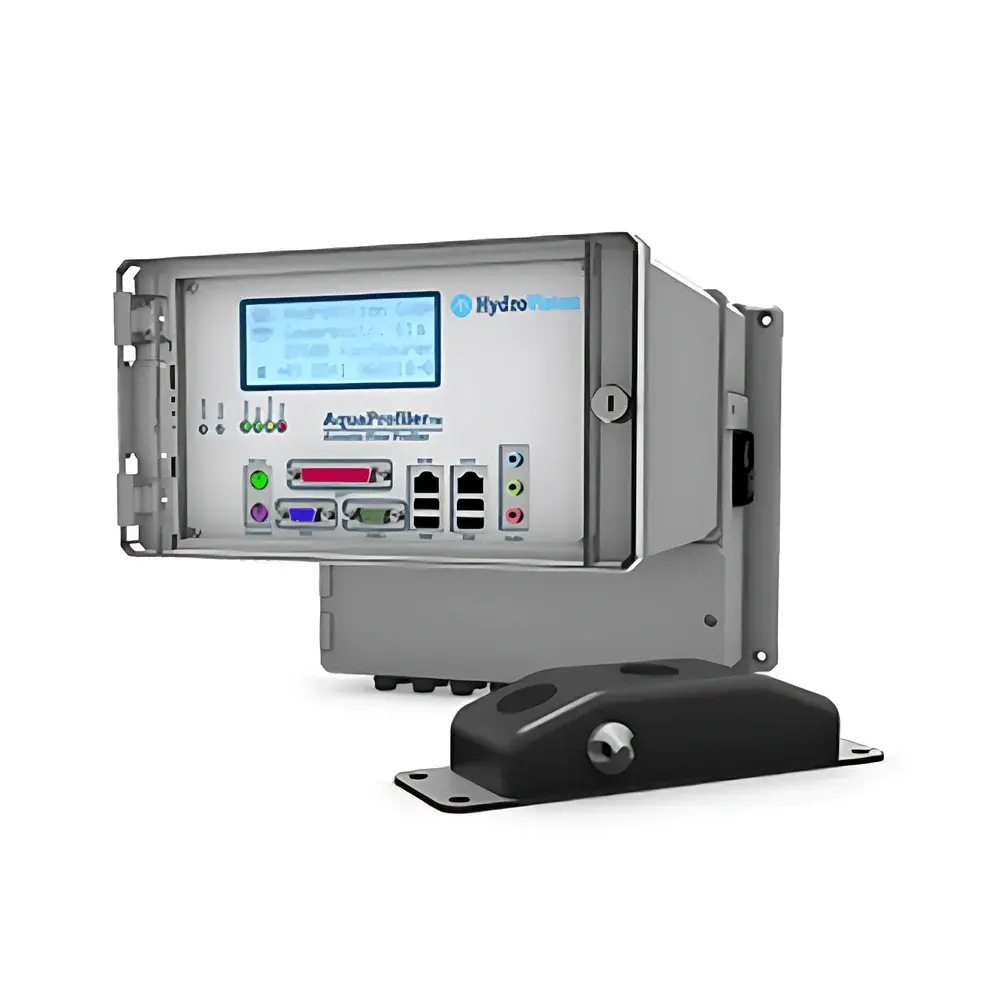
AquaProfiler ST Series Doppler Flow Profiler
| Brand | DSE (Dongshen Electronics) |
|---|---|
| Model | AquaProfiler ST |
| Measurement Principle | Pulsed Doppler Acoustic Velocity Profiling |
| Operating Frequencies | 600 kHz or 2 MHz selectable |
| Measuring Range | River Width 0.25–120 m |
| Beam Configuration | Triple acoustic beam |
| Velocity Profiling Layers | Up to 64 depth cells |
| Integrated Parameters | Water Level, Velocity, Discharge, Water Temperature |
| Mounting Options | Horizontal or vertical fixed installation |
| Data Output | Real-time streaming, continuous logging, remote control via RS-485/Ethernet/4G |
| Compliance | Designed for ISO 748, ISO 10707, and ASTM D5389 field velocity profiling standards |
Overview
The AquaProfiler ST Series Doppler Flow Profiler is an integrated, fixed-mount acoustic velocity profiler engineered for high-reliability riverine and open-channel discharge monitoring. It operates on the principle of pulsed coherent Doppler sonar, transmitting short-duration acoustic pulses and analyzing the frequency shift of backscattered signals from suspended particles to compute instantaneous velocity vectors across multiple depth layers. Unlike single-point current meters, the AquaProfiler ST employs a triple-beam transducer array—typically oriented at ±15° from vertical—to enable simultaneous three-dimensional velocity decomposition and robust rejection of horizontal flow bias. This architecture ensures accurate mean velocity estimation even under non-uniform flow profiles, skewed velocity distributions, or low-signal-to-noise conditions typical in turbid or low-velocity streams.
Key Features
- Pulsed Doppler measurement with dual-frequency transducer options (600 kHz for higher resolution in shallow or low-velocity channels; 2 MHz for improved spatial resolution in narrow or highly turbulent flows)
- Triple-beam configuration enabling independent computation of vertical, cross-sectional, and longitudinal velocity components—minimizing systematic errors from beam misalignment or flow angle uncertainty
- Up to 64 configurable depth cells per profile, with cell size adjustable from 2 cm to 50 cm—supporting fine-scale boundary layer analysis or coarse-grained bulk discharge estimation as required
- Integrated multi-parameter sensing: co-located pressure-based water level, NTC thermistor water temperature, and Doppler-derived velocity—eliminating inter-sensor calibration drift and time synchronization errors
- Ruggedized stainless-steel housing rated IP68, designed for continuous submersion in freshwater or brackish environments with sediment loads up to 50 g/L
- Flexible mounting interface supporting both horizontal (side-looking) and vertical (down-looking) configurations—compatible with existing staff gauges, stilling wells, or purpose-built mounting frames
Sample Compatibility & Compliance
The AquaProfiler ST is validated for use in natural rivers, irrigation canals, wastewater outfalls, and stormwater conveyance structures with hydraulic widths between 0.25 m and 120 m. Its velocity profiling capability complies with ISO 748 (Measurement of liquid flow in open channels — Velocity-area method), ISO 10707 (Acoustic Doppler current profilers — Performance requirements and test methods), and ASTM D5389 (Standard Guide for Use of Acoustic Doppler Current Profilers for Measurement of Water Velocity). The system supports traceable calibration via factory-certified velocity verification using calibrated flow tanks per ISO/IEC 17025-accredited procedures. All firmware and data logging routines are structured to support GLP-compliant audit trails—including operator ID, timestamped configuration changes, and raw binary data archiving.
Software & Data Management
The AquaProfiler ST interfaces with DSE’s AquaView Pro software suite, a Windows-based platform supporting real-time visualization, automated discharge computation (using standard area-velocity integration algorithms), and event-triggered data export. Raw echo intensity and phase-difference datasets are stored in HDF5 format—ensuring long-term readability and compatibility with MATLAB, Python (h5py), and R analytics pipelines. Remote operation is enabled via secure Ethernet or LTE/4G connectivity, with TLS 1.2 encryption for command transmission and HTTPS-based data retrieval. Firmware updates and configuration changes are logged with digital signatures and SHA-256 hash verification. The system optionally supports Modbus TCP and SDI-12 protocols for integration into SCADA or telemetry networks compliant with IEC 60870-5-104 or DNP3.
Applications
- Regulatory compliance monitoring for wastewater discharge permits (e.g., EPA NPDES reporting)
- Real-time flood forecasting and reservoir inflow/outflow accounting
- Irrigation district water allocation and loss detection
- Hydrological research requiring high-temporal-resolution velocity profiles under varying sediment transport regimes
- Urban stormwater management systems with dynamic flow routing and CSO event characterization
- Long-term climate impact studies on baseflow variability and channel morphology evolution
FAQ
What acoustic frequencies are available, and how do they affect performance?
The AquaProfiler ST offers two transducer options: 600 kHz and 2 MHz. The 600 kHz variant provides greater penetration depth and signal strength in turbid, low-velocity water but with lower spatial resolution (~5–10 cm cell size). The 2 MHz option delivers finer vertical resolution (~2–3 cm) and improved accuracy in clear, fast-flowing channels—but with reduced maximum profiling range in high-sediment environments.
Can the device operate unattended for extended periods?
Yes. With external power (12–24 VDC) and optional solar/battery backup, the AquaProfiler ST supports continuous operation for >12 months without maintenance. Internal flash memory retains 30 days of raw profile data at 15-minute intervals; longer-term storage is handled via FTP or MQTT push to cloud or local servers.
Is the system compatible with third-party hydrological modeling software?
All exported datasets include metadata headers compliant with CF (Climate and Forecast) conventions. Velocity, depth, temperature, and timestamp fields are structured for direct ingestion into HEC-RAS, MIKE HYDRO River, and EPA SWMM without preprocessing.
How is velocity accuracy verified in the field?
Field validation is performed using portable ADCPs or mechanical current meters deployed in parallel during stable flow conditions. DSE provides a documented procedure aligned with ISO/TR 24578 for uncertainty propagation analysis, including contributions from beam angle tolerance, sound speed correction, and bottom-tracking error.







