
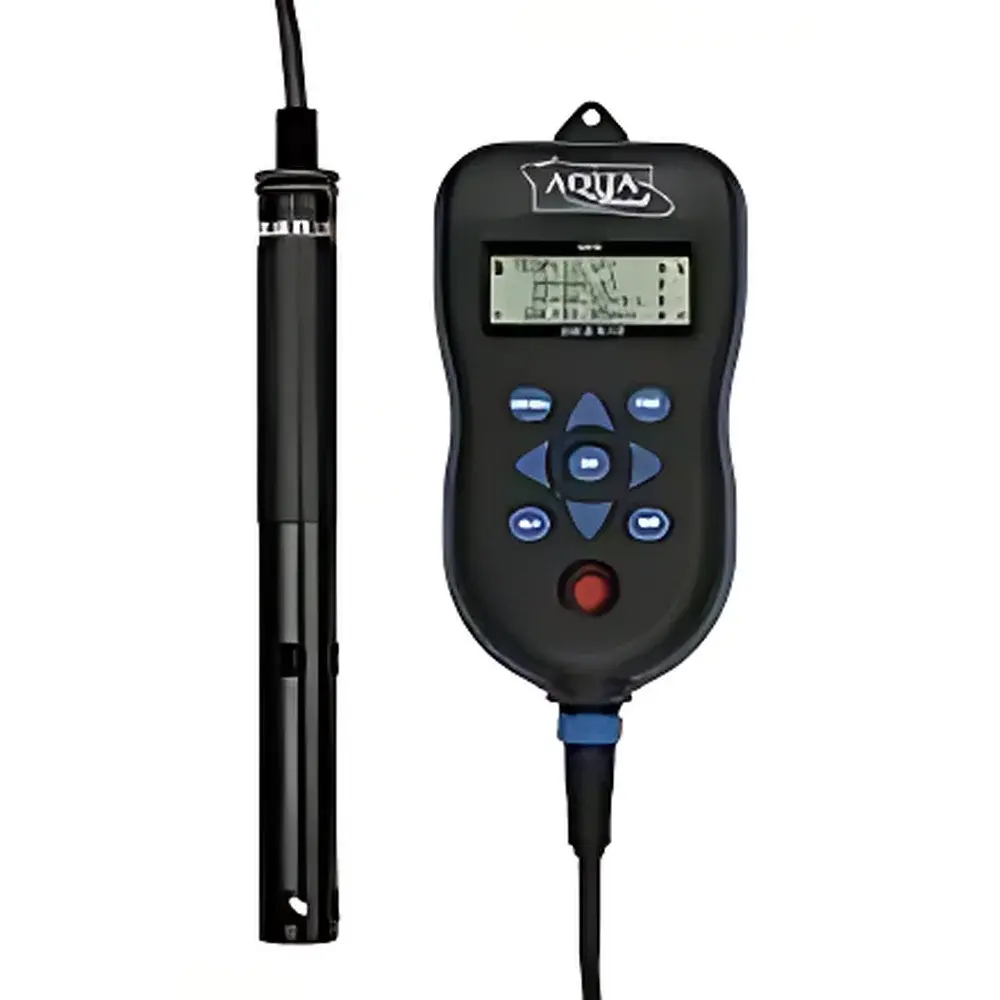
AQUAREAD AP-2000-NH Portable Nitrate Analyzer for Water Quality Monitoring
| Brand | AQUAREAD |
|---|---|
| Origin | United Kingdom |
| Model | AP-2000-NH |
| Instrument Type | Portable / Handheld Water Quality Analyzer |
| Sensor Measurement Range | 0–1,000 mg/L NO₃⁻ (as N or as NO₃, context-dependent) |
| Resolution | 0.01 mg/L (0–99.99 mg/L), 0.1 mg/L (100.0–999.9 mg/L) |
| Accuracy | ±10% of reading |
| Sensor Housing Dimensions | Ø24 mm × 250 mm |
| Aquameter Display Unit Dimensions | 90 × 180 × 39 mm |
| Aquameter Weight (with batteries) | 450 g |
| Display | Backlit 80-character LCD |
| Data Storage Capacity | 1,900 measurements |
| Integrated GPS | 12-channel receiver, ±10 m horizontal accuracy |
| Barometric Pressure Sensor Range | 150–1,150 mbar, resolution ±1 mbar |
| Power Supply | 5 × AA alkaline or Ni-MH rechargeable batteries |
| Operating Temperature | −20 °C to +70 °C |
| Enclosure Rating | IP67 |
Overview
The AQUAREAD AP-2000-NH Portable Nitrate Analyzer is a field-deployable, integrated water quality measurement system engineered for rapid, on-site quantification of nitrate (NO₃⁻) concentration in freshwater, groundwater, estuarine, and wastewater environments. It operates on the principle of ion-selective potentiometry, utilizing a solid-state nitrate-selective electrode housed within a robust, submersible sensor module. Unlike optical or colorimetric methods requiring reagents or sample digestion, this electrochemical approach delivers real-time, in-situ measurements without consumables—making it ideal for high-frequency monitoring campaigns, regulatory compliance verification, and environmental impact assessments where operational simplicity and ruggedness are critical. The system comprises three interoperable components: the handheld Aquameter display and data logger, the AP-2000 sensor housing, and the NH-series nitrate sensor—each calibrated traceably to NIST-traceable standards prior to shipment.
Key Features
- True field-portable architecture: All-in-one design with integrated GPS, barometric pressure compensation, and non-volatile memory for unattended deployment.
- IP67-rated electronics: Fully protected against dust ingress and temporary immersion (up to 1 m for 30 min), enabling reliable operation in rain, shallow streams, or muddy banks.
- Multi-parameter synchronization: Simultaneous logging of nitrate concentration alongside temperature, conductivity, pH, dissolved oxygen, and depth (when paired with optional sensors)—all time-stamped and georeferenced.
- Intelligent sensor diagnostics: Real-time electrode potential monitoring, slope validation, and drift alerts ensure measurement integrity before, during, and after each deployment.
- Battery-efficient firmware: Optimized power management extends operational life to >100 hours per set of AA alkaline cells under typical sampling intervals (e.g., 1 measurement/minute).
Sample Compatibility & Compliance
The AP-2000-NH is validated for use in natural waters with total suspended solids (TSS) < 100 mg/L and salinity up to 35 ppt. It meets the functional requirements of ISO 5667-3 (water sampling — preservation and handling) and supports data collection protocols aligned with EPA Method 353.2 (determination of nitrate + nitrite by automated cadmium reduction). While not certified under USP or ASTM D3867, its documented accuracy (±10% of reading across 0–1,000 mg/L) satisfies Tier 2 field screening criteria per EU WFD (Water Framework Directive) Annex V monitoring guidelines. Sensor calibration adheres to GLP principles: two-point calibration (0 mg/L and 100 mg/L NO₃⁻ standard) is performed using certified reference materials; calibration logs—including date, operator ID, and electrode response metrics—are automatically stored with each dataset.
Software & Data Management
Data export is supported via USB-C connection to Windows/macOS systems using AQUAREAD’s AQView desktop software (v4.2+), which provides batch processing, QA/QC flagging (e.g., outlier detection based on temporal gradient thresholds), and automated report generation compliant with ISO/IEC 17025 documentation requirements. Raw files (.aqd) retain full metadata: GPS coordinates (WGS84), UTC timestamps, sensor serial numbers, battery voltage, and calibration history. For regulated environments, AQView supports audit trail activation per FDA 21 CFR Part 11—enabling electronic signatures, user access controls, and immutable record retention. Cloud synchronization (via optional AQUAREAD Connect subscription) enables secure, role-based sharing of datasets with regulatory agencies or collaborative research networks.
Applications
- Surface water quality surveillance in catchment management programs targeting agricultural runoff mitigation.
- Groundwater nitrate trend analysis for compliance with EU Drinking Water Directive (98/83/EC) limit values (50 mg/L NO₃⁻).
- Wastewater treatment plant effluent monitoring to verify denitrification performance.
- Ecological studies correlating nitrate dynamics with algal bloom onset in eutrophic lakes and reservoirs.
- Educational fieldwork and citizen science initiatives requiring low-barrier, instrumentally rigorous measurement tools.
FAQ
What is the recommended calibration frequency for the NH nitrate sensor?
Calibration is required before each field day or after every 24 hours of continuous operation. Two-point calibration using 0 mg/L and 100 mg/L NO₃⁻ standards is mandatory; slope recovery >95% must be confirmed.
Can the AP-2000-NH measure nitrate in seawater?
It is validated for salinities up to 35 ppt, but chloride interference may elevate readings by 5–8% at full oceanic salinity; use of the optional chloride compensation algorithm (enabled in AQView) is advised.
Is the Aquameter unit compatible with third-party sensors?
No—the AP-2000 platform uses proprietary digital communication protocols; only AQUAREAD-certified AP-series sensors are electrically and firmware-compatible.
How is sensor fouling mitigated during long-term deployment?
The NH sensor features a hydrophobic PTFE diffusion membrane and integrated wiper mechanism (activated manually via the Aquameter menu); routine cleaning with deionized water and soft brush is recommended after exposure to turbid or organic-rich waters.
Does the system support remote telemetry?
Standalone operation does not include cellular or LoRaWAN; however, the .aqd file format is compatible with third-party telemetry gateways when paired with external data loggers (e.g., Campbell Scientific CR1000X) via RS-232 output.
Related Products







