
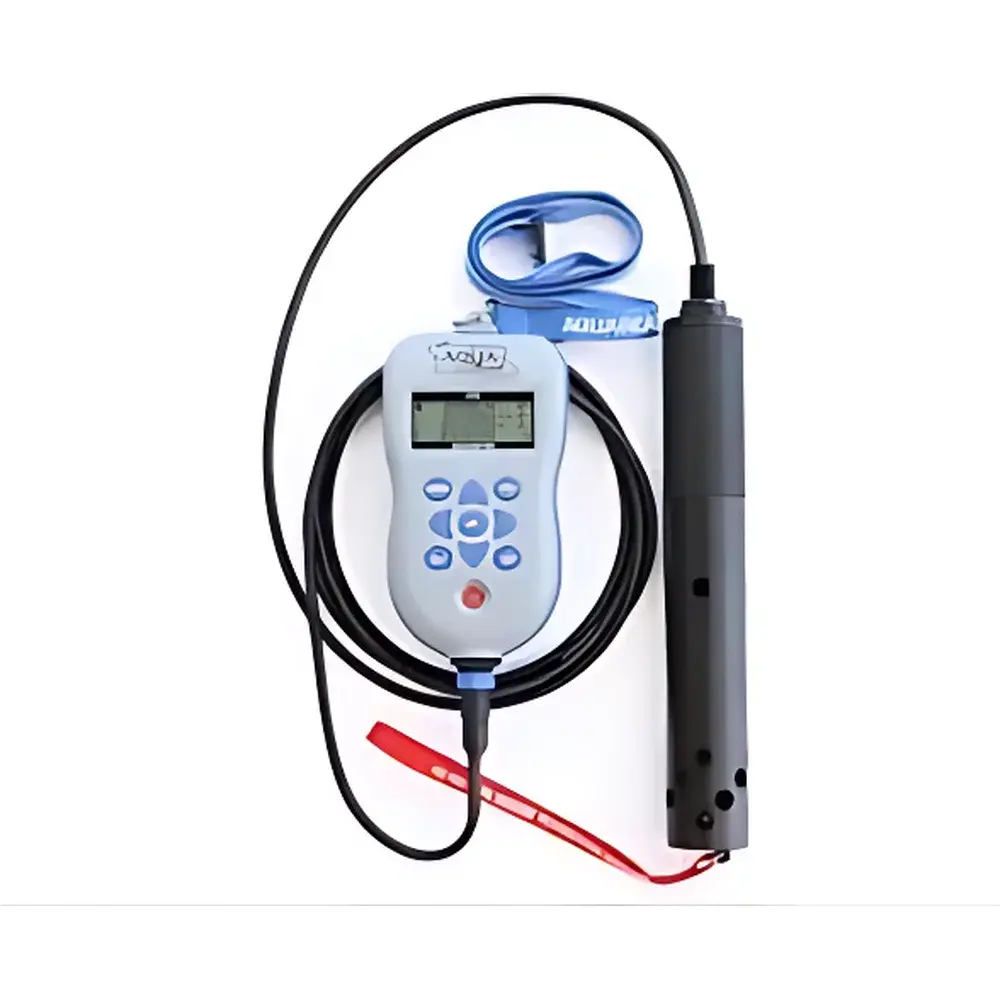
AQUAREAD AP-800 Portable 5-Parameter Water Quality Analyzer
| Brand | AQUAREAD |
|---|---|
| Origin | United Kingdom |
| Model | AP-800 |
| Instrument Type | Portable / Handheld Water Quality Analyzer |
| Sensor IP Rating | IP68 |
| Aquameter Display Unit IP Rating | IP67 |
| Cable Length | 3 m |
| Key Measured Parameters | pH, ORP, Electrical Conductivity (EC), Dissolved Oxygen (DO), Temperature, Turbidity (AP-800 only) |
Overview
The AQUAREAD AP-800 Portable 5-Parameter Water Quality Analyzer is an engineered field-deployable instrument designed for high-fidelity, real-time in-situ measurement of critical water quality indicators. Built upon optical and electrochemical sensing principles—including potentiometric pH/ORP detection, four-electrode conductivity measurement, optical luminescence-based dissolved oxygen (LDO) sensing, and ISO 7027-compliant near-infrared turbidimetry—the AP-800 delivers laboratory-grade data under demanding environmental conditions. Its marine-grade anodized aluminum housing ensures structural integrity across freshwater, estuarine, and full-strength seawater applications, with operational capability from −10 °C to +50 °C. The system operates as a modular sensor–display architecture: the AP-800 probe connects via a ruggedized 3-meter submersible cable to the Aquameter handheld display unit, enabling simultaneous logging of up to six parameters (pH, ORP, EC, DO, temperature, and turbidity) with timestamped metadata. All measurements comply with standardized methodologies referenced in ASTM D1293 (pH), ASTM D5391 (conductivity), ASTM D888 (dissolved oxygen), and ISO 7027 (turbidity), supporting regulatory reporting and long-term trend analysis.
Key Features
- Marine-grade aluminum probe housing rated IP68 for continuous submersion up to 100 m depth
- Aquameter display unit rated IP67—fully operational in rain, dust, and high-humidity field environments
- Optical DO sensor with factory-calibrated luminescent lifetime detection; zero oxygen consumption, no membrane replacement required
- Integrated temperature compensation across all electrochemical and optical channels using dual NTC thermistors
- Four-electrode conductivity cell with automatic salinity correction and TDS derivation per ASTM D1125
- Modular design supports rapid probe interchangeability and field calibration without tooling
- Onboard memory stores >10,000 timestamped readings with GPS-tagged location (when paired with optional external GNSS module)
Sample Compatibility & Compliance
The AP-800 is validated for use in natural waters including rivers, lakes, reservoirs, coastal zones, wastewater effluents, and aquaculture systems. It meets material compatibility requirements per ISO 14001 environmental management standards and conforms to CE marking directives for electromagnetic compatibility (2014/30/EU) and low-voltage safety (2014/35/EU). Sensor materials—including platinum electrodes, epoxy-encapsulated optical components, and FDA-compliant silicone O-rings—are inert to chloride, sulfide, and organic fouling agents typical in eutrophic or industrial influent matrices. Data output formats adhere to EPA STORET and WQX schema conventions, and the system supports audit-trail-enabled calibration logs compliant with GLP and ISO/IEC 17025 requirements when used with AquaLink software’s secure user authentication and electronic signature modules.
Software & Data Management
AquaLink desktop software (included on installation CD) provides full configuration, calibration, visualization, and export functionality. It supports multi-point pH and DO calibrations with uncertainty propagation modeling, conductivity cell constant verification, and turbidity calibration using Formazin or AMCO AEPA standards. Raw sensor outputs are logged in .csv and .aqd binary formats; time-series plots include derivative analysis (e.g., DO saturation rate, pH drift slope) and automated flagging of out-of-specification excursions. Export options include PDF reports compliant with ISO 14040 life-cycle assessment templates and direct upload to LIMS platforms via ODBC or REST API integration. Firmware updates are delivered through signed package files to ensure traceability and cryptographic integrity.
Applications
- Regulatory compliance monitoring under EU Water Framework Directive (WFD) and US Clean Water Act Section 402
- Baseline characterization and impact assessment in environmental site investigations (ESI)
- Real-time process control in drinking water treatment plants and decentralized wastewater systems
- Long-term ecological research in limnological and marine observatories
- Educational field laboratories requiring NIST-traceable, student-safe instrumentation
- Emergency response deployments during chemical spills, algal blooms, or post-flood contamination events
FAQ
What is the maximum operational depth for the AP-800 probe?
The AP-800 sensor is rated IP68 for continuous immersion at depths up to 100 meters, verified per IEC 60529 test protocols.
Can the AP-800 be used in full-strength seawater without performance degradation?
Yes—the four-electrode conductivity cell and optical DO sensor are specifically calibrated for salinities up to 45 psu, with automatic temperature and pressure compensation applied in real time.
Is turbidity measurement available on both AP-700 and AP-800 models?
No—turbidity is exclusive to the AP-800 configuration. The AP-700 measures pH, ORP, EC, DO, and temperature only.
How often does the optical DO sensor require recalibration?
Under stable field conditions, annual two-point (zero and saturated air) calibration is recommended; the sensor’s stability exceeds ±0.1 mg/L/year per ISO 5814 validation studies.
Does AquaLink software support 21 CFR Part 11 compliance?
Yes—when deployed with role-based user accounts, electronic signatures, and immutable audit trails enabled, AquaLink meets FDA 21 CFR Part 11 requirements for electronic records and signatures.







