
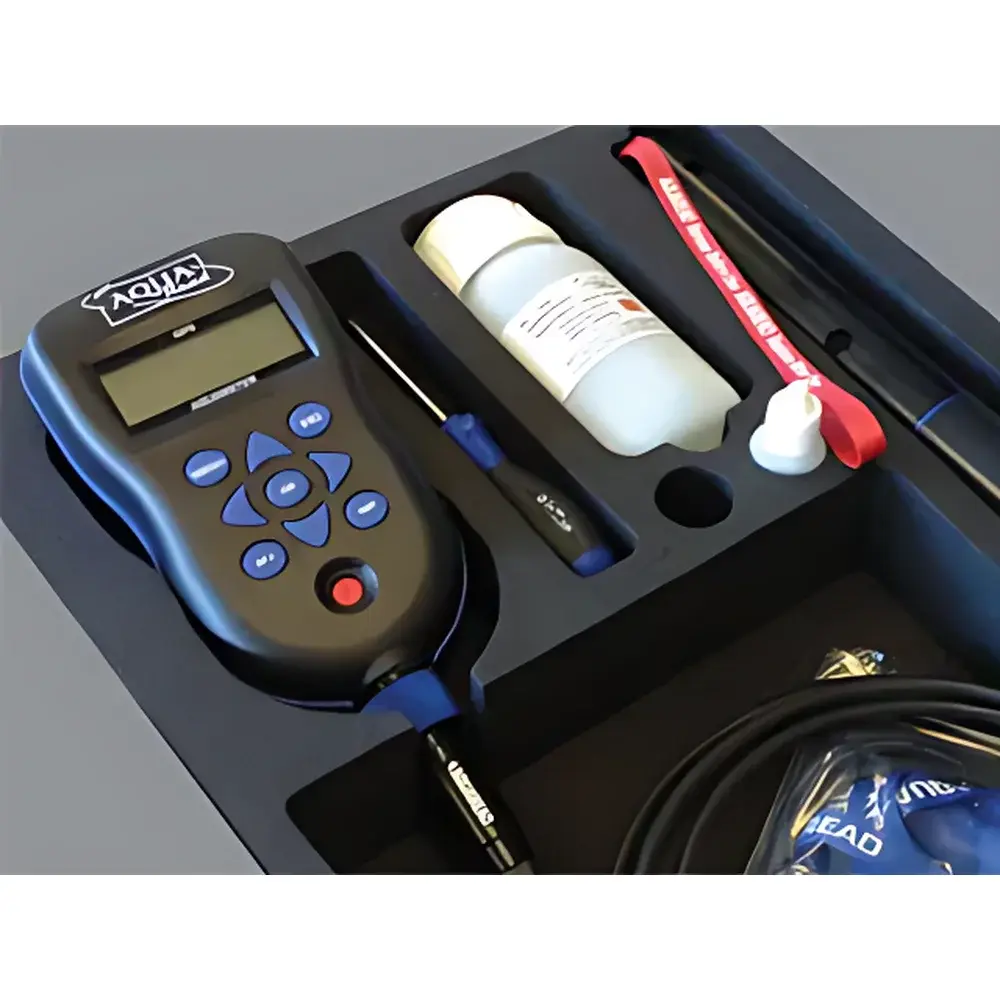
Aquaread AP-800 Portable Multi-Parameter Water Quality Analyzer
| Brand | Aquaread |
|---|---|
| Origin | United Kingdom |
| Model | AP-800 |
| Instrument Type | Portable / Handheld Water Quality Analyzer |
| Enclosure Rating | IP68 (sensor), IP67 (Aquameter display unit) |
| Construction | Marine-grade anodized aluminum housing |
| Sensor Parameters | pH, ORP, Electrical Conductivity (EC), Dissolved Oxygen (DO), Temperature, Turbidity (optional probe) |
| Derived Parameters | Total Dissolved Solids (TDS), Salinity, Specific Conductance, Resistivity (calculated from EC and temperature) |
| Compliance | CE, RoHS, UKCA |
| Software | AquaLink v5.x (Windows/macOS compatible, supports GLP-compliant data export) |
Overview
The Aquaread AP-800 Portable Multi-Parameter Water Quality Analyzer is a field-deployable, high-precision instrument engineered for rigorous environmental monitoring in freshwater, estuarine, and marine environments. Built upon Aquaread’s proven optical and electrochemical sensor architecture, the AP-800 employs a modular probe design with factory-calibrated, digital-output sensors that communicate via RS-485 to the rugged Aquameter display unit. Measurement principles include potentiometric pH/ORP detection, four-electrode conductivity measurement for stable EC readings across wide salinity ranges (0–100 mS/cm), optical luminescence-based dissolved oxygen sensing (avoiding membrane fouling and oxygen consumption artifacts), and ISO 7027-compliant near-infrared turbidity measurement using a 860 nm LED source and 90° scattered light detection. Its marine-grade anodized aluminum housing ensures mechanical durability and corrosion resistance under prolonged exposure to salt spray, UV radiation, and thermal cycling—critical for long-term deployment in coastal and offshore research campaigns.
Key Features
- IP68-rated multi-parameter probe with integrated pH, ORP, EC, DO, temperature, and optional turbidity sensors—designed for continuous submersion up to 100 m depth
- IP67-rated Aquameter handheld display unit with sunlight-readable 3.5″ TFT color screen, 12-hour battery life, and onboard GPS geotagging
- Digital sensor interface eliminates analog signal drift; each sensor carries its own calibration coefficients and temperature compensation algorithms
- Real-time calculation of derived parameters—including TDS (based on EC and temperature), salinity (PSS-78 standard), specific conductance, and resistivity—without external computation
- Pre-configured calibration workflows compliant with ISO 5667-22 and ASTM D3370 for field validation; supports single-point, two-point, and multi-point calibrations with traceable NIST-traceable standards
- Expandable architecture: Additional sensor modules (e.g., ammonium, nitrate, chlorophyll-a) can be added via future firmware updates and hardware interface expansion
Sample Compatibility & Compliance
The AP-800 is validated for use across natural waters including rivers, lakes, reservoirs, wetlands, intertidal zones, and open-ocean profiles. Its optical DO sensor remains unaffected by hydrogen sulfide or low-oxygen conditions, while the four-electrode EC cell maintains accuracy in high-sediment or biofouling-prone matrices. All sensors meet ISO/IEC 17025 traceability requirements when used with Aquaread-certified calibration solutions. The system supports regulatory reporting frameworks including EU Water Framework Directive (WFD) Annex V monitoring protocols, US EPA Method 160.1 (pH), Method 120.1 (conductivity), and Method 360.1 (DO). Data integrity complies with ALCOA+ principles (Attributable, Legible, Contemporaneous, Original, Accurate, Complete, Consistent, Enduring, Available), and AquaLink software enables audit-trail generation per FDA 21 CFR Part 11 requirements when configured with electronic signatures.
Software & Data Management
AquaLink software (v5.3+) provides full instrument configuration, real-time telemetry visualization, batch calibration management, and automated report generation in PDF, CSV, and Excel formats. Field-collected datasets are timestamped, georeferenced, and annotated with operator ID, site metadata, and sensor health diagnostics. Raw sensor outputs—including voltage, frequency, and temperature-compensated values—are stored in encrypted SQLite databases with SHA-256 hashing for data immutability. Export options include ISO 19115-compliant metadata embedding and direct integration with LIMS platforms via ODBC drivers. Firmware updates are delivered over-the-air or via USB, with version-controlled rollback capability to ensure operational continuity during regulatory audits.
Applications
- Long-term ecological monitoring programs requiring high-reproducibility longitudinal datasets (e.g., nutrient flux tracking in catchment basins)
- Regulatory compliance sampling for drinking water sources, wastewater effluents, and shellfish growing areas under EU Bathing Water Directive
- Marine biodiversity surveys where concurrent DO, salinity, and turbidity profiles inform habitat suitability modeling
- Educational fieldwork and citizen science initiatives leveraging intuitive UI and pre-loaded method templates
- Emergency response deployments following chemical spills or algal bloom events, enabled by rapid sensor warm-up (<60 s) and zero-drift stability
FAQ
What is the maximum operating depth for the AP-800 probe?
The AP-800 sensor module is rated IP68 and certified for continuous operation at depths up to 100 meters. Pressure testing is performed to 1.5× rated depth per IEC 60529 standards.
Can the AP-800 measure ammonia or nitrate in situ?
Not natively—but Aquaread offers optional ion-selective electrode (ISE) modules for ammonium and nitrate that integrate seamlessly with the AP-800 platform via the same digital bus and AquaLink software framework.
Is AquaLink software validated for GxP environments?
Yes—when deployed with role-based user accounts, electronic signature enforcement, and audit-trail logging enabled, AquaLink meets FDA 21 CFR Part 11 and EU Annex 11 requirements for regulated laboratories.
How often does the optical DO sensor require maintenance?
The luminescent sensor has no consumables or membranes; cleaning is limited to periodic rinsing with deionized water. Factory recalibration is recommended every 12 months or after 500 immersion hours, whichever occurs first.
Does the AP-800 support Bluetooth or Wi-Fi connectivity?
No—wireless transmission is intentionally omitted to preserve electromagnetic compatibility in sensitive field environments and ensure data security. Communication occurs exclusively via shielded RS-485 cable or micro-USB for data download.







