
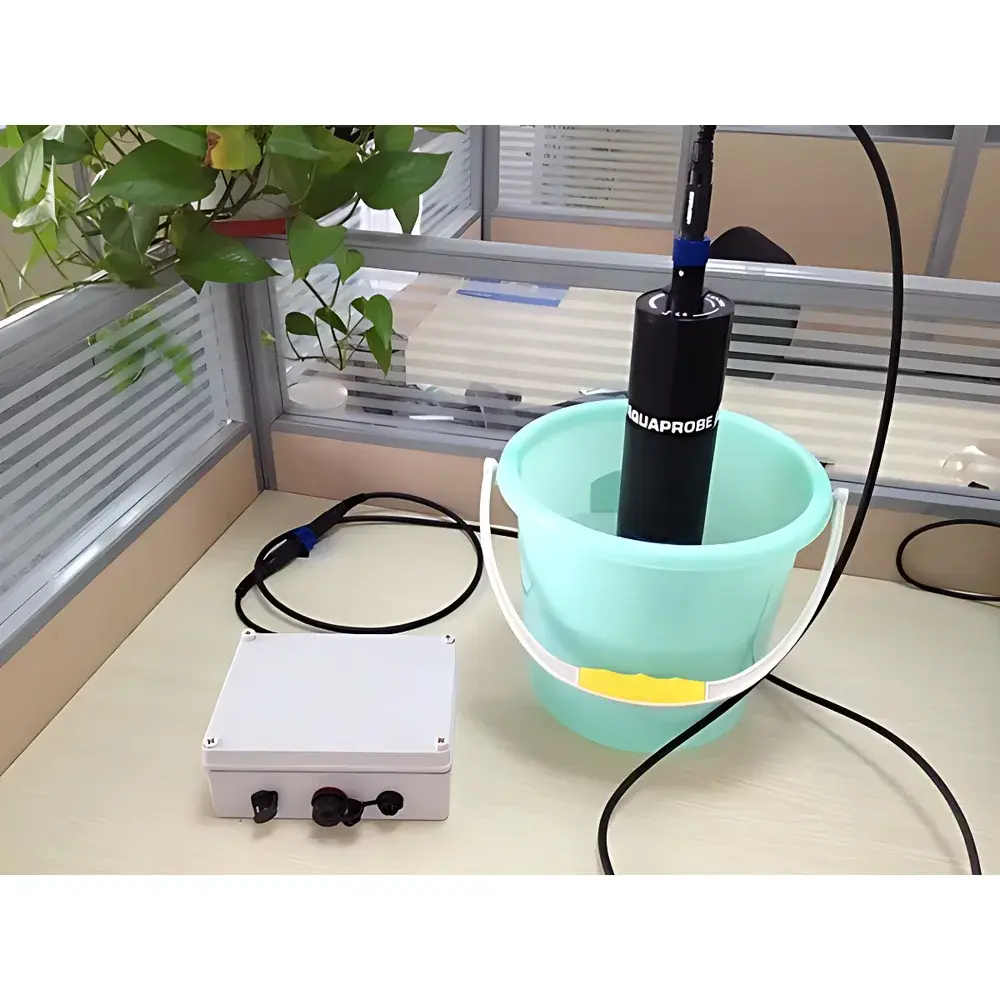
AQUAREAD AP7000SDI Multi-Parameter Water Quality Monitoring System
| Brand | AQUAREAD |
|---|---|
| Country of Origin | United Kingdom |
| Model | AP7000SDI |
| Instrument Type | Online Multi-Parameter Water Quality Analyzer |
| Sensor Capacity | Up to 12 sensors (6 standard + 6 expandable ISE/optical ports) |
| Power | Rechargeable internal battery (7-day continuous operation) |
| Data Storage | 8 GB embedded memory |
| Connectivity | SDI-12, RS-232, USB, Bluetooth, GSM/GPRS for remote alerts |
| IP Rating | IP68 (1 m submersion for 30 min) |
| Housing Material | Marine-grade aluminum alloy |
| GPS Integration | Built-in (via Aquameter handheld controller) |
| Compliance | Designed for ASTM D3370, ISO 5667, US EPA Method 160.1, and GLP-compliant data logging |
Overview
The AQUAREAD AP7000SDI is a field-deployable, multi-parameter water quality monitoring system engineered for long-term, unattended operation in diverse aquatic environments—including groundwater wells, surface water bodies, wastewater outfalls, and coastal zones. Unlike conventional benchtop or fixed-station analyzers, the AP7000SDI employs a modular sensor architecture based on SDI-12 and analog voltage/current interfaces, enabling real-time, high-fidelity measurement of physicochemical parameters without requiring frequent recalibration or manual intervention. Its core measurement principle relies on electrochemical, optical, and pressure-based transduction technologies—each sensor independently calibrated and temperature-compensated per ISO 7027 (turbidity), ISO 5814 (optical DO), and ASTM D1293 (pH)—ensuring traceable accuracy across deployment cycles. The system’s marine-grade aluminum housing, IP68-rated electronics, and integrated anti-fouling components—including self-cleaning wipers and bio-resistant optical windows—address the primary failure modes observed in extended in-situ deployments, particularly in eutrophic or high-biofouling conditions.
Key Features
- Modular sensor platform supporting up to 12 simultaneous measurements: standard configuration includes optical dissolved oxygen (DO), pH, ORP, conductivity (EC), depth/pressure, and temperature; six additional slots accept interchangeable ISE (e.g., nitrate, ammonium, fluoride) and optical sensors (e.g., chlorophyll-a, CDOM, turbidity)
- Integrated anti-fouling design: hydrophobic optical surfaces, mechanical wiper assembly, and copper-alloy anti-biofilm components minimize sensor drift during deployments exceeding 30 days
- Dual-mode operation: functions as both a portable field instrument (paired with Aquameter handheld controller) and a fixed-site logger—enabling rapid site assessment and sustained monitoring within a single hardware platform
- Onboard intelligence: embedded microcontroller performs real-time sensor diagnostics, automatic temperature compensation, linearization, and unit conversion prior to data storage or transmission
- Robust power architecture: rechargeable lithium-ion battery sustains 7 days of continuous sampling at 15-minute intervals; optional solar charging kit extends operational autonomy indefinitely
- GSM/GPRS-enabled alerting: user-defined threshold violations trigger SMS notifications with timestamped parameter values—fully configurable via web-based dashboard or local software
Sample Compatibility & Compliance
The AP7000SDI is validated for use in freshwater, brackish, and low-salinity marine matrices (≤ 35 ppt). Its pressure-rated housing (up to 100 m depth) and corrosion-resistant materials ensure stability in aggressive chemical environments, including wastewater influent streams and acid mine drainage sites. All sensor calibrations adhere to internationally recognized protocols: pH electrodes conform to ISO 10523; conductivity cells meet ASTM D1125 traceability requirements; optical DO sensors comply with ISO 5814 Class B performance criteria. Data integrity is maintained through GLP-compliant audit trails—each logged record includes sensor ID, calibration date, firmware version, ambient temperature, and battery voltage. The system supports 21 CFR Part 11–ready configurations when deployed with AQUAREAD’s AquaLog software suite, including electronic signatures, role-based access control, and immutable data archives.
Software & Data Management
AquaLog Desktop Software provides full lifecycle management—from initial sensor commissioning and field calibration to post-deployment statistical analysis and regulatory reporting. It natively imports CSV, SQLite, and binary .aqd files, auto-generates time-series plots with overlay capability, and exports compliant reports in PDF or Excel formats. The software supports concurrent connection to multiple AP7000SDI units across geographically dispersed sites, enabling centralized oversight of watershed-scale monitoring networks. Remote firmware updates, over-the-air configuration changes, and scheduled data synchronization are managed via encrypted HTTPS channels. For integration into existing SCADA or LIMS infrastructure, the system offers Modbus TCP and MQTT output protocols, with configurable payload formatting (JSON, XML, or plain text) and TLS 1.2 encryption.
Applications
- Groundwater surveillance: Compact 65 mm diameter profile enables direct deployment into boreholes ≥75 mm; pressure-compensated depth sensor allows accurate profiling in confined aquifers; optional flow-through cell accommodates low-yield wells
- Surface water early-warning networks: Deployed as nodes in distributed Water Monitor & Alert systems—synchronizing measurements across tributaries, reservoirs, and intake points to detect contamination plumes in near real time
- Wastewater process control: Installed at key points (influent, bioreactor, effluent) to track nitrification/denitrification efficiency, organic loading, and disinfection residuals—supporting compliance with EU Urban Wastewater Treatment Directive and US Clean Water Act NPDES permits
- Ecological monitoring: Long-duration deployments support nutrient cycling studies, algal bloom forecasting (via combined chl-a, DO, and NO₃⁻), and climate-driven trend analysis under IPCC AR6 observational frameworks
FAQ
What is the maximum recommended deployment duration without maintenance?
Under typical temperate freshwater conditions, the AP7000SDI achieves stable operation for ≥30 days without cleaning or recalibration. In high-fouling environments (e.g., estuarine sediments or wastewater), bi-weekly visual inspection is advised.
Can the system operate autonomously without cellular coverage?
Yes. All measurements are stored locally on the 8 GB internal memory. Data can be retrieved via USB or Bluetooth upon physical access; GSM functionality is optional and does not affect core logging performance.
Which sensor certifications are included with factory calibration?
Each sensor ships with NIST-traceable calibration certificates referencing ISO/IEC 17025-accredited laboratories. Certificates include uncertainty budgets, drift rates, and temperature compensation coefficients.
Is the Aquameter controller required for basic operation?
No. The AP7000SDI operates independently as a logger. The Aquameter is optional hardware used exclusively for handheld mode, GPS geotagging, and on-site sensor validation.
How is data security enforced during wireless transmission?
GSM alerts use AES-128 encrypted SMS payloads; cloud-based telemetry employs TLS 1.2 with client certificate authentication. Local PC connections enforce Windows/macOS native firewall policies and require explicit user consent for port access.
Related Products







