
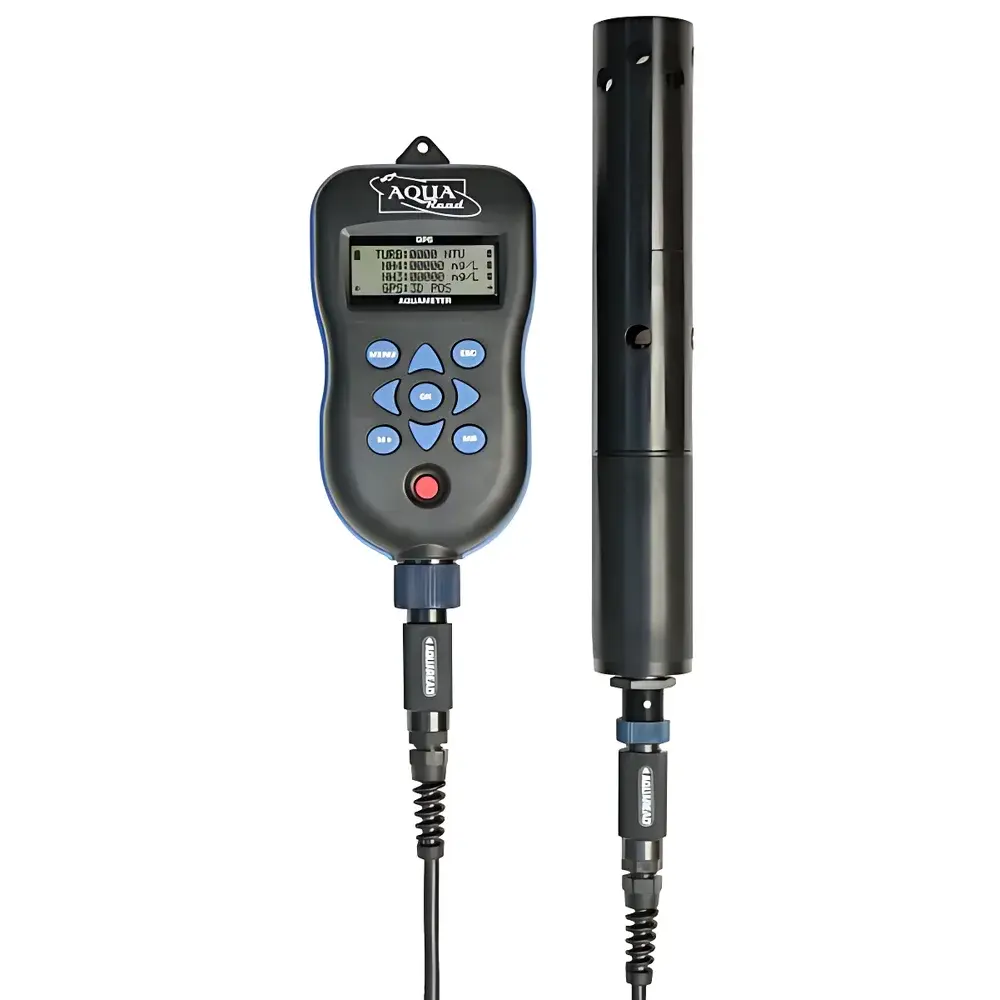
Aquaread APLITE Portable Chlorophyll-a Fluorometer
| Brand | Aquaread |
|---|---|
| Origin | United Kingdom |
| Model | APLITE |
| Detection Principle | In-situ Pulsed LED-Induced Fluorescence |
| Measurement Range (Chlorophyll-a) | 0–500 µg/L |
| Resolution | 0.1 µg/L |
| Accuracy | ±2% of reading |
| Probe Interface | Modular optical sensor bay |
| Data Storage | 1900 records |
| GPS | Built-in 12-channel, ±10 m accuracy |
| Display | Backlit 80-character LCD |
| Dimensions (W×H×D) | 90×180×39 mm |
| Weight (with batteries) | 450 g |
| Power | 5×AA alkaline or Ni-MH rechargeable |
| Battery Life | >20 h (alkaline), >40 h (Ni-MH) |
| Operating Temperature | −20 to +70 °C |
| Enclosure Rating | IP67 |
| Barometric Pressure Sensor | 150–1150 mbar (±1 mbar) |
| Connectivity | USB |
Overview
The Aquaread APLITE Portable Chlorophyll-a Fluorometer is a field-deployable, multi-parameter water quality instrument engineered for rapid, in-situ quantification of phytoplankton biomass via chlorophyll-a fluorescence. Unlike laboratory-based spectrophotometric methods requiring filtration and solvent extraction, the APLITE employs pulsed LED-induced fluorescence (PEF) technology—exciting chlorophyll-a molecules at 470 nm and detecting emitted fluorescence at 685 nm—with temperature-compensated calibration and built-in dark-adaptation logic to minimize photoinhibition artifacts. Designed for limnologists, environmental consultants, and regulatory monitoring teams, it delivers trace-level sensitivity (detection limit <0.1 µg/L) and high reproducibility across diverse aquatic matrices—from oligotrophic lakes and estuarine gradients to eutrophic reservoirs and wastewater-impacted streams. Its modular architecture decouples the handheld meter from interchangeable optical sensors, enabling mission-specific configuration without hardware redundancy.
Key Features
- Modular sensor platform supporting simultaneous or sequential deployment of up to six optical probes: chlorophyll-a, phycocyanin, phycoerythrin, turbidity, rhodamine WT, petroleum hydrocarbons (254 nm deep-UV excitation), and dissolved oxygen (optical luminescence quenching)
- Integrated 12-channel GPS with ±10 m positional accuracy and automatic geotagging of all measurements—essential for spatially referenced trend analysis and compliance reporting
- Ruggedized IP67-rated housing tested to MIL-STD-810G for shock, dust, and submersion (1 m for 30 min), ensuring operational integrity in harsh field conditions
- Low-power electronics optimized for extended battery life: >40 hours on Ni-MH rechargeables; intelligent power management disables non-critical subsystems during idle intervals
- On-device data validation including real-time signal-to-noise ratio (SNR) feedback, probe fouling diagnostics, and automatic zero-point drift correction using internal reference channels
Sample Compatibility & Compliance
The APLITE is validated for use in natural freshwater, brackish, and low-salinity marine environments (up to 15 ppt). Chlorophyll-a measurements adhere to EPA Method 445.0 (in vivo fluorescence) and are traceable to NIST-traceable chlorophyll-a standards. The instrument’s firmware supports audit-ready data logging compliant with ISO/IEC 17025 requirements for environmental testing laboratories. While not certified under FDA 21 CFR Part 11, its secure USB data export and timestamped metadata (including GPS coordinates, barometric pressure, and ambient temperature) meet GLP documentation standards for field-collected environmental data. Sensor calibration protocols align with ASTM D5257 (chlorophyll-a in water by fluorometry) and EN ISO 10260 (phytoplankton biomass estimation).
Software & Data Management
Data acquisition and post-processing are supported via Aquaread’s Aquameter PC software (Windows/macOS), which enables batch calibration curve generation, spectral deconvolution for mixed algal assemblages (e.g., separating chlorophyll-a from phycocyanin interference), and automated QA/QC flagging based on user-defined thresholds. Raw datasets include full metadata headers (sensor ID, calibration date, operator ID, GPS fix status) and support CSV, Excel, and GIS-compatible shapefile exports. Firmware updates are delivered over USB with cryptographic signature verification to ensure integrity. No cloud dependency: all processing occurs locally, preserving data sovereignty—a critical requirement for government-contracted monitoring programs.
Applications
- Eutrophication assessment in lakes and reservoirs—tracking seasonal phytoplankton dynamics and identifying cyanobacterial bloom initiation thresholds
- Regulatory compliance monitoring under EU Water Framework Directive (WFD) Article 5 reporting and US Clean Water Act Total Maximum Daily Load (TMDL) programs
- Baseline surveys for environmental impact assessments (EIAs) prior to hydropower, aquaculture, or coastal infrastructure development
- Real-time validation of satellite-derived chlorophyll-a products (e.g., Sentinel-3 OLCI, MODIS Aqua) through coordinated in-situ ground truthing campaigns
- Education and citizen science initiatives—its intuitive interface and robust build enable reliable student-led water quality sampling in undergraduate field courses
FAQ
Does the APLITE require factory recalibration between deployments?
No. Each optical sensor includes a factory-calibrated reference diode and onboard temperature compensation; field recalibration is performed using Aquaread’s certified standard solutions (e.g., chlorophyll-a in acetone) per ASTM D5257 guidelines.
Can the chlorophyll-a sensor distinguish between live and dead algal cells?
Yes—the pulsed fluorescence methodology responds preferentially to intact photosystem II reaction centers; degraded or lysed cells exhibit significantly reduced quantum yield, enabling semi-quantitative viability inference when combined with parallel turbidity and DO trends.
Is the 254 nm UV source in the hydrocarbon sensor safe for field operators?
Yes. The deep-UV LED operates at sub-mW output power and is fully enclosed within the probe housing; no external exposure occurs during normal operation, satisfying IEC 62471 photobiological safety classification for Exempt Group.
How does the instrument handle biofouling in long-term deployments?
While designed for handheld spot sampling, optional anti-fouling wipers and copper-alloy sensor sleeves are available for short-term moored configurations (≤72 h); routine cleaning with isopropyl alcohol and lint-free wipes restores baseline performance.
What barometric pressure range does the integrated sensor cover, and why is it relevant?
The 150–1150 mbar range accommodates altitudes from Death Valley (−86 m) to high Andean lakes (>5000 m); pressure-corrected DO and gas-transfer calculations are essential for accurate metabolic rate estimates in respiration studies.
Related Products







