
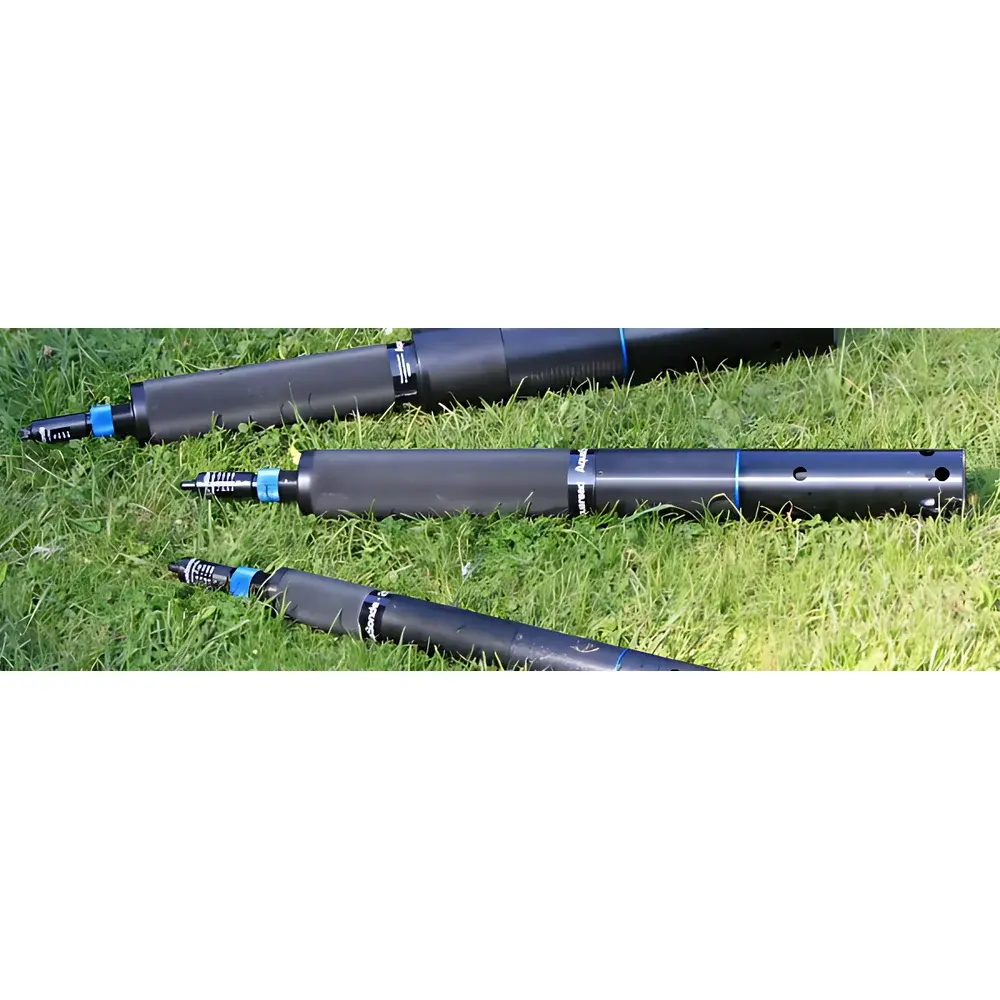
AQUAREAD Aquasonde-2000/5000/7000 Self-Contained Multiparameter Water Quality Analyzer
| Brand | AQUAREAD |
|---|---|
| Origin | United Kingdom |
| Model | Aquasonde-2000 / Aquasonde-5000 / Aquasonde-7000 |
| Detection Parameters | Dissolved Oxygen (DO), Conductivity (Relative & Absolute), pH, ORP, TDS, Temperature, Salinity, Depth, Resistivity, Specific Conductance (SSG) |
| Ingress Protection | IP68 |
| Depth Range | 0.075–100 m (profiling), 0–30 m (long-term submersion) |
| Operating Temperature | −5 °C to +70 °C |
| Data Storage Capacity | 150,000 full datasets |
| Battery Life | Up to 180 days (model- and configuration-dependent) |
| Sampling Frequency | Programmable from 0.5 Hz to once per 120 hours |
| Sensor Interfaces | 2 (AS-2000), 4 (AS-5000), 6 (AS-7000) |
| Auto-Cleaning System | Integrated only on AS-7000 |
Overview
The AQUAREAD Aquasonde series represents a robust class of self-contained, submersible multiparameter water quality analyzers engineered for long-term, unattended deployment in diverse aquatic environments—from rivers and lakes to estuaries and coastal zones. Unlike traditional tethered sondes, the Aquasonde operates autonomously using internal lithium batteries and onboard non-volatile memory, eliminating the need for continuous power or data telemetry during field operation. Its measurement architecture is grounded in standardized electrochemical and optical sensing principles: dissolved oxygen is quantified via luminescence-based optical sensing (ASTM D888-12); pH and ORP employ temperature-compensated glass and noble-metal electrodes; conductivity, salinity, TDS, and resistivity are derived from high-precision four-electrode AC conductivity cells compliant with ISO 7888 and ASTM D1125; depth is measured via piezoresistive pressure transduction with integrated barometric compensation—enabled either internally or via vented cable connection. All models meet IP68 ingress protection (IEC 60529) for continuous submersion at depths up to 30 m (permanent) or 100 m (profiling), ensuring mechanical integrity under hydrostatic stress and sediment abrasion.
Key Features
- Autonomous operation with internal rechargeable lithium battery packs: up to 180 days of continuous logging (dependent on model, sensor load, and sampling interval)
- Onboard memory capacity of 150,000 full parameter datasets—equivalent to >3 years of hourly measurements
- Vented cable option enables real-time atmospheric pressure referencing for accurate depth calculation and DO saturation correction (per USGS TWRI 4-A4 and EPA Method 360.1)
- Modular sensor architecture: AS-2000 supports 2 additional sensors; AS-5000 supports 4; AS-7000 supports 6—compatible with both ion-selective electrodes (e.g., NH₄⁺, NO₃⁻) and optical probes (e.g., chlorophyll-a, CDOM)
- AS-7000-exclusive automatic cleaning system: programmable mechanical wiper mechanism reduces biofouling impact on optical DO and turbidity sensors, extending calibration stability and deployment intervals
- QuickDeploy Key: hardware token that seals the connector, initiates preconfigured logging protocols, and provides instant visual diagnostics (battery voltage, memory usage, sensor health) prior to submersion
- Programmable sampling resolution: per-parameter logging intervals adjustable from 1 minute to 99 hours; maximum global frequency of 0.5 Hz for burst-mode profiling
Sample Compatibility & Compliance
The Aquasonde is validated for use in freshwater, brackish, and marine matrices across regulatory and research applications. Its sensor suite complies with internationally recognized water quality standards including ISO 5814 (DO), ISO 7888 (conductivity), ISO 10523 (pH), and ASTM D3693 (ORP). All electrical interfaces adhere to IEC 61000-6-2/6-4 for electromagnetic compatibility. The device supports GLP-compliant workflows through timestamped, audit-trail-enabled calibration logs generated via SondeLink software—fully traceable to NIST-traceable reference standards. Data export formats (CSV, TXT, Excel-compatible XLSX) facilitate integration into LIMS platforms and comply with EPA SW-846 Chapter One requirements for raw environmental data integrity.
Software & Data Management
SondeLink PC software (freely distributed, Windows-compatible) serves as the central interface for configuration, calibration, and post-retrieval analysis. It provides full control over measurement parameters, GPS geotagging (via connected USB GPS receiver), station naming, and metadata annotation—including operator ID, deployment location, and ambient conditions. Calibration routines follow multi-point, slope-intercept methodologies with automated report generation conforming to ISO/IEC 17025 documentation requirements. Real-time streaming mode allows direct acquisition to PC storage, while offline mode retrieves archived datasets with time-synchronized parameter alignment. All firmware updates, sensor diagnostics, and memory management functions are accessible within the GUI. Optional Bluetooth module (released Q4 2018) enables mobile access via Android/iOS apps, supporting field verification, rapid QA/QC checks, and georeferenced photo logging.
Applications
- Long-term limnological monitoring of reservoirs, wetlands, and groundwater-fed streams
- Tidal and estuarine salinity intrusion studies requiring simultaneous DO, conductivity, and temperature profiling
- Regulatory compliance monitoring under EU WFD (Water Framework Directive) and US Clean Water Act Section 303(d) listing criteria
- Wastewater effluent characterization and receiving water impact assessment
- Climate-driven phenology tracking (e.g., thermal stratification onset, hypolimnetic anoxia development)
- Calibration validation for remote sensing algorithms using in situ ground-truth datasets
FAQ
What is the difference between vented and non-vented deployment?
Vented deployment uses a pressure-equalized cable to reference ambient atmospheric pressure—essential for accurate depth-derived calculations (e.g., DO saturation %) over multi-day periods. Non-vented mode relies on the internal barometer and is suitable for short-term profiling or when barometric drift is negligible.
Can I replace or upgrade sensors in the field?
Yes—modular sensor cartridges are user-swappable without tools. Each probe includes factory calibration coefficients stored in EEPROM; SondeLink auto-reads these upon installation.
How does the AS-7000 auto-clean system function?
A motor-driven wiper arm sweeps across optical sensor windows at user-defined intervals (e.g., every 6–24 hours), removing biofilm and particulate accumulation without chemical agents or consumables.
Is the Aquasonde compatible with third-party data loggers or telemetry systems?
While designed for autonomous operation, ASCII serial output (RS-232/RS-485) is available via optional adapter, enabling integration with Campbell Scientific CR-series loggers or cellular telemetry gateways.
Does SondeLink support FDA 21 CFR Part 11 compliance?
SondeLink supports electronic signatures, audit trails, and role-based access control—configurable to meet Part 11 requirements when deployed within validated IT infrastructure and documented SOPs.
Related Products







