
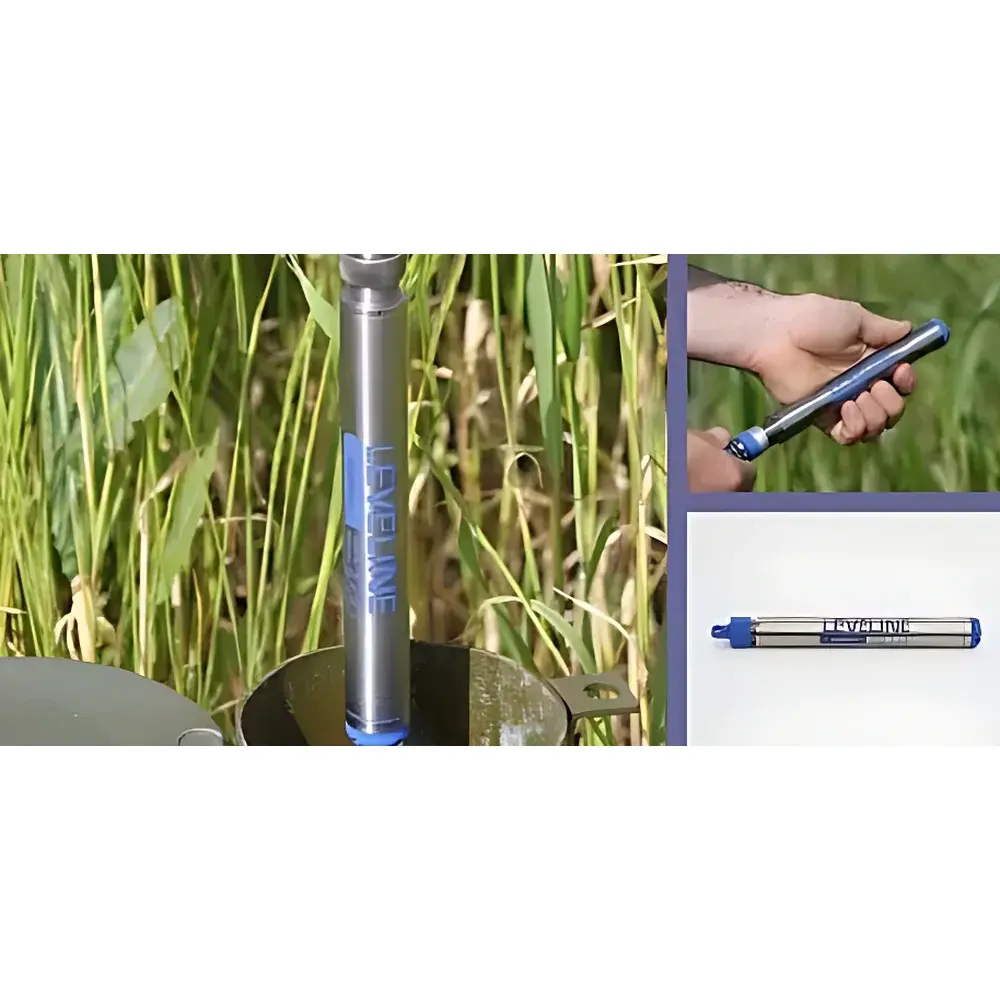
Aquaread LeveLine Self-Contained Water Level and Temperature Logger
| Brand | Aquaread |
|---|---|
| Origin | United Kingdom |
| Model | LeveLine |
| Power Source | 3.6 V Lithium Battery (10-year typical operational life) |
| Sampling Rate | Up to 10 Hz |
| Memory Capacity | 500,000 data points |
| Pressure Range Options | Absolute (up to 500 m H₂O) or Gauge (vented) |
| Housing Material | Titanium alloy body with corrosion-resistant connectors |
| Sensor Type | High-accuracy piezoresistive ceramic pressure sensor + NTC thermistor |
| Cable Options | Kevlar-reinforced vented (gauge) or unvented (absolute) cable |
| Optional Accessories | LeveLine-BARO barometric compensation unit, GPS-enabled LeveLine Meter, QuickDeploy Key |
Overview
The Aquaread LeveLine is a self-contained, long-term water level and temperature logger engineered for high-reliability deployment in demanding hydrological and environmental monitoring applications. It operates on the principle of hydrostatic pressure measurement: water column height above the sensor is derived from absolute or gauge pressure readings, corrected for temperature-induced density variations using an integrated NTC thermistor. When configured in absolute mode (unvented), the device measures total pressure at depth; when used with a vented cable (gauge mode), it references atmospheric pressure directly at the surface—enabling precise relative water level tracking. Its titanium alloy housing, marine-grade connectors, and POM (polyoxymethylene) nose cone provide exceptional resistance to mechanical stress, biofouling, and chemical corrosion in freshwater, estuarine, and saline environments. Designed for unattended operation over multi-year intervals, the LeveLine meets the structural and functional requirements of permanent installations in boreholes, rivers, lakes, coastal zones, and mine dewatering systems.
Key Features
- Ultra-long service life: Powered by a non-replaceable 3.6 V lithium battery rated for up to 10 years of continuous logging under typical sampling regimes (e.g., 15-minute intervals).
- High-resolution pressure sensing: Piezoresistive ceramic pressure transducer with inherent thermal stability and low hysteresis—optimized for repeatability across wide temperature gradients (–20 °C to +50 °C operating range).
- Robust mechanical architecture: Titanium body ensures compatibility with high-pressure deployments up to 500 m H₂O (≈5 MPa); POM nose cone minimizes flow disturbance and protects the diaphragm from sediment abrasion and macro/micro-fouling.
- Flexible deployment configurations: Available in both absolute (unvented) and gauge (vented) versions. The unvented variant requires concurrent barometric compensation via the optional LeveLine-BARO unit—designed for co-located surface-level atmospheric pressure logging.
- On-device intelligence: Embedded firmware supports programmable sampling schedules, real-time battery and memory status reporting, and automatic zeroing via the QuickDeploy Key—eliminating post-deployment depth offset corrections.
Sample Compatibility & Compliance
The LeveLine is suitable for continuous immersion in natural waters ranging from ultrapure groundwater to hypersaline seawater (up to 45 ppt). Its materials comply with ISO 14688-1 for geotechnical soil classification instrumentation and meet EN 14154-2 requirements for water metering devices used in environmental monitoring infrastructure. For regulatory reporting contexts—including those aligned with EU Water Framework Directive (WFD) monitoring programs or USGS NWIS data submission standards—the instrument supports traceable calibration certificates (NIST-traceable pressure and temperature reference standards available upon request). Data integrity protocols align with GLP principles, including time-stamped logging, immutable memory storage, and audit-ready metadata tagging (e.g., deployment location, sensor serial number, firmware version).
Software & Data Management
Data retrieval is performed via the Aquaread GPS LeveLine Meter—a field-portable interface enabling direct USB or Bluetooth download without requiring a laptop. The meter captures and embeds GPS coordinates, air pressure (when BARO unit is active), and salinity inputs (for density correction) as integral metadata fields within each dataset. Export formats include CSV and Excel-compatible .xlsx, with optional integration into third-party SCADA platforms via ASCII-based serial output. Firmware updates and configuration changes are executed through Aquaread’s proprietary AquaSuite desktop application (Windows/macOS), which enforces password-protected parameter locking and maintains full revision history for QA/QC documentation. All logged timestamps are synchronized to UTC and support daylight saving time (DST) auto-adjustment where enabled.
Applications
- Aquifer characterization and groundwater level trend analysis in monitoring wells and piezometers.
- River, lake, and reservoir stage monitoring for flood forecasting, drought assessment, and ecological flow management.
- Tidal and harbor level studies requiring sub-centimeter resolution over multi-decadal timescales.
- Surface water–groundwater interaction investigations in riparian zones and wetland hydrology research.
- Mine dewatering system performance validation and long-term pit lake level surveillance.
- Urban stormwater infrastructure monitoring—including detention basin outflow control and combined sewer overflow (CSO) event detection.
FAQ
What is the difference between absolute and gauge pressure modes?
Absolute mode measures total pressure at sensor depth (hydrostatic + atmospheric), requiring external barometric compensation for true water level calculation. Gauge mode uses a vented cable to reference ambient atmospheric pressure directly at the surface—ideal for shallow, open-water deployments where barometric drift is minimal.
Can the LeveLine be deployed in seawater?
Yes—the titanium housing, Hastelloy C-276 wetted parts, and IP68-rated seals ensure full compatibility with marine environments, including long-term submersion in saline or brackish conditions.
How does the QuickDeploy Key improve field efficiency?
It performs instantaneous depth zeroing at the moment of deployment, stores pre-programmed sampling schedules, and verifies battery voltage and memory availability—reducing setup errors and eliminating manual post-processing depth corrections.
Is barometric compensation mandatory for absolute-mode deployments?
Yes—accurate water level derivation in absolute mode requires concurrent atmospheric pressure data. The LeveLine-BARO unit provides synchronized, co-located barometric logging with identical timebase and temperature compensation.
Does the device support remote telemetry?
The base LeveLine is self-contained and non-telemetric; however, it can be integrated with third-party cellular or LoRaWAN gateways via optional analog/digital output modules or external data loggers configured for serial polling.







