
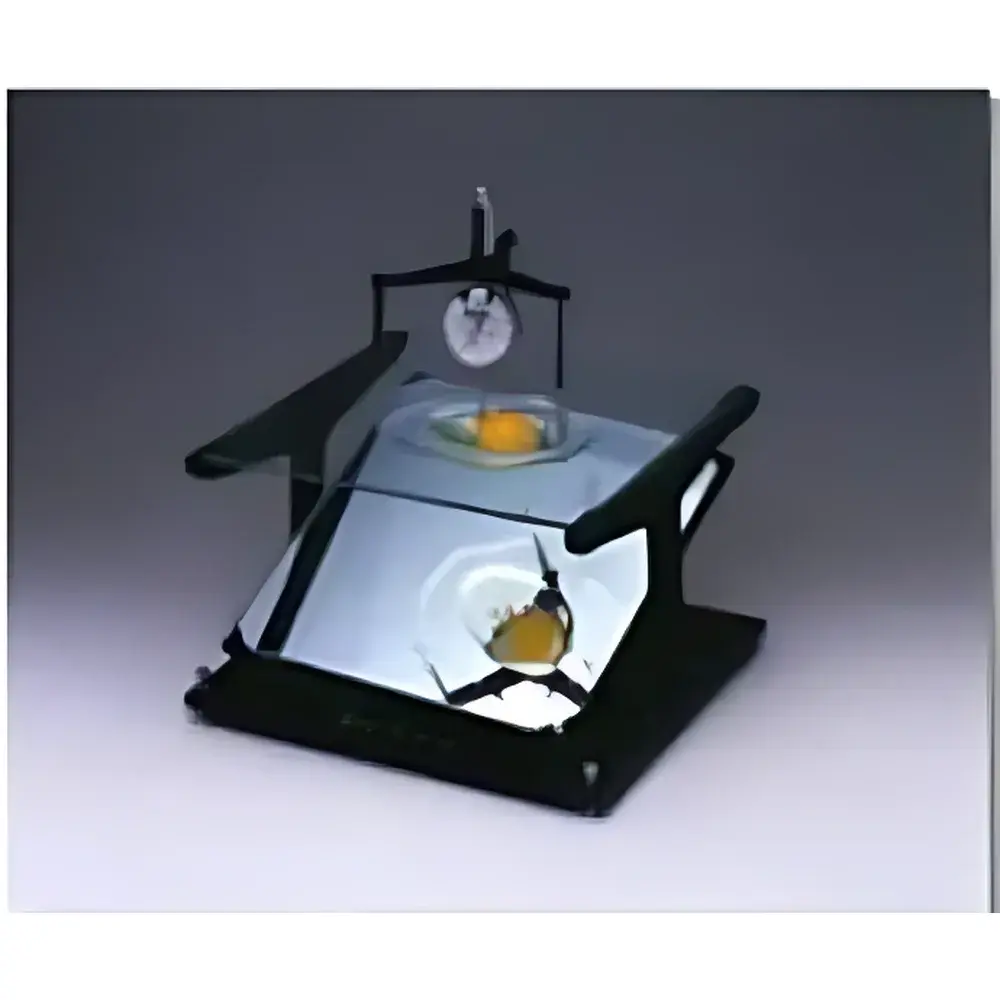
AQUAREAD MAO-1A Haugh Unit Analyzer
| Brand | AQUAREAD |
|---|---|
| Origin | Japan |
| Model | MAO-1A |
| Measurement Range | 0–12 mm |
| Resolution | 0.01 mm |
| Display | Digital LCD |
| Probe Material | Precision Alloy |
| Haugh Unit Calculation | Manual via integrated scale (based on albumen height and egg weight) |
| Compliance | Designed for ASTM E1695-08 (Standard Practice for Determination of Haugh Units), ISO 6497:2002 (Animal feeding stuffs — Sampling), and aligned with USDA Agricultural Handbook No. 75 and EU Regulation (EC) No. 589/2008 Annex IV criteria for egg classification |
Overview
The AQUAREAD MAO-1A Haugh Unit Analyzer is a precision mechanical instrument engineered for objective, repeatable assessment of egg quality in food processing, poultry research, and regulatory inspection laboratories. It operates on the internationally standardized Haugh Unit (HU) methodology—a physics-based metric derived from the logarithmic relationship between thick albumen height (measured in millimeters) and egg mass (in grams). This principle relies on the structural integrity of ovomucin networks within fresh egg white; as storage time increases, proteolytic degradation reduces viscosity and height, directly lowering the HU value. The MAO-1A implements a calibrated vertical probe system that physically contacts the albumen surface under controlled loading, eliminating parallax error and operator-dependent visual estimation. Its design conforms to the fundamental measurement geometry specified in AOAC Official Method 965.20 and supports traceable, GLP-compliant data recording when paired with external weighing instrumentation.
Key Features
- Precision alloy probe tip with wear-resistant surface finish ensures long-term dimensional stability and consistent contact pressure across >100,000 measurements
- Digital LCD display with 0.01 mm resolution enables direct reading of thick albumen height without interpolation or secondary magnification
- Linear measurement range of 0–12 mm accommodates standard hen eggs (50–70 g) as well as larger duck and goose eggs (up to 120 g) with proportional HU derivation
- Zero-drift mechanical architecture—no internal electronics, batteries, or firmware—eliminates calibration drift, thermal hysteresis, or software-related failure modes
- Integrated Haugh Unit conversion scale allows immediate calculation using measured albumen height and independently recorded egg mass, supporting manual verification per USDA and EFSA protocols
- Compact benchtop footprint (180 × 120 × 220 mm) and low mass (<1.2 kg) facilitate transport between grading stations, field labs, and cold-chain inspection points
Sample Compatibility & Compliance
The MAO-1A is validated for use with avian eggs including Gallus gallus domesticus (chicken), Anser anser (goose), Cairina moschata (muscovy duck), and Coturnix japonica (quail). Sample preparation requires only shell-breaking onto a flat, non-porous surface at ambient temperature (18–22°C), per ISO 6497:2002 sampling guidelines. Instrument output supports compliance with EU Commission Regulation (EC) No. 589/2008 Annex IV (grading criteria), USDA Egg Grading Manual Chapter 4 (freshness classification), and China’s GB/T 21294-2018 (Egg Quality Testing Standard). While the device itself does not generate electronic audit trails, its analog-digital hybrid operation permits full documentation of raw height values, egg mass inputs, and calculated HU scores in laboratory notebooks or LIMS-integrated spreadsheets meeting FDA 21 CFR Part 11 record retention requirements.
Software & Data Management
The MAO-1A operates without embedded software or connectivity interfaces, reflecting its purpose-built role as a primary metrology tool rather than a data endpoint. All measurements remain operator-owned and manually transcribed—ensuring full transparency, reproducibility, and freedom from algorithmic black-box interpretation. Users may integrate readings into validated laboratory information management systems (LIMS) via standardized CSV templates. For high-throughput environments, the instrument pairs seamlessly with certified analytical balances (e.g., Mettler Toledo XP series) whose RS232/USB outputs auto-populate mass fields in Excel-based HU calculators compliant with ISO/IEC 17025 clause 7.7 (data control). No firmware updates, cloud dependencies, or vendor lock-in are involved in daily operation.
Applications
- Quality assurance in commercial egg packing houses for real-time grading against Class A/B thresholds (HU ≥72 vs. HU 60–71)
- Stability studies evaluating refrigerated vs. ambient storage effects on albumen rheology over 28-day periods
- Genetic selection programs quantifying heritability of albumen quality traits in layer breeding stock
- Feed formulation trials assessing impacts of dietary lysine, selenium, or omega-3 supplementation on protein matrix integrity
- Regulatory surveillance by national food safety authorities conducting random market basket audits per Codex Alimentarius Stan 224-2003
- Academic research in food science departments investigating enzymatic hydrolysis kinetics during egg aging
FAQ
Does the MAO-1A require calibration certificates or annual recalibration?
No—its measurement mechanism is based on NIST-traceable micrometer-grade linear translation. Users verify accuracy quarterly using certified gauge blocks (e.g., 2.00 ± 0.005 mm and 8.00 ± 0.005 mm) per ISO 17025 clause 6.5.3.
Can it measure eggs with cracked shells or blood spots?
Yes—shell integrity does not affect albumen height measurement; however, blood spots or meat spots must be excluded from the central measurement zone per USDA Handbook 75 Section 4.3.1.
Is the Haugh Unit calculation automated within the device?
No—the MAO-1A outputs only albumen height. Final HU computation requires external egg mass input using the standard formula: HU = 100 × log(h − 1.7 × w0.37 + 7.6), where h = height (mm) and w = mass (g).
What maintenance is required?
Wipe probe tip with ethanol after each use; inspect for micro-scratches annually using 10× loupe; store vertically in supplied foam-lined case to prevent tip deformation.
Does it comply with FDA 21 CFR Part 11 for electronic records?
As a non-electronic device, it generates no electronic records. When used with compliant balance/LIMS workflows, the complete measurement chain satisfies Part 11 requirements for attributable, legible, contemporaneous, original, and accurate (ALCOA+) data.





