
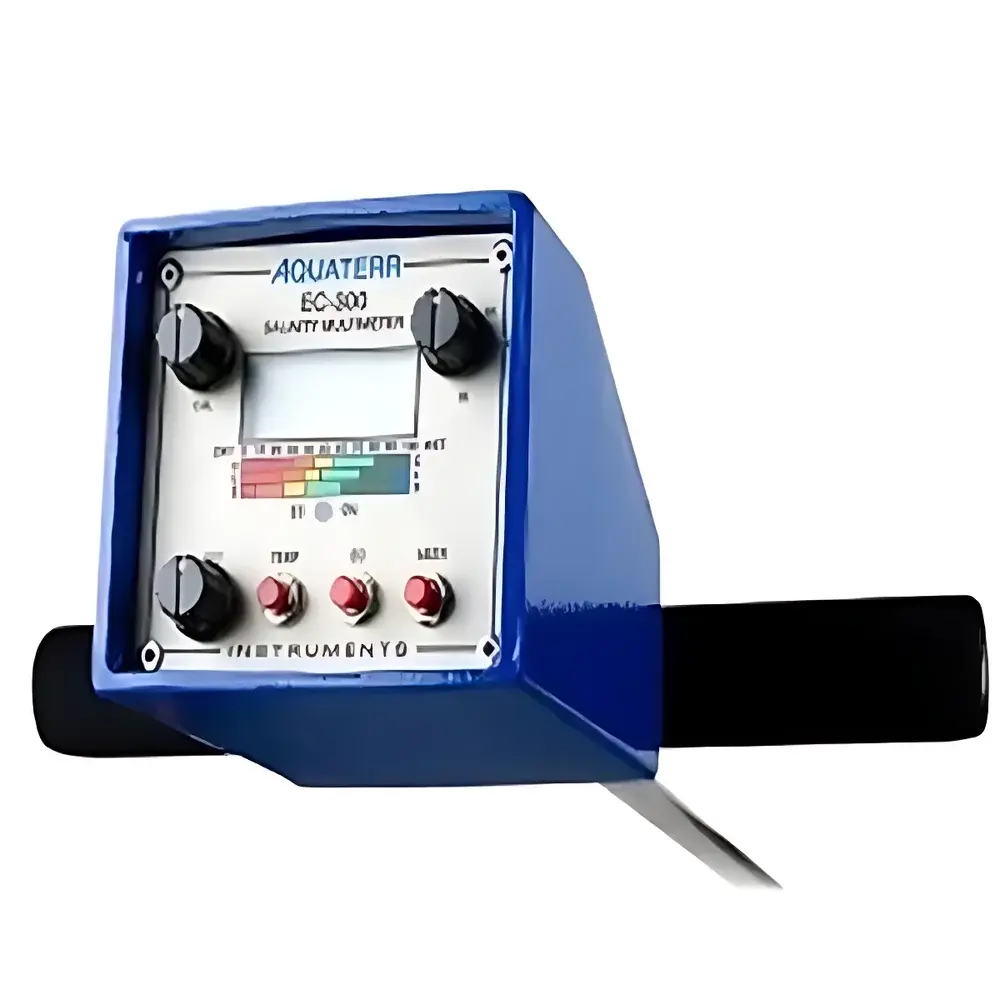
Aquaterr EC-350 Portable Soil Tri-Parameter Analyzer
| Brand | Aquaterr |
|---|---|
| Origin | USA |
| Model | EC-350 |
| Instrument Type | Soil Moisture, Temperature & Electrical Conductivity Analyzer |
| Probe Length | 76.2 cm |
| Probe Diameter | 1.27 cm |
| Probe Material | Aerospace-Grade Stainless Steel & Aluminum |
| Total Unit Length | 91.44 cm |
| Moisture Range | 0–100% (v/v) |
| Temperature Range | 4.44–65.55 °C |
| EC Range | Up to 2000 µS/cm |
| Moisture Sensing Principle | Capacitive Dielectric Measurement |
| Temperature Sensing Principle | Silicon Junction Sensor |
| EC Sensing Principle | Inductive (Non-Contact) Conductivity Measurement |
| Accuracy | ±1.5% FS |
| Power Supply | 9 V Alkaline Battery (≈3 months typical operation) |
| Net Weight | 1.52 kg |
| Shipping Weight | 2.69 kg |
| Packaging Dimensions | 79.4 × 127 × 965.2 mm |
Overview
The Aquaterr EC-350 Portable Soil Tri-Parameter Analyzer is an integrated field-deployable instrument engineered for simultaneous, real-time measurement of soil volumetric water content (VWC), temperature, and bulk electrical conductivity (EC). Unlike laboratory-based or single-parameter sensors, the EC-350 employs a co-located tri-sensor probe architecture grounded in established physical principles: dielectric permittivity measurement via high-frequency capacitance for moisture quantification; semiconductor junction voltage response calibrated to thermal energy for temperature; and inductive (toroidal) coupling for non-contact, electrodeless EC determination—eliminating polarization errors and sensor fouling common in direct-contact electrodes. Designed for operational continuity across diverse pedological conditions—from sandy loam to clay-rich profiles—the EC-350 delivers traceable, repeatable data without sample extraction or lab turnaround. Its ruggedized probe assembly meets IP67 ingress protection standards, enabling reliable use in humid, dusty, or intermittently submerged environments typical of agricultural fields, greenhouses, turfgrass systems, and watershed monitoring sites.
Key Features
- Triple-parameter acquisition in a single insertion: synchronized VWC, temperature, and bulk EC output with timestamped logging capability
- Aerospace-grade stainless steel and aluminum probe housing resistant to corrosion, mechanical abrasion, and thermal cycling (−10 to 70 °C operating envelope)
- Inductive EC sensing eliminates electrode degradation, calibration drift from salt crystallization, and maintenance downtime associated with contact-based systems
- Capacitive moisture sensing validated against gravimetric standards per ASTM D4944 and ISO 11274 protocols
- On-device LCD display with backlight for low-light field conditions and intuitive navigation via tactile push-button interface
- Battery-powered operation (9 V alkaline) supporting continuous field use for ≥90 days under typical sampling intervals (1 reading/15 min)
- Compact ergonomic design (91.44 cm total length, 1.52 kg net weight) optimized for handheld deployment and backpack transport
Sample Compatibility & Compliance
The EC-350 is validated for direct insertion into undisturbed mineral and organic soils (including peat, silty clay, and volcanic ash substrates), as well as liquid-phase applications such as irrigation reservoirs, leachate collection sumps, and hydroponic nutrient solutions. Probe geometry (76.2 cm active length, 1.27 cm diameter) ensures representative volumetric averaging over ~200 cm³ of soil matrix while minimizing root or stone interference. For regulatory alignment, moisture and EC outputs comply with USDA-NRCS soil characterization guidelines; temperature accuracy satisfies ASABE EP418.3 requirements for field sensor stability. While not a GLP-certified instrument, its measurement traceability supports QA/QC documentation required under EPA Method 9045D (soil EC) and ISO 11276 (soil water retention curve derivation). Data export formats (CSV via USB-C) are compatible with LIMS integration and 21 CFR Part 11–compliant audit trail configurations when paired with validated third-party software.
Software & Data Management
The EC-350 operates autonomously without mandatory PC connectivity. Field data are stored internally (up to 10,000 readings) with UTC timestamp, GPS coordinates (when paired with external Bluetooth GNSS receiver), and user-defined site identifiers. USB-C interface enables direct download to Windows/macOS platforms using Aquaterr’s free EC-Link Desktop Suite—a lightweight application supporting spectral visualization, statistical summary (mean, SD, min/max per session), and export to CSV, Excel, or GIS-ready shapefile attributes. Raw sensor outputs undergo on-device linearization and temperature compensation per manufacturer calibration coefficients (NIST-traceable at 25 °C reference point). Firmware updates are delivered via signed binary packages to ensure integrity and version control—critical for multi-year longitudinal studies requiring instrument consistency across deployments.
Applications
- Irrigation scheduling optimization: Correlating real-time VWC and EC trends to crop-specific thresholds (e.g., maize at 12–22% VWC; tomato at 18–28%) to reduce water waste and salinity buildup
- Drip irrigation system diagnostics: Detecting uneven emitter performance or clogging through spatial EC variance mapping along lateral lines
- Salinity risk assessment: Monitoring root-zone EC accumulation pre- and post-leaching events to validate leaching fraction efficacy (LF = applied water / drainage water)
- Nutrient management: Inferring nitrate mobility via EC shifts during fertigation cycles, particularly in sandy soils with low CEC
- Restoration ecology: Quantifying moisture-temperature-EC coupling in phytoremediation plots to assess rhizosphere activity and contaminant bioavailability
- Green infrastructure monitoring: Evaluating infiltration rates and solute transport in bioswales and rain gardens through time-series EC profiling at multiple depths
FAQ
Does the EC-350 require soil-specific calibration?
No. The capacitive moisture sensor is factory-calibrated to a universal dielectric model (Topp equation variant) validated across 12 soil textural classes. Optional user-defined calibrations are supported via EC-Link Desktop for specialized media (e.g., coconut coir, rockwool).
Can the probe be used in frozen or saturated soils?
The probe is rated for operation down to −10 °C but does not provide valid VWC readings below 0 °C due to phase-change effects on dielectric response. In saturated conditions (>95% VWC), EC measurements remain accurate; however, prolonged submersion beyond 72 hours may affect long-term seal integrity.
How often must the battery be replaced?
Under typical usage (10–20 readings/day), the 9 V alkaline battery lasts approximately 3 months. Low-battery indication appears 72 hours prior to depletion, and battery replacement requires no recalibration.
Is the EC-350 compliant with FDA or EU environmental directives?
While not certified under CE marking or FDA device classification (as it is a non-invasive environmental monitor, not a medical or food safety instrument), its materials meet RoHS 2011/65/EU restrictions on hazardous substances, and packaging adheres to ISO 14001-compliant recyclability standards.







